Physical Address
304 North Cardinal St.
Dorchester Center, MA 02124
Physical Address
304 North Cardinal St.
Dorchester Center, MA 02124

Religions News Around the World
Religions News Around the World
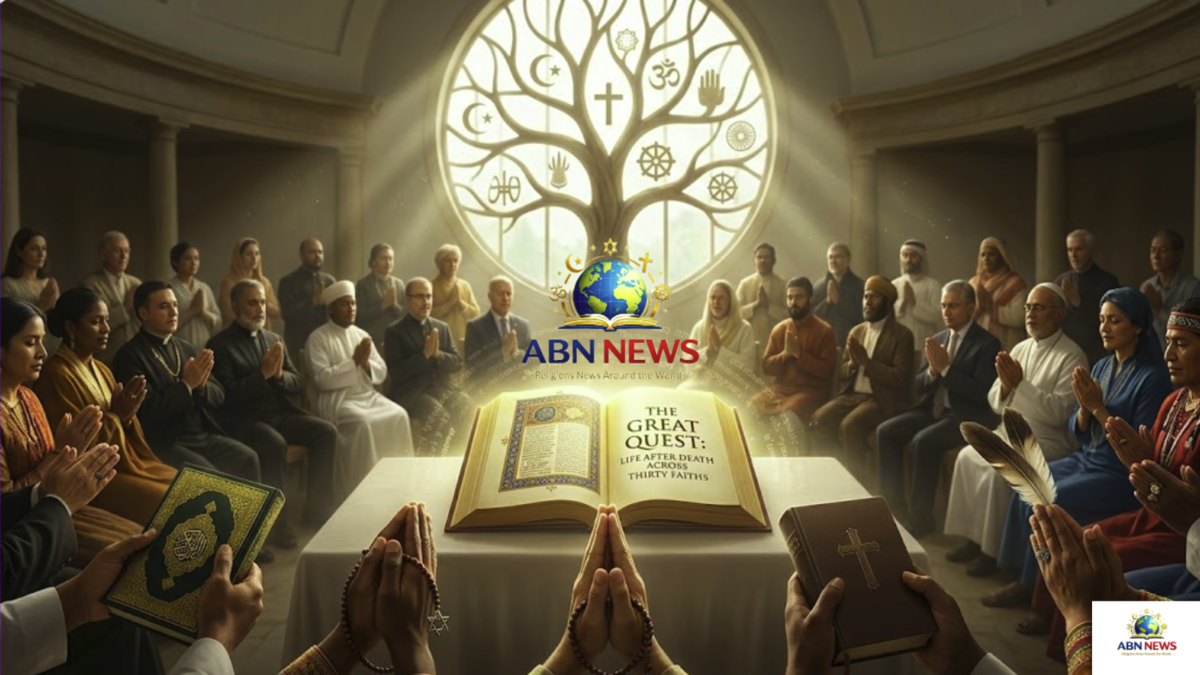
ABN NEWS. Life after death: does it offer hope, judgment, or eternal cycles? What do humanity’s major religions actually teach about what comes next? This is the question that has haunted every civilization since the dawn of time, and while science remains silent, faith provides a complex map of the unknown.
For centuries, people have asked: Will we continue in another realm, return, or simply cease? Sacred texts and traditions provide insight—but often, interpretations differ. According to ABN NEWS, understanding these teachings requires looking at the sources themselves. Why do these differences exist, and how do they shape our modern world?
The largest group of faiths globally follows the linear path. In Christianity, Islam, and Judaism, life is a one-way journey toward an ultimate divine reckoning.
In Islam, the Quran (3:185) states: “Every soul will taste death. And on the Day of Resurrection, you will be returned to Allah.” Similarly, Christianity looks toward the afterlife as a time of awakening. The Holy Bible (John 5:28-29) notes: “The hour is coming when all in the graves will hear His voice and come forth—those who have done good, to the resurrection of life.”
Judaism shares this focus on justice, with the Tanakh (Daniel 12:2) mentioning that “the righteous will rise again.” Even for Mormonism (LDS), the Doctrine and Covenants 76 emphasizes that “the spirits of men are judged; eternal life is given to the faithful.” These faiths use the afterlife as a moral compass for life on Earth.
Moving toward the East, the narrative changes from a straight line to a circle. In these traditions, death is not an end but a “changing of clothes” for the soul.
Hinduism captures this perfectly in the Bhagavad Gita (2:22): “Just as a man casts off worn-out garments and puts on new ones, so the soul casts off the old body and enters a new one.” For Buddhists, the Dhammapada teaches that all beings pass through cycles of birth and death until enlightenment frees them from suffering.
Sikhism offers a similar path of merging with the divine. The Guru Granth Sahib (p. 723) says: “Those who meditate on God depart in peace; the soul merges with the eternal.” Even in Jainism, the Tattvartha Sutra explains that the soul transmigrates according to karma until liberation (moksha) is finally attained.
Beyond the major pillars, many other belief systems offer unique “textual” views on the transition. Taoism, for instance, views death as a return to the natural order. The Tao Te Ching (Chapters 33-34) suggests that the spirit is not destroyed but flows back into the Tao.
In Zoroastrianism, the Avesta describes the “Chinvat Bridge” where the soul is judged and the righteous cross into eternal light. Meanwhile, Shinto traditions in the Kojiki emphasize that the soul continues among the “kami” (spirits) and ancestors, guiding the living. For Scientology, the “thetan” or spirit is seen as immortal, moving from body to body until it is free from material constraints.
| Religion | Main Source/Text | Core Teaching on Afterlife |
| 1. Christianity | Holy Bible | Resurrection of life for the good. |
| 2. Islam | Quran | Return to Allah on Day of Resurrection. |
| 3. Hinduism | Bhagavad Gita | Soul casts off old body for a new one. |
| 4. Buddhism | Dhammapada | Cycle of rebirth until enlightenment. |
| 5. Sikhism | Guru Granth Sahib | Soul merges with the eternal God. |
| 6. Taoism | Tao Te Ching | Return to the Tao; spirit is not destroyed. |
| 7. Shinto | Kojiki | Soul becomes a protective Kami spirit. |
| 8. Jainism | Tattvartha Sutra | Transmigration until moksha (liberation). |
| 9. Judaism | Tanakh | Resurrection for righteous; Sheol for wicked. |
| 10. Baháʼí Faith | Kitáb-i-Aqdas | Soul continues progress in worlds of God. |
| 11. Zoroastrianism | Avesta | Judgment at the Chinvat Bridge. |
| 12. Confucianism | Analects | Focus on ancestral respect and legacy. |
| 13. Druze | Epistles of Wisdom | Reincarnation for soul purification. |
| 14. Sufism | Masnavi (Rumi) | Journey closer to God; shedding ties. |
| 15. Mandaeism | Ginza Rabba | Soul ascends through heavenly realms. |
| 16. Yazidism | Traditional Prayers | Soul is eternal; guided by prayers. |
| 17. Nanak Panthi | Guru Granth Sahib | Spirit merges with the eternal light. |
| 18. Hopi | Cultural Teachings | Spirits return to the spirit world. |
| 19. Stoicism | Seneca’s Letters | Soul disperses back into universal reason. |
| 20. Quakers | Peace Testimony | Reunion with God’s spirit. |
| 21. Mormonism | Doctrine & Covenants | Spirits are judged; eternal progression. |
| 22. Scientology | Scientology Creed | Immortal thetan moves between bodies. |
| 23. Theosophy | Society Constitution | Evolution toward spiritual perfection. |
| 24. Tenrikyo | Ofudesaki | Spirits act for the collective good. |
| 25. Caodaism | Sacred Texts | Moral actions determine afterlife journey. |
| 26. Wicca | Wiccan Rede | Summerland or return to wheel of rebirth. |
| 27. Oomoto | Oomoto Principles | Union with universal life force. |
| 28. Unitarian Univ. | Seven Principles | Spiritual continuity or communal memory. |
| 29. Yarsanism | Saranjam | Soul unites with divine reality. |
| 30. Eckankar | Shariyat-Ki-Sugmad | Ongoing lessons and spiritual awareness. |
ABN NEWS notes clear patterns across these 30 faiths. Reincarnation is a dominant theme in Hinduism, Buddhism, Jainism, and Druze traditions. On the other hand, the concept of a singular “Judgment” leading to Heaven or Hell is the backbone of Christianity, Islam, and Zoroastrianism.
We also see a third category: Spiritual Continuity. Faiths like Shinto and Taoism don’t necessarily promise a “new” place, but a “different” way of being part of this world. This variety proves that while the destination is debated, the importance of the journey is universal. Most traditions regard death as a transition rather than a full stop.
Do all religions believe in an afterlife?
Not all; some, like Confucianism, focus on moral legacy and ancestral respect rather than literal continuation.
Which religions emphasize reincarnation?
Hinduism, Buddhism, Jainism, Wicca, Druze, and Theosophy highlight cycles of rebirth until spiritual liberation.
What religions teach judgment after death?
Judaism, Zoroastrianism, Christianity, Islam, Mandaeism, and Mormonism describe post-death judgment leading to reward or punishment.
Does the soul continue in all traditions?
Most traditions depict some form of ongoing spiritual existence, whether in union with God, cycles of rebirth, or ancestral realms.
Many people think death is a full stop. In reality, for billions, it is just a comma. Paperwork, rituals, and prayers are the tools humanity uses to face the great mystery. Understanding these 30 perspectives is the first step in respecting the deep spiritual diversity of our world.