Physical Address
304 North Cardinal St.
Dorchester Center, MA 02124
Physical Address
304 North Cardinal St.
Dorchester Center, MA 02124

Religions News Around the World
Religions News Around the World
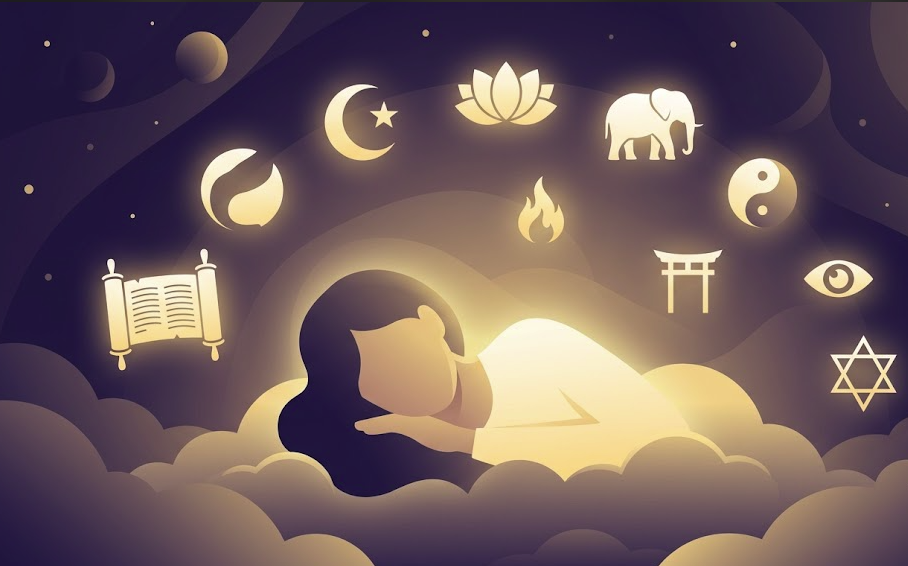
GLOBAL — ABN News: Dream interpretation in religion has shaped scripture, law, and daily practice across nine of the world’s largest faiths, long before modern psychology gave the subject a clinical name. From the Talmud’s ruling that an unexplained dream is “like an unread letter” to Jain texts that catalogue sixteen dreams announcing the birth of a spiritual leader, religious traditions have treated sleep as a channel worth decoding. What, then, separates a prophetic dream from an ordinary one — and does every faith agree an answer exists at all?

Judaism’s clearest teachings on dreams come from the Babylonian Talmud, compiled in tractate Berakhot. The text states that a dream “follows the mouth” of whoever interprets it, meaning the same dream can produce opposite outcomes depending on the interpretation given. Berakhot also records that rabbi Bana’ah once received twenty-four different interpretations of a single dream from twenty-four separate interpreters in Jerusalem — and reports that all twenty-four came true.
The Talmud further ranks dreaming as “one-sixtieth of prophecy,” with the remainder dismissed as devarim b’teilim, or idle nonsense. Because of that mixture, sages counseled consultation with a trained interpreter rather than self-diagnosis. The biblical account of Joseph, sold by his brothers after describing dreams in which they bowed to him, remains the tradition’s central dream narrative and later became the basis for his rise in Pharaoh’s court.

Christianity inherited these same biblical accounts and treats dreams as one of several channels God used to communicate with figures such as Jacob, Joseph the patriarch, and Joseph the husband of Mary, who was reportedly warned in a dream to flee to Egypt with his family. Pilate’s wife is also described as intervening in Jesus’s trial after a disturbing dream convinced her of his innocence.
Contemporary Christian teaching, particularly within evangelical circles, treats these cases as historical instances of prophecy rather than a continuing method of revelation. Mainstream theologians generally hold that dream-based prophecy was tied to the biblical era and caution against relying on dreams for guidance today.
Islamic scholarship developed dream interpretation into a distinct discipline known as ilm ta’bir al-ru’ya, built on rules drawn from the Quran and hadith. The field is not recognized as an academic science and is not taught in accredited universities, but it remains widely practiced as a tool for reading “true visions” believed to carry meaning from God.
The best-known reference work in this field is popularly attributed to the eighth-century scholar Ibn Sirin, who was widely reputed for his skill in reading dreams during his lifetime. Researchers who have examined the surviving manuscript, however, say the text in circulation likely was not written by Ibn Sirin himself, since major biographical sources from his era make no mention of it. Contemporary religious authorities have also cautioned against treating the book, or dream interpretation generally, as a fixed science, noting that a single dream symbol can carry multiple, sometimes contradictory, meanings depending on the interpreter.
Hindu teaching describes dreams as a distinct state of consciousness shaped by planetary positions, past karma, and the subconscious mind, often serving as a channel for divine communication. Comparative religion scholars describe the ultimate source of that communication as Brahman, the divine ground of reality, breaking through the veil of maya, or illusion. Some Hindu dream dictionaries, drawing on teachers such as Swami Sivananda, assign specific meanings to symbols — an elephant, for instance, is traditionally read as a sign of prosperity and strength.
Buddhism departs from this model by removing a divine sender altogether. Dreams are treated as reflections of the mind’s own attachments and habitual patterns rather than external revelation, and their fleeting nature is seen as an illustration of Buddhism’s core teaching on impermanence.
Jain texts offer one of the most structured dream frameworks of any tradition, centered on a set of “auspicious dreams” seen by the mothers of major religious figures, including the Tirthankaras. The Svetambara branch of Jainism counts fourteen such dreams, while the Digambara branch counts sixteen; most of the symbols overlap, including a four-tusked white elephant, a rising sun, and an ocean of milk.
The best-documented case is Queen Trishala, mother of Mahavira, the twenty-fourth and final Tirthankara. Jain scripture describes court dream-interpreters explaining to her husband that the fourteen dreams specifically indicate the mother of either a universal monarch or a Jina.
Sikh scripture, the Guru Granth Sahib, uses the concept of dreaming as a metaphor for worldly existence itself — a state marked by illusion, impermanence, and attachment to material things. Alongside that philosophical use, a popular tradition within Sikh communities holds that seeing one of the ten Gurus, or the Guru Granth Sahib itself, in a dream constitutes a form of darshan, a sacred spiritual encounter regarded as a sign of spiritual progress. Sikh teaching does not, however, offer a formal symbol-by-symbol interpretation system comparable to the Jain or Islamic frameworks.
Taoism does not maintain a formal dream-symbol dictionary, but the tradition uses dreaming as a philosophical device to question the nature of reality itself. The clearest example is the philosopher Zhuangzi’s account of dreaming he was a butterfly, then waking uncertain whether he was a man who had dreamed of being a butterfly or a butterfly now dreaming he was a man. Later Chinese folk religion, blending Taoist and other influences, developed divination practices such as yin-yang calendrical rituals aimed at interpreting or warding off ill fortune signaled in dreams.
Shinto, Japan’s native tradition centered on nature spirits known as kami, has no codified dream-interpretation text either. Within its folk and shamanistic roots, however, dreams are traditionally understood as one possible channel through which kami or ancestral spirits communicate with the living, a role that later blended with Buddhist and Taoist practice as the traditions mixed in Japan.
Does every religion agree that dreams carry meaning? No. Buddhism treats dreams as products of the mind rather than external messages, while Judaism’s Talmud holds that most dreams are meaningless “idle things,” with only a small fraction carrying prophetic weight.
Which religion has the most detailed dream-symbol system? Jainism and Islam both developed structured symbol catalogues — Jainism’s fourteen or sixteen auspicious dreams tied to religious figures, and Islam’s ilm ta’bir al-ru’ya, though scholars dispute the authorship of its best-known reference text.
Is the Ibn Sirin dream book authentic? Researchers who have studied the text say it was likely not written by Ibn Sirin, since major biographical sources from his lifetime do not mention it, despite his known reputation as a skilled dream interpreter.
What role do dreams play in Jainism specifically? Jain scripture describes a fixed set of dreams — fourteen in the Svetambara tradition, sixteen in the Digambara tradition — seen by the mothers of Tirthankaras before birth, interpreted by court dream-readers as signs of the child’s future spiritual or royal status.
Dream interpretation in religion reveals a consistent divide rather than a single shared belief: Abrahamic traditions largely frame the dream as a possible message from a personal God, Dharmic traditions frame it as a marker of illusion or karmic status, and East Asian traditions treat it as part of a wider, less clearly bounded reality. Across all nine faiths, however, the underlying question remains the same one raised in the Talmud nearly two thousand years ago — whether a dream means anything at all until someone decides what it means.… Read more
Contact: info@abnnews.net