Physical Address
304 North Cardinal St.
Dorchester Center, MA 02124
Physical Address
304 North Cardinal St.
Dorchester Center, MA 02124
Religions News Around the World
Religions News Around the World
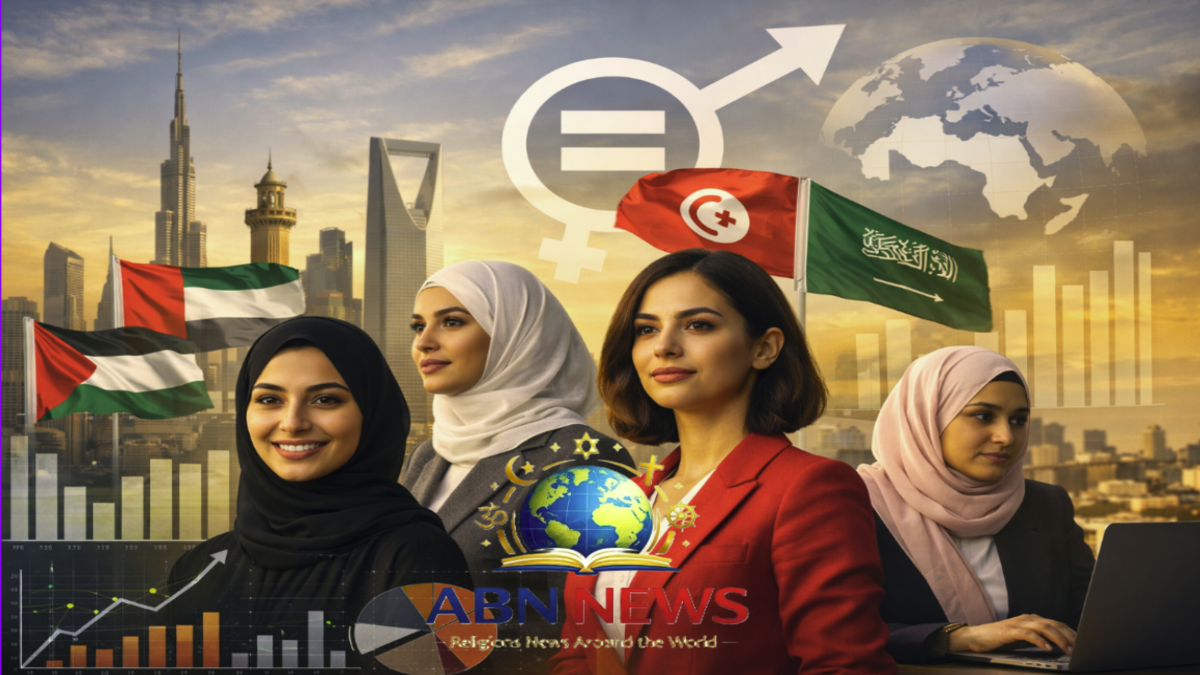
Marbella – ABN NEWS. Gender equality in Arab countries is no longer a static debate or a distant goal written on paper. Today, it is a moving target, a living process shaped by bold reforms, changing economies, and the shifting expectations of a new generation. But what does real progress look like when hard numbers, deep-rooted culture, and modern policy finally collide?
Across the region, the story is anything but uniform. While some capitals are accelerating reforms at a remarkable speed, others still struggle with structural barriers that slow down women’s participation in public life. In this ABN NEWS report, we don’t just focus on slogans; we look at the measurable change transforming the landscape.
The gender equality in Arab countries index does not tell a single, simple story. Instead, it reveals multiple realities unfolding at the same time. According to global benchmarks, such as the World Economic Forum’s Gender Gap Index, Arab nations remain spread across a wide spectrum of rankings. While some are rapidly approaching mid-global performance, others are still held back by institutional limitations.
Education, fortunately, remains the strongest pillar in the region. In several countries, female university enrollment now equals or even exceeds that of men. This isn’t just a statistic; it’s a major transformation in human capital. However, the transition from the classroom to the office remains uneven. Many women graduate with honors but face a “glass ceiling” in private-sector absorption. This specific gap continues to shape the gender equality in Arab countries outcome more than almost any other factor.
When we look at the leaders, we see that success is often driven by a mix of political will and economic necessity. The United Arab Emirates continues to show a strong performance, particularly in government representation. Women there are not just present; they hold visible, high-impact roles in diplomacy and emerging industries like space and tech.
On the other side of the map, Tunisia remains a powerhouse in North Africa. Its long-standing legal reforms have created a stable framework for women’s rights, even amidst economic challenges. Meanwhile, Saudi Arabia has recently caught the world’s attention with one of the fastest transitions in modern history. By expanding access to employment and entrepreneurship, the Kingdom has significantly influenced its position in recent gender equality in Arab countries assessments. It is a clear reminder that where there is a policy-driven model, change follows quickly.
Despite this visible progress, the gender equality in Arab countries index still reflects some deep-seated structural hurdles. The most pressing issue is labor market absorption. We see a mismatch where education systems produce highly qualified women, yet the job markets fail to expand at the same pace.
Furthermore, women are often overrepresented in public sector roles but remain scarce in high-growth industries like finance or advanced manufacturing. At ABN NEWS, we have observed a clear pattern: where economies diversify, gender participation naturally becomes more balanced. Therefore, the issue is not just social—it is deeply economic.
What does gender equality in Arab countries measure?
It measures the gaps between men and women in four key areas: education, economic participation, health, and political empowerment.
Which Arab countries perform best in gender equality rankings?
The UAE and Tunisia frequently lead the regional rankings, though Saudi Arabia is currently showing the most rapid improvement.
Why is female workforce participation still uneven?
The gap is mostly driven by economic structures and the slow absorption of graduates into the private sector across different countries.
Is gender equality truly improving in the Arab world?
Yes, the data shows steady progress, especially in education and legal reform, even if economic parity takes longer to achieve.
The gender equality in Arab countries landscape is evolving through a blend of policy and social restructuring. Progress is real, but it is also uneven. In the end, the nations that successfully align their educational success with real economic opportunity will be the ones shaping the next decade of the region’s history.