Physical Address
304 North Cardinal St.
Dorchester Center, MA 02124
Physical Address
304 North Cardinal St.
Dorchester Center, MA 02124

Religions News Around the World
Religions News Around the World
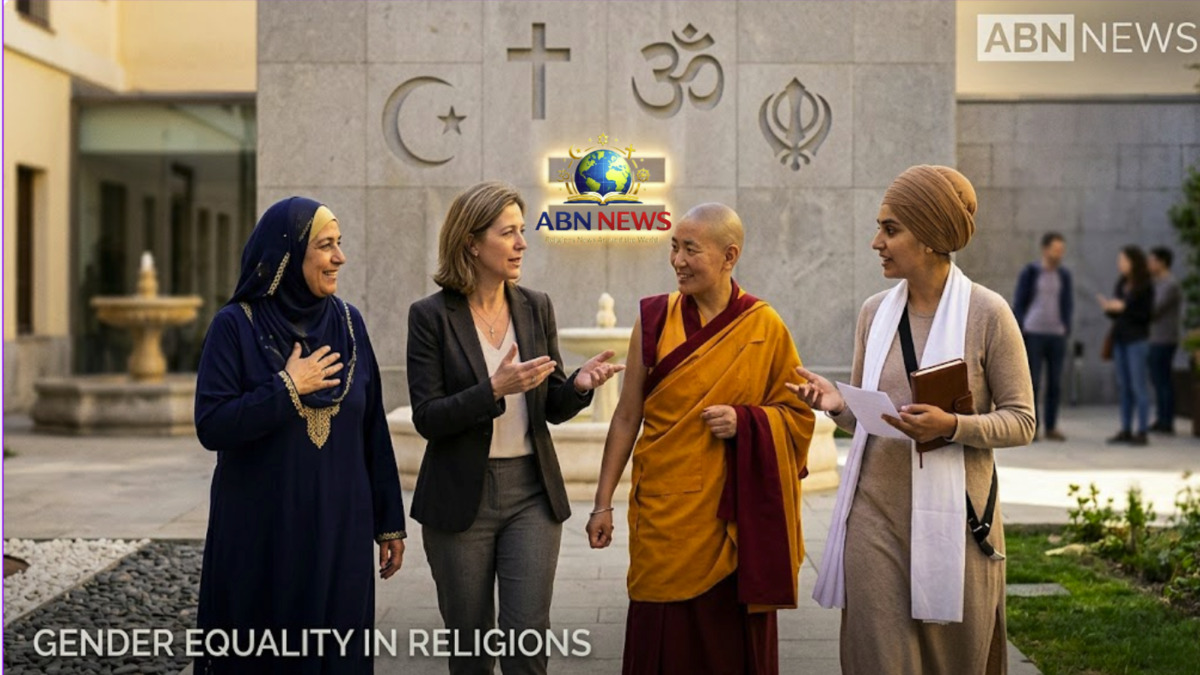
ABN NEWS : Can ancient scriptures and modern justice ever truly shake hands, or are they destined for an eternal conflict? This question haunts every debate about the gender equality in religions, as millions of women today look for their reflection in the mirror of the divine. While many view faith as a traditional cage, others argue that the original spirit of religion was the first spark of liberation. Is it the holy texts themselves that create barriers, or is it the human hands that translate them?
In the heart of the Middle East and across the globe, Islam remains a central point of discussion regarding the gender equality in religions. The Quranic foundation is built on human dignity, explicitly stating: “And We have certainly honored the children of Adam.” This spiritual parity suggests that in the eyes of the Creator, value is not determined by sex. However, practical application often reveals a different story in traditional jurisprudence.
Differences in inheritance, legal testimony, and leadership roles are frequently cited by critics as evidence of inequality. Yet, a growing movement of modern Muslim scholars argues that these rulings were revolutionary for their time and should be reinterpreted within a 21st-century context. For example, in countries like Tunisia, legislative shifts have challenged traditional inheritance laws, sparking a massive internal debate between historical text and contemporary needs.
Christianity faces its own internal struggles with the gender equality in religions, divided largely by denominational lines. On one hand, you have the Catholic Church, which maintains a male-only priesthood based on theological tradition. On the other, many Protestant denominations have broken the glass ceiling, appointing female bishops and pastors. This theological tug-of-war shows that “Christianity” is not a single voice, but a collection of evolving perspectives.
Moving to the East, Hinduism presents one of the most fascinating paradoxes in the study of the gender equality in religions. It is perhaps the only major faith that elevates the feminine to the highest level of cosmic power through deities like Durga and Kali. In many Hindu rituals, the feminine energy (Shakti) is considered the driving force of the universe.
However, the reality on the ground in traditional Indian society has historically been far less egalitarian. This gap between the “Goddess in the temple” and the “woman in the street” highlights how cultural patriarchy can often overshadow religious ideals. Recently, legal battles in India, such as the entry of women into the Sabarimala temple, have forced a confrontation between ancient customs and the constitutional right to equality.
Buddhism, similarly, offers a path to enlightenment that is theoretically open to all. The Buddha himself eventually ordained women, creating the first order of nuns. Despite this, for centuries, the status of these nuns has been lower than that of monks. In places like Thailand and Sri Lanka, women are now fighting to restore the full ordination of bhikkhunis, proving that the struggle for the gender equality in religions is a living, breathing movement.
When we look for models of explicit parity, Sikhism stands out as a pioneer in the gender equality in religions. Founded on the principles of social justice, its founder, Guru Nanak, famously asked: “Why call her inferior, who gives birth to kings?” In a Sikh Gurdwara, there is no role—spiritual or administrative—that is forbidden to a woman. This is a rare example of a faith where the 15th-century foundation aligns perfectly with modern human rights.
The Bahá’í Faith also offers a unique perspective, making the gender equality in religions a core pillar of its belief system. They use the powerful metaphor of a bird with two wings; if one wing is weak, the bird cannot fly. This isn’t just a suggestion but a requirement for the progress of civilization. ABN NEWS has observed that such clear stances often provide a blueprint for how older, more traditional faiths might navigate their own reforms.
Taoism, by contrast, focuses on the concept of Yin and Yang—the idea that the universe functions through the harmony of opposites. In this view, the question isn’t about “who is higher,” but how to achieve balance. It is a complementary approach that avoids the western “clash of the sexes” and instead focuses on the necessity of both energies for a healthy society.
A major realization in the modern era is that many “religious” restrictions are actually cultural traditions disguised as divine law. In Confucianism, for instance, the subordinate role of women was a social tool to ensure stability in ancient China. As these societies modernize, they are finding that they can keep their cultural identity while discarding the outdated hierarchies that no longer serve a just world.
Secular humanism, while not a religion in the traditional sense, acts as a significant catalyst in this conversation. By pushing for legal frameworks that mandate equality, it forces religious institutions to look inward. ABN NEWS notes that when a state passes an equality law, it often triggers a “reformation” within the religious communities of that country to stay relevant to younger generations.
Ultimately, the gender equality in religions is a journey, not a destination. Within every major faith, there is a battle being fought between those who want to preserve the past and those who want to honor the spiritual essence of equality. The diversity of interpretations ensures that religion will remain a key player in the global fight for human rights for decades to come.
Does any religion provide 100% equality in its traditional laws?
Sikhism and the Bahá’í Faith are the most prominent examples where gender equality is an explicit and foundational religious law, applying to all roles.
How do modern scholars justify changing traditional religious roles?
They often use “contextual interpretation,” arguing that specific laws were intended for a certain historical time and that the core message of justice is what should remain.
Why is there a difference between Protestant and Catholic views on women?
Protestantism generally emphasizes individual interpretation of the Bible, leading to more flexibility, while the Catholic Church relies heavily on centuries of fixed tradition and apostolic succession.
Can the gender equality in religions truly be achieved?
It is a process of constant evolution. As global communication increases, different religious groups are learning from each other and adapting their practices to meet modern standards of fairness.
The debate over the gender equality in religions is far from over, but the direction of travel is clear. As more women gain access to religious education and leadership, the old walls are beginning to crack. It is a transformation that touches the very soul of humanity, proving that even the most ancient institutions can change when the call for justice becomes too loud to ignore.