Physical Address
304 North Cardinal St.
Dorchester Center, MA 02124
Physical Address
304 North Cardinal St.
Dorchester Center, MA 02124

Religions News Around the World
Religions News Around the World
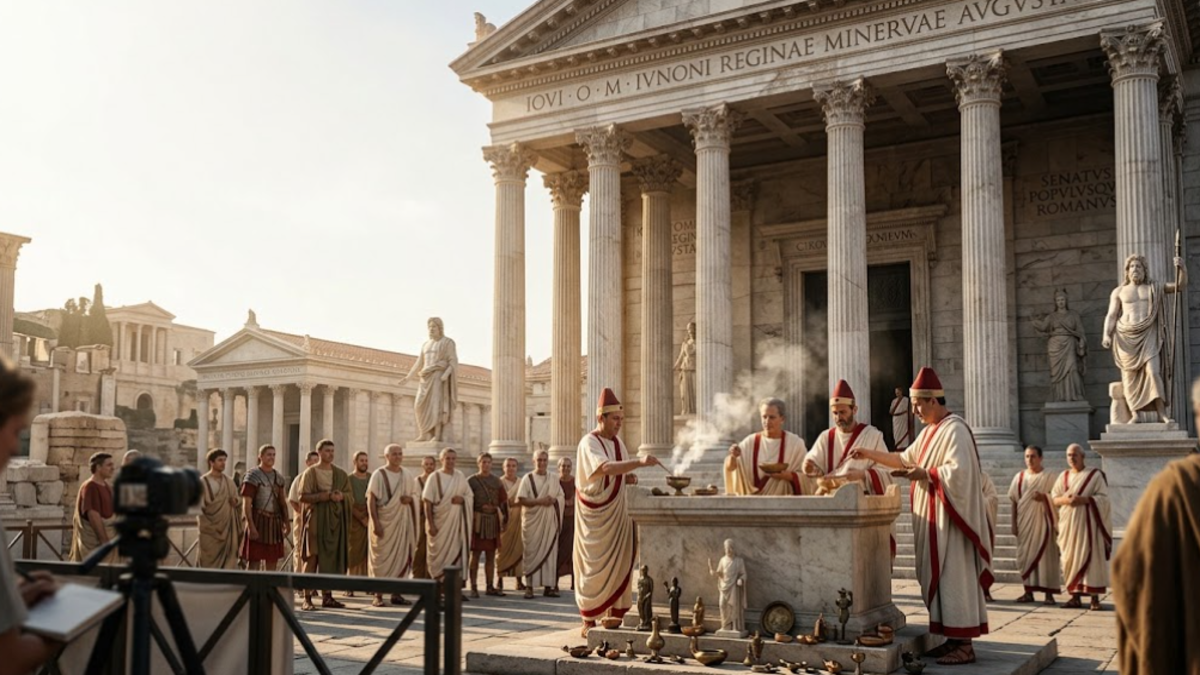
ROME – ABN News: History of Roman Religion offers far more than a list of gods and temples; it tells the story of how Romans understood family, warfare, politics, nature and even the fate of the state itself. Recent archaeological reports are once again bringing that religious world into view, from a Jupiter altar emerging from the Danube to a rare image of a protective Roman spirit found at a frontier fort. What can these discoveries tell us about the beliefs that shaped Roman society?

The History of Roman Religion begins long before Rome became the dominant power of the Mediterranean. Early Roman worship grew from a mixture of local traditions, household customs and influences from neighboring Italian peoples, particularly the Latins and Etruscans.
Religion in early Rome did not function as a separate institution in the modern sense. It formed part of everyday life. Families honored household spirits, communities maintained sacred places, and public officials carried out ceremonies that Romans believed were necessary to preserve harmony between people and the divine.

Roman religion also placed strong emphasis on ritual. A worshipper did not simply express private belief. The correct prayer, sacrifice, offering or ceremony mattered because Romans viewed their relationship with the gods as an exchange of obligations. They offered gifts and honored the gods while seeking protection, prosperity or favorable outcomes.
This principle helps explain why Roman religion remained closely connected to public authority. Rome maintained priests, priestly colleges and religious offices, while political leaders often participated in major ceremonies. Religious practice therefore reinforced the structure of the state.
The Roman religious world included major gods such as Jupiter, Juno and Minerva, who eventually formed the Capitoline Triad. Other important deities included Mars, Venus, Mercury, Neptune, Diana and Apollo. But the Roman pantheon was never completely fixed.
As Rome expanded, its religious system absorbed new traditions. Gods from Greece, Egypt, Syria and other parts of the Mediterranean entered Roman religious life, sometimes under new names or with modified functions. This adaptability became one of the defining characteristics of Roman worship.
Recent archaeological discoveries make that diversity easier to understand. A report published this month described a fragment of a limestone altar found in shallow waters near Dunaújváros in Hungary, at the site of the ancient Roman settlement of Intercisa. Archaeologists associated the altar with Jupiter, Rome’s supreme public deity, and noted that military personnel at frontier settlements commonly dedicated altars to him.
That discovery is significant because it places Roman religion in a military setting. The empire’s soldiers did not leave religion behind when they crossed provinces. They carried rituals, gods and traditions with them, helping Roman religious culture spread across distant regions.
The History of Roman Religion cannot be understood through mythology alone. Roman worship was practical, political and deeply embedded in community life.
Jupiter stood at the top of the public religious order. Romans associated him with authority, the sky and the protection of the Roman state. His importance extended far beyond individual devotion. Temples and ceremonies devoted to Jupiter could express Roman power itself.
The altar recently reported from the Danube frontier illustrates this connection. Ancient Intercisa functioned as a Roman military settlement, and archaeological evidence from such locations often connects religious objects with specific units, officers and soldiers. In that environment, worship was part of military identity as well as personal faith.
Mars occupied another important position. Although later popular culture often presents him simply as a god of war, his Roman role was broader. Early Roman traditions linked him with agriculture and the protection of the community, showing how Roman religion could connect military strength with the survival of the city and its land.
Juno represented another essential dimension of Roman religious life, particularly in her connection with marriage, women and the Roman state. Minerva became associated with wisdom, crafts and strategic intelligence. Together, Jupiter, Juno and Minerva formed a central religious grouping on the Capitoline Hill.
At the household level, however, Roman religion looked very different. Romans honored the Lares, associated with the protection of the household and place, and the Penates, connected with the family’s provisions and welfare. The head of a household could maintain a small domestic shrine and perform offerings as part of ordinary family life.
A striking modern reminder of this domestic side of Roman belief came from Britain. Archaeologists at Vindolanda recently identified a sandstone carving of a genius, a protective spirit associated with a person, household or place. The relief had been reused as building material and was found beneath the floor of a fourth-century barracks building.
The object is particularly revealing because genii were not simply distant gods. They represented a more personal dimension of Roman religious thinking. A genius could be connected with the identity and protection of a household, community or individual.
The Vindolanda discovery is also unusual because archaeologists have found relatively few surviving depictions of such spirits in Roman Britain. Researchers believe the carving may once have belonged to a domestic shrine before later being reused in construction.
That evidence helps historians move beyond the monumental temples of Rome and consider the religious lives of ordinary people.
Temples were among the most visible expressions of Roman worship, but they were only one part of a much larger ritual system.
A Roman temple usually served as the sacred home of a deity’s image rather than as a meeting hall resembling a modern place of worship. Ritual activity often took place around an altar outside the inner shrine. Priests and worshippers could present offerings, perform sacrifices and recite prayers as part of formal ceremonies.
Animal sacrifice occupied an important position in major public rituals. The choice of animal, the procedure followed and the timing of the ceremony could all carry religious significance. Other offerings included wine, grain, incense, oil and various objects.
Romans also used divination to seek divine guidance. Augurs interpreted signs associated with birds and other observations, while haruspices examined the organs of sacrificed animals. These practices could influence public decisions because Romans believed the gods could communicate approval or warning through signs.
The religious calendar reinforced this connection between ritual and civic life. Festivals marked agricultural cycles, military traditions and major moments in the Roman year. Some ceremonies were local and family-based; others involved large crowds and major civic institutions.
Archaeology continues to reveal the physical traces of these practices. Recent work at Roman and Roman-era sacred sites has produced altars, offerings, inscriptions, votive objects and remains associated with ritual meals.
At the ancient frontier settlement of Intercisa, for example, the newly exposed Jupiter altar appeared together with limestone tablet fragments. Researchers see such objects as part of a larger archaeological record showing how religious devotion operated within Roman military communities.
The significance of these finds does not rest only in the objects themselves. Their locations matter. An altar found near a military complex tells a different story from one found inside a private home, while a domestic shrine can reveal beliefs that official monuments cannot.
The study of Roman religion therefore depends on combining inscriptions, architecture, objects and written sources. A temple alone cannot explain how people used it. Archaeologists must reconstruct the ritual setting and social context around the remains.
This approach is helping researchers build a more detailed picture of Roman religious practice across the empire.
The History of Roman Religion changed dramatically as Rome transformed from an Italian city into a Mediterranean and European empire.
Expansion brought Rome into contact with established religious traditions. Rather than eliminating every local cult, Roman authorities often allowed communities to preserve local worship, provided their practices did not directly challenge Roman political authority.
This produced a remarkable religious diversity. Egyptian worship, eastern cults, local Celtic traditions and Greek religious ideas all became part of the wider Roman world.
The cult of Mithras provides one of the clearest examples of this diversity. Recent archaeological work in Regensburg, Germany, has highlighted evidence of a Roman sanctuary associated with Mithras, including a votive inscription, metal plaques and objects connected with ritual activity. The sanctuary had a timber structure and was partly sunk into the ground, following features known from other Mithraic sites.
Mithraism developed into a distinctive Roman mystery cult, particularly associated with soldiers and other male participants. Its sanctuaries, known as mithraea, were generally small compared with major civic temples, reinforcing the private and initiatory nature of the cult.
Another important feature of Mithraic worship was the imagery of Mithras killing the bull, a scene commonly called the tauroctony. Scholars continue to debate the full meaning of the imagery, but archaeological evidence confirms that the ritual system spread widely across the Roman world.
The rise of Christianity eventually changed this religious landscape. Christianity began as a minority movement within the Roman Empire and gradually gained influence. Under Constantine and later emperors, Christian institutions received increasing imperial support, while traditional Roman cults faced growing restrictions.
The transformation was not immediate. Traditional rituals continued in many communities for generations, and old religious buildings could remain important landmarks even after their original functions changed.
Archaeology has become particularly valuable for studying this transition because the physical evidence often survives when written accounts are incomplete. Temples that were abandoned, reused or transformed into other structures can reveal the complicated process through which Roman religious traditions declined and Christianity became dominant.
The pattern varied from place to place. There was no single moment when Roman religion disappeared. Instead, change unfolded unevenly across regions, cities and communities.
New discoveries are changing the way historians approach the History of Roman Religion because they reveal details that ancient literary sources often overlook.
The Jupiter altar from the Danube is important not simply because it is old, but because it connects Roman religious practice with a frontier population. Its discovery shows how military communities could participate in established state cults far from Italy.
The Vindolanda genius offers a different perspective. It points toward household and personal religion, showing that Roman spiritual life included protective spirits associated with places and people. The fact that the carving may have originated in a domestic shrine makes the discovery especially valuable.
Together, the two finds reveal a central truth about Roman religion: there was no single way to be religious in the Roman world.
An officer at a frontier fort could honor Jupiter. A family could maintain a household shrine. A merchant could participate in a mystery cult. A local community could continue venerating a traditional deity while adopting Roman religious language and institutions.
The Roman state itself also used religion as a source of legitimacy. Public rituals, temples and imperial ceremonies helped connect political authority with divine protection. Emperors could receive religious honors, and loyalty to the imperial order could become intertwined with ritual practice.
Yet ordinary believers remained central to the system. Inscriptions dedicated by individuals, small household objects and votive offerings demonstrate that religious life was not limited to senators, emperors or priests.
Modern archaeology continues to recover these quieter traces. Researchers can learn from a damaged carving, a fragment of an altar or an object buried beneath a building floor because each item preserves part of a much larger human story.
Recent discoveries also demonstrate how fragile archaeological evidence can be. The Danube altar became visible because unusually low water levels exposed parts of the riverbed. Archaeologists working in the area have also reported other Roman remains, including a painted tombstone fragment and a large statue recovered from shallow or exposed river areas.
Such discoveries can disappear again when environmental conditions change. That makes documentation and conservation essential.
The Italian Ministry of Culture has likewise continued to announce archaeological discoveries and excavation results that help expand knowledge of ancient religious and cultural landscapes. The ministry’s official releases provide a useful record of current archaeological work and public heritage projects.
For readers trying to understand Roman religion today, these finds offer something that ancient legends alone cannot provide. They reveal what people actually left behind.
The legacy of Roman religion extends well beyond temples and mythology.
Roman ideas about sacred spaces, civic ceremonies, household traditions and the relationship between religion and government influenced later European history. Roman gods continued to appear in art and literature, while Roman temples and inscriptions became important sources for generations of historians and archaeologists.
Perhaps more importantly, the Roman religious system demonstrates how belief can evolve within a changing society.
Rome did not begin with a fully formed pantheon. Its religious traditions developed over centuries, absorbed foreign influences, adapted to political changes and eventually confronted Christianity. The result was a religious world that was both deeply conservative and remarkably flexible.
That apparent contradiction is one reason the subject remains so compelling.
Recent archaeological discoveries reinforce the point. The Jupiter altar found in the Danube connects religion with the Roman military frontier. The genius carving from Vindolanda brings attention to personal and household protection. Research into Mithraic sanctuaries shows how religious diversity extended across the empire.
The History of Roman Religion, therefore, is not simply a story of Jupiter, Mars, Venus or Minerva. It is a history of people trying to understand their world, protect their communities, explain uncertainty and maintain a relationship with forces they believed were greater than themselves.
As archaeologists continue to uncover sanctuaries, inscriptions, altars and small religious objects, the ancient Roman world becomes more personal. Behind every monument is evidence of individual choices and collective traditions.
And that is perhaps the most important lesson emerging from today’s archaeology: Roman religion was not only something practiced in grand temples. It was present in barracks, homes, streets, marketplaces and frontier settlements, woven into the ordinary routines of Roman life.
Ancient Rome followed a polytheistic religious system centered on many gods and spirits, with Jupiter, Juno and Minerva among the most important public deities.
Yes. Families commonly maintained household religious practices and honored protective spirits associated with the home and family.
Jupiter was regarded as the supreme Roman deity and was strongly connected with state authority, protection and public religion.
Traditional Roman cults declined gradually as Christianity expanded and received increasing imperial support. The transition differed across regions and took place over generations.