Physical Address
304 North Cardinal St.
Dorchester Center, MA 02124
Physical Address
304 North Cardinal St.
Dorchester Center, MA 02124

Religions News Around the World
Religions News Around the World
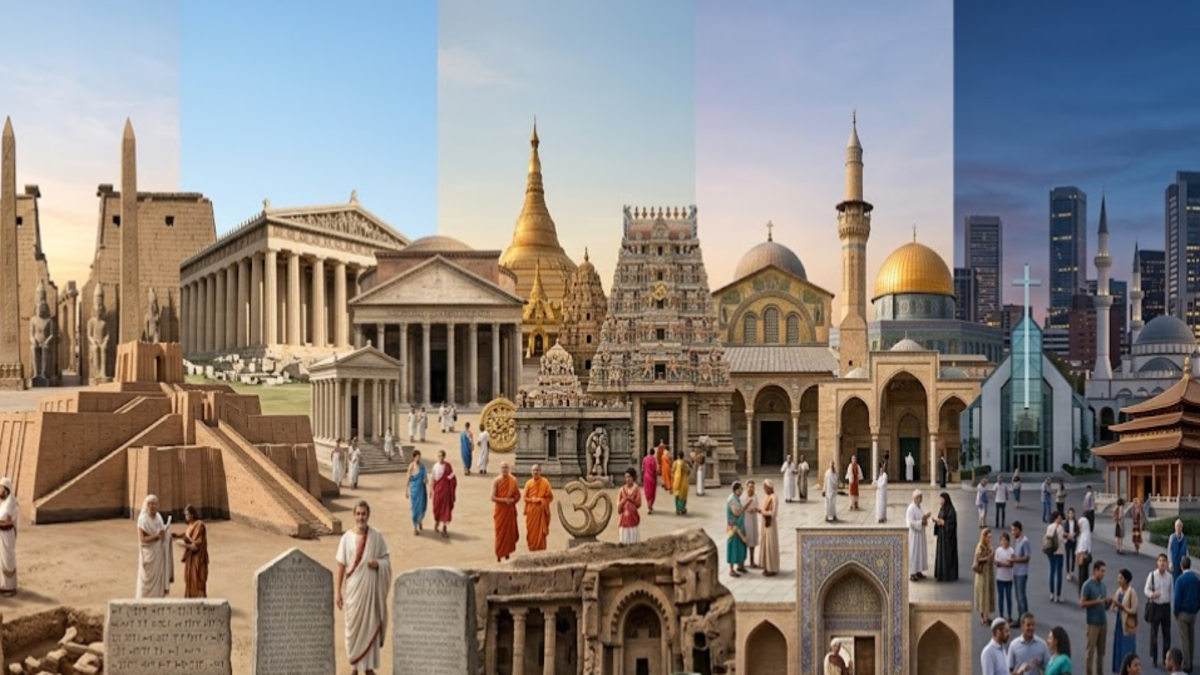
London – ABN News: The history of religions stretches from the earliest human communities and ancient civilizations to the diverse spiritual landscape of the modern world, with recent archaeological discoveries continuing to reshape what researchers know about the beliefs, rituals and sacred practices of earlier societies. But how did religion develop across civilizations, and why does it remain such a powerful force in the modern world?

Religion has accompanied human societies throughout recorded history. Ancient peoples developed systems of belief that helped them understand nature, death, creation and the relationship between the human world and the divine.
Today, archaeology, anthropology and the study of ancient texts continue to provide new evidence about how those beliefs evolved. Recent discoveries have also shown how difficult it can be to separate religious practice from political authority, social organization and everyday life.

The earliest civilizations created complex religious systems that were closely connected to government and social order. In ancient Egypt, Mesopotamia, the Indus Valley and China, religious beliefs influenced architecture, burial customs, festivals and ideas about kingship.
In ancient Egypt, temples served as important religious and economic institutions, while rulers were closely associated with the divine order. Egyptian beliefs about the afterlife also shaped burial practices and the construction of tombs.
Recent archaeological reporting has renewed attention on this period. A settlement discovered at Tell el-Koua in Egypt’s Wadi Tumilat region has been dated to the Second Intermediate Period, an era connected by some scholars to the historical context surrounding discussions of the biblical Exodus. Archaeologists reportedly found tombs, residential structures, ovens, storage facilities and artifacts including scarab amulets. The discovery offers further evidence of the complexity of communities living in the region during a period of major political transition.
In Mesopotamia, religious life centered on a large pantheon of gods and goddesses. Cities often had their own principal deities, and temples played central roles in political and economic life.
Elsewhere, religious traditions developed in different forms. Ancient Greek and Roman societies had multiple gods, sacred festivals and elaborate temples, while religious practices in South Asia and East Asia developed traditions that would eventually influence major world religions and philosophical systems.
The archaeological record shows that religious life was rarely isolated from wider society. Sacred spaces, burial sites and ritual objects often reveal how ancient communities understood authority, identity and the natural world.
Over time, new religious and philosophical traditions emerged across Asia, the Middle East and the Mediterranean world.
Judaism developed as a monotheistic tradition centered on a covenant between God and the people of Israel, with its beliefs and texts becoming foundational to later religious traditions.
Christianity emerged in the first century from the Jewish religious environment of the Roman-ruled eastern Mediterranean. It later spread throughout the Roman Empire and beyond, eventually becoming one of the world’s largest religions.
Islam emerged in the Arabian Peninsula in the seventh century and expanded across large parts of the Middle East, North Africa, Asia and other regions. Its growth created new intellectual, cultural and political centers.
In South Asia, Hindu traditions developed over many centuries, while Buddhism emerged from the teachings associated with Siddhartha Gautama and spread across Asia. Jainism also developed in the same broader cultural environment.
China saw the development and expansion of traditions including Confucianism and Daoism, which influenced ethics, philosophy, social organization and ideas about the relationship between humanity and the natural world.
These traditions did not develop in isolation. Trade routes, migration, political expansion and cultural exchange helped religious ideas travel across borders.
The history of religions is also a history of movement.
Merchants, travelers, missionaries, scholars and migrants carried beliefs and practices across continents. Religious traditions often changed as they encountered new languages, customs and political systems.
Recent archaeological research continues to highlight this interconnected past. A study reported by Antiquity found evidence of Orthodox Christian migrants from the Kievan Rus’ traveling hundreds of kilometers into medieval Vilnius during the 13th and 14th centuries. The research adds to evidence that medieval cities were shaped by mobility and interaction among different populations and religious communities.
Archaeological discoveries also continue to reveal the importance of ritual in societies that existed long before the major modern religions. Recent reporting from the archaeological community has highlighted discoveries including Bronze Age sacred hearths and altars in Türkiye, as well as evidence of ancient cult practices in the Roman world.
Such findings remind researchers that religious history cannot be understood only through written scriptures. Buildings, inscriptions, graves, objects and ritual spaces can also provide evidence of how people understood their world.
During the medieval period, religion remained deeply connected to political authority and cultural identity.
Christianity shaped much of European political and social life, while Islamic civilization became a major center of scholarship, science, medicine, philosophy and trade. Across Asia, Buddhism, Hindu traditions, Confucianism, Daoism and other belief systems continued to influence societies.
Religious communities also interacted through trade and intellectual exchange. These contacts sometimes produced cooperation and cultural exchange, while at other times they contributed to conflict.
The early modern period brought major changes. The Protestant Reformation transformed Christianity in Europe, while expanding global trade and European colonialism carried religious traditions into new regions.
At the same time, new intellectual movements increasingly questioned traditional religious authority. The Enlightenment, the growth of modern science and the development of secular political institutions changed the relationship between religion and government in many societies.
Religion remains an important part of contemporary life, even as societies become more interconnected and, in many places, more religiously diverse.
Today, Christianity, Islam, Hinduism, Buddhism, Judaism and other traditions continue to shape the identities of billions of people. At the same time, secularism, agnosticism, atheism and newer spiritual movements have become increasingly visible parts of the global religious landscape.
Modern religious life is also influenced by migration. Communities often establish places of worship far from their historical homelands, creating multicultural religious environments in major cities.
Recent religion reporting illustrates how faith continues to intersect with public life. The Religion Media Centre’s recent coverage has examined debates involving Christian, Jewish and Muslim communities, religious freedom, migration, technology and the role of faith organizations in society.
The Vatican has also recently highlighted questions about faith and technology. In a report on Pope Leo XIV’s message to communicators, Vatican News said the Pope urged communicators to place technological tools at the service of truth and the common good. The development reflects a wider modern question: how should religious institutions respond to rapidly changing technology and communication?
Studying the history of religions provides a way to understand how societies have interpreted life, death, morality and the world around them.
It also helps explain the development of art, architecture, literature, law and political institutions. Religious beliefs have influenced some of humanity’s most important cultural achievements, from ancient temples and cathedrals to manuscripts and works of philosophy.
At the same time, religious history is not a simple story of uninterrupted continuity. Traditions change, divide, merge and adapt as societies change.
Modern archaeology is adding another dimension to this understanding. Discoveries made today can challenge older assumptions about ancient communities and demonstrate that religious and cultural exchange was often more extensive than previously recognized.
The history of religions therefore remains an evolving field. New archaeological discoveries, newly interpreted texts and advances in scientific research continue to provide fresh perspectives on the beliefs and practices of people who lived thousands of years ago.
The history of religions is the study of how religious beliefs, traditions, institutions and practices have developed and changed across human societies.
Ancient Egypt, Mesopotamia, Greece, Rome, China and civilizations in South Asia all developed complex religious or philosophical traditions.
Religions spread through migration, trade, travel, missionary activity, political expansion and cultural exchange.
It helps explain the cultural, social and political development of societies and provides context for understanding religious diversity in the modern world.
From ancient temples and burial rituals to modern places of worship and global religious communities, religion has remained closely connected to human history. Current archaeological discoveries and contemporary religious developments continue to add new chapters to that story, showing that the study of faith is also a study of civilization itself.
… Read more
Contact: info@abnnews.net