Physical Address
304 North Cardinal St.
Dorchester Center, MA 02124
Physical Address
304 North Cardinal St.
Dorchester Center, MA 02124

Religions News Around the World
Religions News Around the World
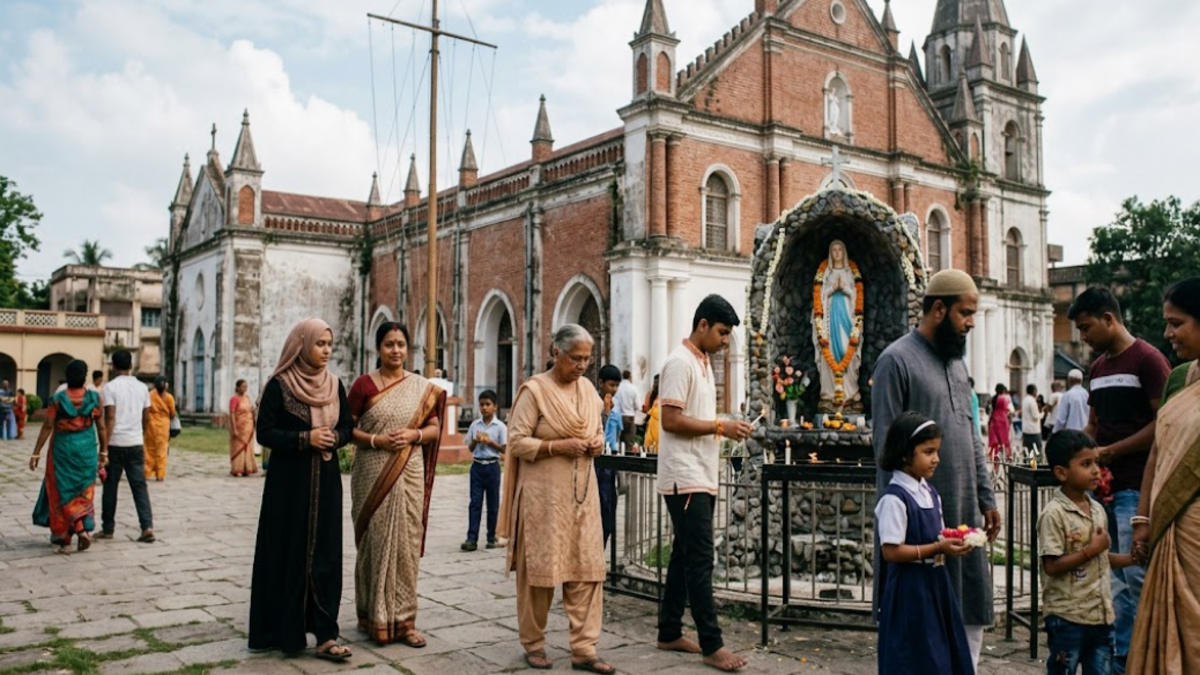
KOLKATA – ABN News: Christians, Hindus and Muslims visit Marian shrine together in eastern India, where the Basilica of the Holy Rosary, popularly known as Bandel Church, has become a place of prayer, community and spiritual consolation for people from different religious traditions. What draws thousands of devotees to this historic Catholic shrine, and why has devotion to Mary crossed religious boundaries in the region?

The historic Basilica of the Holy Rosary in Bandel, on the banks of the Hooghly River in eastern India, continues to attract pilgrims from different religious backgrounds, with Christians, Hindus and Muslims visiting the Marian shrine in search of prayer, peace and hope.
The Catholic basilica stands about 50 miles north of Kolkata and has become a distinctive place of pilgrimage in the region. Although it is a Catholic church dedicated to the Virgin Mary, many of its visitors do not belong to the Christian faith.

According to a recent Religion News Service report, thousands of pilgrims visit the basilica during feast days, with Hindus and Muslims forming a significant part of the visiting community.
The shrine’s appeal reflects a broader tradition in parts of India, where Mary is respected not only as the mother of Jesus in Christian belief but also as a maternal and protective spiritual figure by people from other faiths.
For many devotees, the visit is deeply personal. They come with prayers connected to family concerns, health, work and other difficulties, while others describe the shrine as a place where they can find peace and a sense of belonging.
The story of Bandel Church is particularly notable because the shrine operates in a neighborhood where Hindu and Muslim families live alongside the Christian community. The interaction among these communities has helped make the basilica more than a place of Catholic worship.
It has also become a meeting point where people from different religious traditions share a common reverence for the figure of Mary.
The Basilica of the Holy Rosary is locally known as Bandel Church and has a history stretching back centuries. Its location beside the Hooghly River has long connected the shrine to the religious and cultural history of Bengal.
The church’s Catholic identity remains central to its life, but its visitors represent a much wider religious landscape.
The recent report highlighted the experience of Rimpa Chowdhury, a Hindu devotee who has visited the historic Catholic church every week for 13 years. For her, the basilica has become a place where prayer and community come together.
Chowdhury’s experience illustrates why the shrine attracts attention beyond the Catholic community. Her visits are not simply occasional trips to a religious monument. Over the years, the church has become part of her spiritual routine and a place where she feels connected to others.
The presence of Hindu and Muslim pilgrims at the shrine is not a new phenomenon. For decades, people from different communities have come to Bandel Church, particularly around important feast days.
Their motivations may differ, but many share a belief that the shrine offers an opportunity to seek divine help and spiritual comfort.
The devotion also reflects the importance of the feminine dimension of spirituality in Bengal. Some visitors see Mary through the lens of motherhood, protection and compassion, while Catholics understand her within the Christian tradition as the mother of Jesus.
These different perspectives coexist around the shrine without necessarily erasing the distinct religious identities of the pilgrims.
That has made Bandel Church an important example of how religious devotion can sometimes create spaces where communities meet despite differences in belief.
For many devotees, the attraction of Bandel Church is closely linked to the belief that Mary can intercede on behalf of those who come to her in prayer.
The people who arrive at the basilica may carry different religious identities, but they often come with similar human concerns. Some seek healing. Others pray for their families or for relief from personal difficulties.
The recent account of the shrine described visitors who see Mary as a source of protection and hope.
Among them are Hindu and Muslim devotees who live in and around the area. Their presence demonstrates how Marian devotion has developed beyond the boundaries of formal Catholic practice.
At the same time, the shrine remains firmly rooted in the Catholic tradition. The basilica is cared for by Catholic religious communities, and its devotional life centers on Mary and the Christian faith.
The coexistence of different groups therefore does not mean that all pilgrims share the same theology. Instead, the shrine provides a setting in which people with different beliefs can approach a figure they associate with compassion, motherhood and divine assistance.
This distinction is important when understanding the significance of Bandel Church.
The pilgrims do not necessarily abandon their own religious identities when they enter the shrine. Rather, they participate in a shared spiritual space while interpreting their experience according to their own faith and traditions.
The result is a form of religious interaction that has become part of the social fabric surrounding the basilica.
The role of Catholic religious sisters is another important part of the story.
According to the recent report, nuns serving the shrine have developed close relationships with people in the surrounding communities. Their presence extends beyond the boundaries of the church itself.
For some local devotees, the sisters represent compassion and service. Their work has helped strengthen the connection between the Catholic shrine and the Hindu and Muslim families who live nearby.
The sisters’ presence also contributes to the sense that the basilica belongs to the wider community, even though it remains a Catholic institution.
For devotees who regularly visit, the shrine can therefore become a place where religious differences are accompanied by everyday relationships and acts of kindness.
This is particularly significant in a region where religious identity remains an important part of public and private life.
The story of Bandel Church shows that interreligious relationships do not always emerge through formal conferences or official dialogue. Sometimes they develop through repeated personal encounters: a weekly visit, a conversation with a nun, a shared moment of prayer or simply the experience of entering the same sacred space.
Over time, such encounters can create a sense of familiarity and trust.
That appears to be one of the reasons why the Bandel shrine continues to draw people from different communities.
One of the most striking elements of the story is the way some non-Christian devotees understand Mary.
In the religious and cultural environment of Bengal, the idea of a powerful female spiritual figure has deep resonance. Some Hindu devotees approach Mary through their own understanding of feminine divine power, while Catholic pilgrims approach her through Christian devotion.
The two traditions are not identical, but the figure of Mary can provide a point of connection.
For devotees such as Chowdhury, the shrine represents more than a building or a historic church. It is a place associated with spiritual strength and a sense of protection.
Her testimony, as reported by Religion News Service, reflects the personal character of the devotion found at the shrine.
The belief in a powerful maternal presence can also help explain why the Marian shrine attracts people who do not identify as Christians.
Mary’s image is familiar across much of South Asia, and her reputation as a compassionate mother has allowed her to become a figure of interest to people beyond the Catholic community.
This does not necessarily mean that Hindus, Muslims and Christians understand Mary in the same way.
Instead, the shrine demonstrates how a religious figure can acquire different meanings for different communities while remaining central to the tradition from which she comes.
That complexity is part of what makes Bandel Church significant.
The story of the Bandel shrine comes at a time when religious coexistence remains an important subject across India.
The country is home to communities with different faiths, traditions and cultural practices. In many places, religious identity shapes daily life, but there are also spaces where people from different communities regularly interact.
Bandel Church is one such place.
The regular presence of Hindu and Muslim pilgrims at a Catholic Marian shrine offers an example of religious coexistence rooted in personal devotion rather than political slogans.
The visitors may not agree on every religious question, but they can still share a common place of pilgrimage.
This creates a different kind of interfaith encounter—one that emerges from people’s own choices and experiences.
For local residents, the church is also part of the neighborhood. The surrounding area includes Hindu and Muslim families, and the basilica’s presence has become intertwined with the social life of the community.
The shrine’s ability to attract visitors from outside the Catholic faith also challenges the assumption that religious places are always visited exclusively by members of the tradition that manages them.
In Bandel, the reality is more complicated.
The church remains Catholic, its religious identity remains clear, and its Marian devotion remains at the center of its spiritual life. Yet the people who enter its grounds come from a broader spectrum of India’s religious society.
Bandel Church is not the only Marian shrine in India to attract non-Christian visitors.
Across the country, several Catholic shrines dedicated to Mary have become destinations for pilgrims from different faiths.
One of the best-known examples is the Basilica of Our Lady of Good Health at Vailankanni in Tamil Nadu, often called the “Lourdes of the East.” The shrine attracts millions of visitors and has long welcomed Hindu and Muslim pilgrims alongside Christians.
The popularity of such shrines points to a wider pattern in Indian religious life.
People sometimes visit places of worship outside their own formal traditions because they believe those places offer spiritual assistance, healing or protection.
The practice is particularly visible at Marian shrines, where Mary can be approached as a compassionate mother and intercessor.
The Catholic Church has also acknowledged the presence of non-Christian pilgrims at Marian sanctuaries.
The phenomenon has prompted discussions about how religious devotion should be understood when people from different traditions gather at the same sacred site.
In the case of Bandel Church, however, the central reality remains the lived experience of the pilgrims themselves.
They continue to come.
They pray.
They seek hope.
And they return.
The presence of Christians, Hindus and Muslims at Bandel Church does not erase the differences between their faiths.
Instead, it shows that people can sometimes find common ground without giving up their distinct religious identities.
For Catholic pilgrims, Mary remains the mother of Jesus and a central figure of Christian devotion.
For Hindu devotees, her image may be understood through a different spiritual framework, particularly in relation to the power and protection associated with the feminine divine.
Muslim visitors approach the figure of Mary from within a tradition that also honors Maryam, the mother of Jesus, although Islamic and Catholic teachings about her differ significantly.
These distinct perspectives help explain why Marian shrines can become places of interreligious contact.
The common thread is often not identical doctrine but a shared search for comfort, protection and hope.
At Bandel, this shared search has continued for generations.
The basilica’s location, history and religious importance have given it a special place in the region, while the participation of non-Christian pilgrims has added another dimension to its story.
The result is a shrine where Catholic faith and India’s complex religious landscape meet in a visible way.
For the people who visit, the significance may be deeply individual.
Some come because they believe their prayers have been answered. Others return because the church gives them a sense of peace. Still others see the shrine as a place where they can be close to a spiritual power they understand as maternal and protective.
Whatever their personal reasons, the continued presence of different religious communities at Bandel Church makes the shrine an important example of India’s diverse pilgrimage culture.
It also offers a reminder that religious boundaries, while real and significant, do not always prevent people from sharing sacred spaces.
Why do Hindus and Muslims visit Bandel Church?
Many non-Christian pilgrims visit the Marian shrine seeking prayer, spiritual comfort, protection and hope.
Where is Bandel Church located?
The Basilica of the Holy Rosary, commonly called Bandel Church, stands beside the Hooghly River about 50 miles north of Kolkata in eastern India.
Is Bandel Church a Catholic shrine?
Yes. It is a historic Catholic basilica dedicated to the Virgin Mary.
Do Christians, Hindus and Muslims pray at the shrine together?
People from all three communities visit the shrine, although they may understand Mary and the purpose of their pilgrimage in different ways according to their own religious traditions.
… Read more
Contact: info@abnnews.net