Physical Address
304 North Cardinal St.
Dorchester Center, MA 02124
Physical Address
304 North Cardinal St.
Dorchester Center, MA 02124

Religions News Around the World
Religions News Around the World
The First Sunday of Advent will be observed on November 29, 2026, opening a season of expectation and spiritual preparation ahead of Christmas. For many Christian communities, the day also marks the beginning of a new liturgical year, bringing a renewed focus on hope, reflection and the coming of Jesus Christ.

Advent is not simply a countdown to December 25. In the Catholic tradition, it looks both towards the celebration of Christ’s birth and towards the Christian belief in his future return. The season invites believers to prepare through prayer, worship and acts of care for others.
USCCB+1

The word Advent comes from the Latin adventus, meaning “coming” or “arrival”. The season has a twofold focus: remembering the birth of Jesus in Bethlehem and looking ahead to his promised return.
In the Roman Catholic calendar, Advent begins with the First Vespers of the Sunday that falls on or closest to November 30. It continues through four Sundays and ends before Christmas. The exact number of days therefore changes from year to year.
The first part of the season places particular emphasis on watchfulness and hope. Later, especially from December 17, the liturgy turns more directly towards preparation for the celebration of the Nativity.
USCCB+1
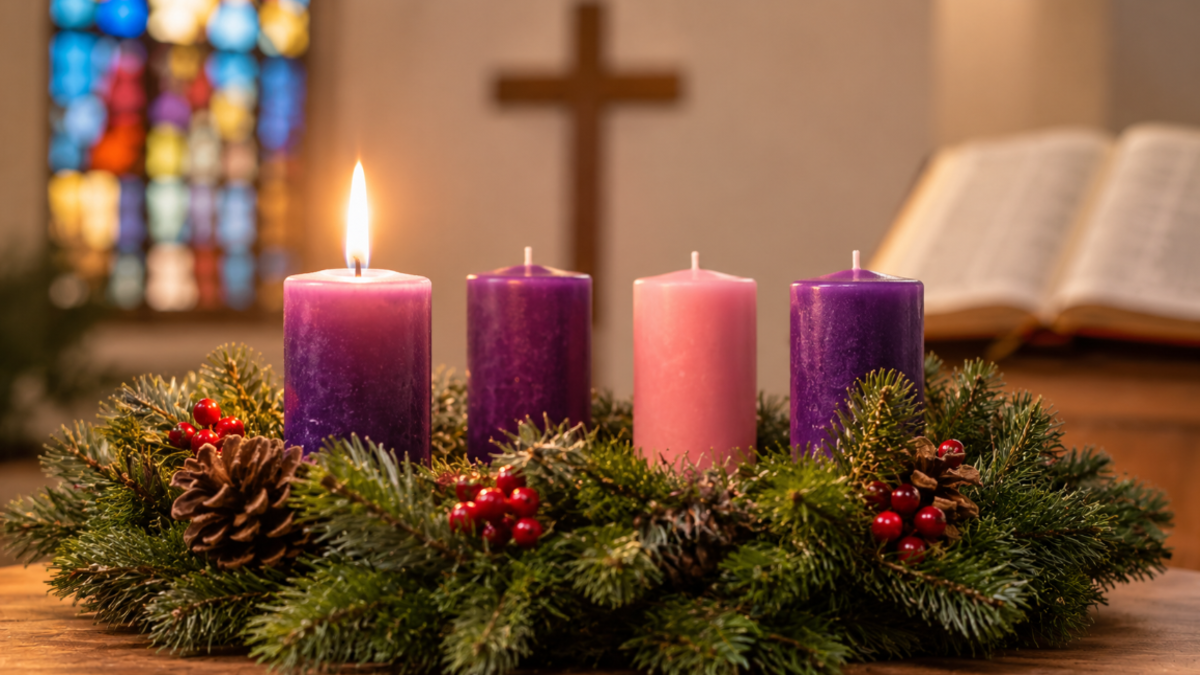
One of the best-known traditions associated with Advent is the wreath made from evergreen branches, usually holding four candles. A candle is lit on each Sunday as Christmas approaches.
In the Catholic tradition described by the United States Conference of Catholic Bishops (USCCB), the wreath traditionally has three purple candles and one rose-coloured candle:
First Sunday: The first purple candle is lit, traditionally associated with hope and expectation.
Second Sunday: A second purple candle is added.
Third Sunday: The rose candle is lit on Gaudete Sunday, a day whose name comes from the Latin word for “rejoice”.
Fourth Sunday: All four candles are lit.
The gradual increase in light symbolises growing anticipation of Christ’s coming. Practices and interpretations can differ between Christian denominations and local communities, so the colours and explanations are not universal.
Purple is the principal liturgical colour in the Roman Catholic Church during Advent. Rose may be used on the Third Sunday as a sign of joy as Christmas draws nearer.
USCCB+1
The date is confirmed in the official 2026 liturgical calendars published by the USCCB and the Liturgy Office of the Catholic Bishops’ Conference of England and Wales.
The First Sunday of Advent also begins a new Sunday reading cycle in the Roman Catholic Church. The 2026–2027 cycle is Year B, in which the Gospel of Mark has a central place in the Sunday readings, alongside passages from the other Gospels where appropriate.
2026+1
For many families and parishes, the day is also when Advent wreaths are blessed or first used, seasonal prayers begin and preparations for Christmas take on a more reflective character.
The way Advent is celebrated varies across churches, countries and households. Common practices include:
Attending Sunday worship and reflecting on the biblical readings.
Lighting the first candle on an Advent wreath.
Setting aside time for prayer or quiet reflection.
Using an Advent calendar to mark the days before Christmas.
Supporting people who are lonely, vulnerable or in need.
Taking part in parish charity initiatives and community activities.
These traditions give the season a practical dimension. Preparation for Christmas is not limited to decorations and shopping; it can also involve reconciliation, generosity and greater attention to neighbours.
Advent offers Christians an opportunity to approach Christmas with a sense of purpose rather than treating it only as a festive event. Its message combines remembrance, expectation and responsibility in everyday life.
The USCCB describes the season as a time to remain spiritually alert and avoid becoming distracted by the pressures of daily life. That emphasis is reflected in the readings and prayers used during the weeks before Christmas.
USCCB+1
The First Sunday of Advent is a reminder that the approach to Christmas can be about more than the passage of time. Its emphasis on hope, reflection and generosity offers a meaningful way for Christian communities and families to prepare for the holiday.
The tradition of lighting one candle at a time captures this message simply: preparation is gradual, and small acts of kindness can make the season more meaningful for others.
United States Conference of Catholic Bishops (USCCB) — What is Advent? — https://www.usccb.org/prayer-worship/liturgical-year/advent
United States Conference of Catholic Bishops (USCCB) — Liturgical Calendar for the Dioceses of the United States of America – 2026 — https://www.usccb.org/resources/2026cal.pdf
United States Conference of Catholic Bishops (USCCB) — Commentary on the Proper Prayers of Advent from the Roman Missal — https://www.usccb.org/prayer-and-worship/liturgical-year-and-calendar/advent/commentary-on-advent-proper-prayers
Catholic Bishops’ Conference of England and Wales, Liturgy Office — Liturgical Calendar 2026 — https://www.liturgyoffice.org.uk/Calendar/2026/Calendar-2026.pdf
Canadian Conference of Catholic Bishops — Celebrating the Season of Advent — https://www.cccb.ca/section/liturgy-english-sector/