Physical Address
304 North Cardinal St.
Dorchester Center, MA 02124
Physical Address
304 North Cardinal St.
Dorchester Center, MA 02124

Religions News Around the World
Religions News Around the World
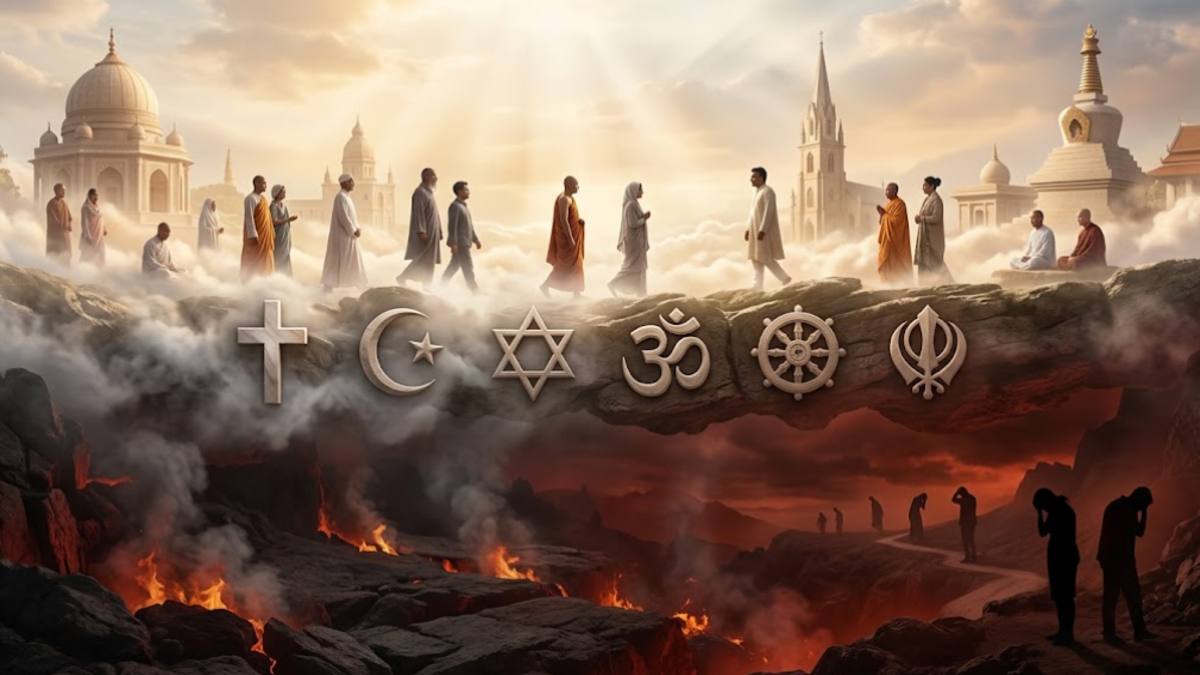
ROME – ABN News: Heaven and Hell in Different Religions remain among humanity’s most enduring questions, and today’s religious news shows that ideas about death, judgment, salvation and spiritual destiny still shape public life in very different ways.

In Rome, Pope Leo XIV is scheduled to preside over Mass and join a Marian procession on Lake Albano, an unusual public religious event that Vatican media has linked to gratitude for creation and Christian faith. In Buddhist circles, the Dalai Lama has expressed condolences after devastating floods in the Himalayan region, while reports from the disaster have also described pilgrims caught in the catastrophe. Sikh institutions, meanwhile, are holding prayers today for the release and well-being of imprisoned Sikhs, placing faith, justice and human dignity at the center of communal worship.
These developments do not mean that all religions share one idea of what comes after death. Some traditions describe heaven and hell as destinations following divine judgment. Others emphasize rebirth, karma and liberation from the cycle of existence. Still others use symbolic or philosophical language to describe a final state that cannot be reduced to a physical place. So, what do the major religious traditions actually teach about heaven, hell and life beyond death?

The words “heaven” and “hell” often sound universal, but they do not carry the same meaning across religious traditions. In Judaism, Christianity and Islam, ideas about reward, punishment, judgment and the world to come developed within broadly related monotheistic traditions, although each religion formed its own theology. Academic discussions commonly group these faiths together when examining classical doctrines of heaven and hell.
Hinduism and Buddhism present a markedly different framework. Both traditions developed teachings around samsara, the cycle of birth, death and rebirth, although they disagree profoundly about the nature of the self and the process of liberation. In these traditions, the ultimate religious goal does not simply mean moving permanently from Earth to a heavenly location. It can mean escaping the cycle itself.
That distinction matters because popular culture often places every religion into the same heaven-versus-hell model. Religious texts and theological traditions do not support such a simple comparison.
In some faiths, the central question is whether a person enters the presence of God. In others, the question focuses on karma and rebirth. In Buddhism, the deepest goal concerns liberation from suffering and the forces that keep beings within samsara.
Even within one religion, scholars and believers may disagree over details. Christianity contains different traditions concerning judgment and the afterlife. Judaism has long preserved a wide range of interpretations. Islam contains extensive descriptions of paradise and punishment, alongside theological discussions about divine mercy, human responsibility and judgment.
The idea of an afterlife therefore serves more than one purpose. It answers questions about what happens after death, but it also expresses each tradition’s understanding of justice, morality, human identity and the relationship between the individual and the divine.
Christianity offers one of the clearest examples of a tradition that speaks directly about heaven and hell, yet even here the concepts involve more than simple places above and below the Earth.
Catholic teaching describes heaven as the ultimate fulfillment of human longing through communion with God. It presents eternal life as participation in the life of the Trinity, together with the blessed, rather than merely as a beautiful location in the sky. The Vatican’s official Catechism also describes heaven as a state of definitive happiness and life with Christ.
The Catechism distinguishes hell from popular images that focus only on fire. Catholic doctrine describes hell principally as definitive separation from God. It says that this state results from a person’s free rejection of God and the refusal of divine mercy. The Church also teaches the eternity of hell.
The Catholic tradition also includes purgatory, which is neither a second version of heaven nor the same as hell. It describes purgatory as a final purification for those who die in God’s friendship but still require purification before entering the fullness of heavenly life.
The distinction between these ideas helps explain why Christian discussions of death often include judgment, resurrection, forgiveness, salvation and moral responsibility.
The official Catholic teaching on these subjects is set out in the Catechism of the Catholic Church, although individual Christian denominations can differ in their interpretation of particular doctrines.
Today’s Vatican coverage gives this ancient theology a modern public setting. Pope Leo XIV is due to lead a Marian celebration beside Lake Albano, with the procession partly taking place on the water. Vatican media says the event connects faith with gratitude for creation and continues a long religious tradition at Castel Gandolfo.
The symbolism is significant. For Christians, devotion to Mary, the saints, resurrection and heavenly glory all point toward a destiny understood not simply as escape from this world, but as transformation and communion with God.
Islam places the afterlife at the heart of religious belief. Traditional Islamic teaching describes a resurrection, judgment and a final destiny in which human actions matter.
Paradise is commonly known as Jannah, while hell is called Jahannam. Islamic sources portray paradise as a realm of reward and peace, while hell represents punishment for wrongdoing and rejection of God. The concepts form part of a broader Islamic understanding of the Day of Judgment and accountability before God.
Unlike the Buddhist framework of repeated rebirth, mainstream Islamic theology generally understands each person to live one earthly life followed by resurrection and judgment. The afterlife therefore carries a strong moral structure. Human actions, faith, repentance and divine judgment all become central to the final outcome.
Descriptions of Jannah and Jahannam can be vivid. Islamic scripture uses gardens, rivers, peace and reward to portray paradise, while imagery connected with fire and suffering appears in descriptions of hell. These images serve both theological and ethical purposes, reminding believers that earthly behavior has consequences beyond immediate experience.
Islam also places strong emphasis on the mercy and justice of God. That combination prevents the afterlife from becoming merely a system of rewards and punishments detached from divine character.
Current religious news from the Muslim world also shows how faith remains deeply connected to communal life rather than only to abstract beliefs about death. In Qatar, the Ministry of Awqaf and Islamic Affairs is holding a religious session focused on the character and life of the Prophet Muhammad, with scholars and specialists taking part.
That event does not itself concern heaven or hell, but it reflects the broader role of Islamic religious teaching: moral conduct, devotion, prophetic example and spiritual awareness remain closely connected.
Judaism presents perhaps the clearest warning against treating religious traditions as fixed systems with one universally accepted map of the afterlife.
Jewish sources contain several concepts associated with life after death, including Sheol, Olam Ha-Ba, Gan Eden and Gehinnom. Their meanings changed across periods and texts, and Jewish thinkers have often disagreed over how the concepts relate to one another.
Sheol appears in biblical tradition as a realm associated with the dead. Later Jewish writings developed more detailed ideas about the World to Come and the destiny of righteous and wicked souls.
Gan Eden can refer to a heavenly state associated with the righteous, while Gehinnom can represent punishment or purification. Some traditional accounts describe a limited period of purification rather than an endless punishment for most souls, although Jewish sources preserve differing views.
The diversity of Jewish thought is especially important because popular descriptions often import later Christian concepts into Judaism without recognizing the differences.
Modern Jewish thought frequently focuses more strongly on ethical life in this world than on creating a detailed description of the next. That approach does not eliminate belief in an afterlife, but it can change the emphasis from speculation about what lies beyond death toward how a person should live now.
Today, the Jewish calendar also places many communities in the Hebrew month of Elul, traditionally associated with introspection, repentance, prayer and preparation for the Days of Awe. The emphasis on examining one’s actions provides a useful reminder that religious traditions can connect future destiny with present moral reflection.
Hindu traditions introduce a different understanding of what happens after death. Rather than concentrating primarily on a single final judgment, many Hindu philosophical and religious traditions describe samsara, the cycle of birth, death and rebirth.
The concept connects future existence with karma, meaning that actions have consequences within the continuing cycle of life. Classical Indian philosophy developed extensive discussions of this process, while the Upanishadic tradition explored the possibility of liberation from repeated rebirth.
Hindu cosmology does include heavenly and lower realms. These should not automatically be equated with the eternal heaven and hell of some Abrahamic traditions. Traditional descriptions can place heavens and hells within the larger cycle of samsara, meaning that they remain part of a changing cosmic order rather than necessarily representing the final destination of the individual.
The ultimate goal in many Hindu traditions is moksha, liberation from samsara. Different schools explain that liberation in different ways. Some describe it in terms of realizing the relationship between the self and ultimate reality, while devotional traditions may emphasize loving union with or closeness to God.
This makes the Hindu vision fundamentally different from the common Western image of choosing between two eternal destinations. Heaven can exist without being the final goal.
Today’s reports from India also underline the continuing importance of sacred places in ordinary life. A section of a Swaminarayan temple complex in Prayagraj collapsed after prolonged rain and construction activity, according to local reporting. No casualties were reported, and authorities were investigating the cause.
The incident carries no theological conclusion by itself, but it illustrates how temples remain living institutions used for worship, accommodation, community gatherings and religious service. Beliefs about ultimate destiny exist alongside the practical realities of religious communities in the present world.
Buddhism creates perhaps the sharpest contrast with traditions that teach an immortal soul entering heaven or hell.
Buddhist teachings generally reject the idea of a permanent, unchanging self. Instead, Buddhism explains existence through processes of change, dependent conditions, craving and consciousness. Yet Buddhist traditions do teach rebirth and karma, creating a complex picture in which continuity exists without an eternal soul moving unchanged from one body to another.
Buddhist cosmology includes heavenly and hellish realms, but these realms do not represent the same kind of permanent heaven and hell found in some interpretations of Christianity or Islam. Beings can experience different realms according to karma and remain within samsara.
The highest goal is nirvana, understood as liberation from the causes of suffering and release from samsara. Buddhist traditions differ in how they explain nirvana, especially when discussing whether it should be described positively or understood through the ending of craving, ignorance and suffering.
That philosophical difference changes the central question. Instead of asking, “Where will I live forever?” Buddhism often asks, “How can suffering, attachment and ignorance come to an end?”
The distinction is especially relevant in today’s news from the Himalayas. The Dalai Lama has expressed sorrow after floods caused deaths and severe damage in the Rasuwa region of Nepal and Kyirong in Tibet, while wider reports have described a large number of missing people, including pilgrims traveling toward the sacred Mount Kailash.
The tragedy does not prove any religious doctrine. What it reveals is more human: pilgrimage, mortality, compassion and spiritual meaning continue to intersect in moments of disaster.
Sikhism also does not fit neatly into a simple heaven-versus-hell formula.
Sikh teachings place strong emphasis on remembrance of God, truthful living, humility and liberation from the cycle of birth and death. The concept of mukti, or liberation, points toward freedom from spiritual bondage and union with the divine rather than an endless search for pleasure in a celestial place.
The present-day Sikh response to imprisoned community members offers a contemporary example of how religious practice can connect spiritual belief with justice. The Shiromani Gurdwara Parbandhak Committee has called for collective ardas, or prayer, today seeking the release and well-being of Sikh prisoners who supporters say have completed their sentences.
The religious significance lies in the act of collective prayer itself. Sikh practice does not isolate spiritual concerns from social responsibility. Prayer, remembrance, justice, service and communal solidarity can exist together.
This also reinforces a wider pattern across religions: teachings about what happens after death often influence how believers act before death.
The comparison reveals several major differences, but it also exposes important similarities.
Christianity, Islam and many Jewish traditions place strong emphasis on moral accountability before God, although the details differ. Hinduism and Buddhism connect present conduct to karma and future existence, while emphasizing liberation from samsara. Sikhism likewise stresses liberation and a life oriented toward God.
In nearly every tradition, however, death does not simply erase the moral significance of life.
Beliefs about the next world often answer questions that governments, science and journalism cannot settle: Is justice ultimately possible? Does suffering have meaning? Can wrongdoing be forgiven? Does consciousness continue? Is the self permanent? Is there a reality beyond the visible world?
Religious answers differ because the underlying assumptions differ.
One tradition may speak of resurrection. Another may speak of rebirth. Another may emphasize a World to Come. Another may describe nirvana as liberation from the very conditions that make ordinary existence possible.
This is why comparing religions requires caution. Calling every positive afterlife “heaven” can hide major differences, just as calling every negative realm “hell” can distort traditions that treat suffering realms as temporary or symbolic within a wider cycle of existence.
Today’s religious headlines offer the same lesson. A papal procession, Jewish introspection, Islamic teaching, Sikh prayer and Buddhist compassion may all concern spiritual life, yet they arise from distinct theological worlds.
For believers, these traditions can offer answers of profound personal importance. For journalists and readers, the challenge is to understand those beliefs accurately without reducing them to stereotypes.
Heaven and hell, in the broadest sense, are not merely stories about what comes after death. They are also stories about how different cultures understand justice, hope, fear, responsibility, compassion and the ultimate purpose of human life.
And that may explain why these ideas continue to appear, directly or indirectly, in religious news today.
In Catholic teaching, heaven is eternal communion with God and the fullness of happiness with Christ and the blessed.
Jewish tradition includes ideas such as Gan Eden and Gehinnom, but interpretations vary significantly across texts, periods and communities.
Both traditions contain teachings about difficult or hellish realms, but these generally operate within broader systems of karma and rebirth rather than matching the permanent hell described in some Abrahamic traditions.
Heaven is often described as blessed existence or communion with the divine, while nirvana refers to liberation from suffering and the cycle of samsara.