Physical Address
304 North Cardinal St.
Dorchester Center, MA 02124
Physical Address
304 North Cardinal St.
Dorchester Center, MA 02124

Religions News Around the World
Religions News Around the World
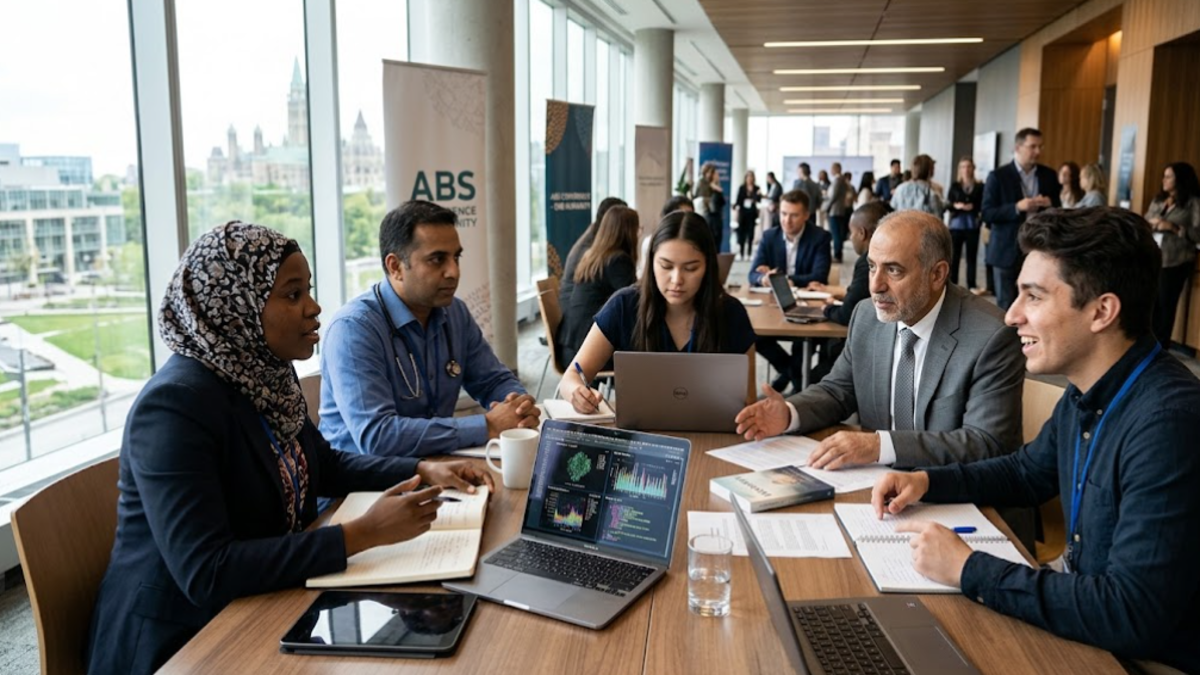
The 50th annual conference of the Association for Bahá’í Studies (ABS) has prompted researchers, academics and professionals to examine how the principle of the oneness of humanity can shape their work across fields ranging from healthcare and mental health to artificial intelligence, anthropology and social justice.

In an episode published on October 23, 2026, the Bahá’í World News Service’s Insights from the Field series brings together reflections from conference participants on a central question: how can a commitment to humanity’s shared well-being influence not only professional decisions, but also the questions researchers choose to investigate?
The conference brought approximately 2,100 participants to Ottawa, Canada, for discussions on scholarship, knowledge and service to the common good. The latest episode highlights how spiritual principles can inform practical inquiry into social conditions, human development and technological progress.


Jasmine Miller-Kleinhenz, a cancer researcher at the University of Mississippi Medical Center, reflects on the relationship between health outcomes and the conditions in which people live.
Her research into an aggressive form of breast cancer led her to consider why particular populations of women were especially affected. Explanations based primarily on ancestry, she said, did not provide a complete account of the issue.
The principle of human oneness encouraged a broader line of inquiry: whether social conditions, including access to nutritious food, green spaces and quality education, might help explain differences in health outcomes.
This perspective does not replace scientific investigation. Instead, it directs attention towards the wider circumstances that may influence health and raises questions about whether improvements in those conditions could lead to better outcomes.
For Miller-Kleinhenz, the principle of oneness must influence the questions guiding research rather than remain a general personal belief.
Clinical psychologist Michael Penn explores how a shared understanding of human dignity and spiritual capacity can influence psychological care and community life.
Through the ABS Mental Health Collaborative, Penn and colleagues consider how supportive social relationships can contribute to well-being. His approach emphasizes that people are not defined solely by biology or social circumstances; they also possess capacities for reflection, choice and personal growth.
Penn points to Bahá’í community-building activities that bring people from different religious, cultural and economic backgrounds together for prayer, meditation and meaningful conversation. Such settings, he suggests, can help nurture relationships that provide encouragement and support during difficult periods.
The discussion broadens the question of mental health beyond individual treatment to include the social environments in which people live. It does not establish that community activities can replace professional mental healthcare, but it highlights the potential importance of belonging and supportive relationships.
Anthropologist Whitney White-Kazemipour challenges the assumption that science and religion must operate in entirely separate spheres, with one concerned exclusively with facts and the other with values.
She proposes understanding both as systems of knowledge that can contribute to a more complete examination of reality.
This perspective is reflected in the work of Adib Shafipour, whose research involves artificial intelligence applications for disease detection. He considers how spiritual and ethical questions might influence the direction of technological development.
Rather than evaluating technology solely through technical performance, efficiency or the ability to achieve a particular result, Shafipour encourages researchers to consider the broader human consequences of their work.
Questions about the purpose of innovation, the values embedded in design choices and the kind of relationships technology encourages become part of the inquiry.
This approach does not diminish the need for scientific evidence or rigorous evaluation. Instead, it invites researchers to examine the assumptions that shape their objectives and consider whether technological progress serves wider human needs.
Derik Smith, a professor of literature at Claremont McKenna College, considers how the principle of oneness can influence efforts to advance social justice.
His perspective places emphasis on building the kind of society people want to see, rather than defining social change primarily through opposition to an adversary.
The distinction is significant because it shifts attention towards cooperation, shared responsibility and the practical creation of more just social conditions.
A related discussion in the wider conference programme examined how the principle of oneness could influence political thought. Rather than treating society solely as a collection of competing interests, participants explored how consultation might help people understand different needs and work towards collective solutions.
These ideas do not eliminate disagreements or guarantee consensus. They offer a framework for approaching differences without assuming that the interests of one group must necessarily be advanced at the expense of another.
The reflections featured in Insights from the Field build on the broader discussions at the ABS conference in Ottawa.
Established in 1975, the Association for Bahá’í Studies has developed opportunities for academics, professionals and other interested participants to examine how Bahá’í teachings can engage with contemporary intellectual and professional questions. Its activities include conferences, seminars, collaborative research and publications.
The conference also included a programme for young people aged 15 to 21, exploring the relationship between education, work, service and contribution to society. This reflects an effort to broaden participation in intellectual inquiry and encourage younger generations to contribute alongside experienced professionals.
One recurring theme is that knowledge need not remain confined to universities or specialist institutions. People working in communities and professional settings also possess experience that can contribute to understanding social challenges.
For this approach to produce meaningful results, however, collaboration must be accompanied by intellectual rigour, openness to evidence and a willingness to reconsider established assumptions.
The discussions presented in the latest episode offer a useful perspective on the relationship between professional expertise, ethical reflection and social responsibility.
The examples span very different disciplines, but they share an underlying concern: the questions guiding research and professional practice influence the outcomes people pursue.
In healthcare, that may mean examining the social conditions associated with unequal health outcomes. In mental health, it may involve considering the contribution of supportive relationships. In technology, it means examining not only what a system can do, but also whose needs it serves and what consequences its use may have.
The principle of oneness provides the moral and spiritual framework through which the participants approach these questions. It should not be confused with empirical proof that a particular policy or intervention will succeed. Practical outcomes still require research, evaluation and critical discussion.
The broader lesson is that knowledge can become more useful when technical expertise is accompanied by attention to human dignity, social conditions and the common good. Bringing these considerations into professional discussions may help researchers and practitioners identify questions that otherwise remain overlooked.
The Association for Bahá’í Studies is an organization that creates opportunities to examine connections between Bahá’í teachings, academic disciplines and contemporary social questions through conferences, seminars and scholarly activities.
It is a central principle of the Bahá’í Faith that humanity constitutes one human family. In the conference discussions, participants consider how this principle can influence research, professional decisions and efforts to improve society.
The episode explores healthcare, cancer research, mental health, anthropology, artificial intelligence and social justice, among other areas.
The episode is available through the Bahá’í World News Service’s Insights from the Field series.
1. Bahá’í World News Service — At 50th ABS conference, participants ask how oneness impacts their fields — Read the original report and episode
2. Bahá’í World News Service — Scholarship and knowledge in service to the common good — Read the report on the 50th annual ABS conference
….Read More
Contact: info@abnnews.net