Physical Address
304 North Cardinal St.
Dorchester Center, MA 02124
Physical Address
304 North Cardinal St.
Dorchester Center, MA 02124

Religions News Around the World
Religions News Around the World
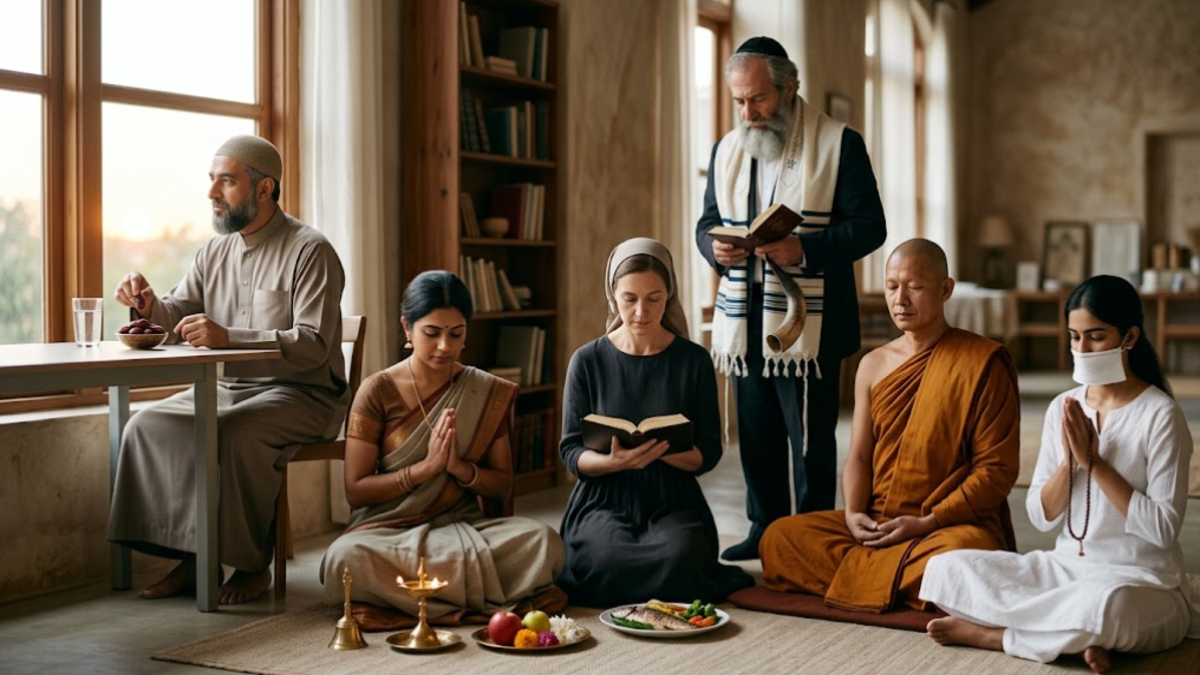
NEW DELHI – ABN News: Fasting in Different Religions remains one of the most widespread forms of religious devotion, with believers across faiths using abstinence, prayer and self-discipline to deepen their spiritual practice. Current religious coverage in India is again drawing attention to fasting observances, including Kajari Teej and Sankashti Chaturthi, both of which fall on Monday and involve fasting traditions for devotees. But how does fasting differ from one religion to another, and what does the practice mean beyond simply going without food?

Fasting appears in many of the world’s major religious traditions, but there is no single definition of what a fast should look like.
For some believers, fasting means avoiding all food and drink during particular hours. For others, it can mean giving up selected foods, eating only at certain times, reducing meals or abstaining from particular habits.

The purpose also varies. Fasting can express repentance, mourning, gratitude, spiritual preparation, self-control, solidarity with others or a desire to concentrate more closely on prayer and religious teachings.
Current religious reporting from India illustrates how prominently fasting remains woven into the Hindu calendar. Coverage of August religious observances has highlighted a series of vratas, or religious fasts, connected with festivals and devotional days. The sacred month of Shravan, for example, is associated with fasting and worship dedicated to Lord Shiva.
Monday’s observances provide another example. Reports identify Kajari Teej and Sankashti Chaturthi as important occasions involving fasting, prayer and ritual practices.
The news coverage is a reminder that fasting is not an isolated religious activity. In many communities, it remains part of the rhythm of family life, worship and cultural identity.
At the same time, fasting should not be treated as identical across religions. Each tradition has its own theology, calendar, rules and interpretation.
In Hinduism, fasting is commonly associated with the concept of vrat or upavas. The practice can take many forms, depending on the festival, deity, region, family tradition and individual observance.
A Hindu fast may involve complete abstinence from food for a specified period. In other cases, devotees may eat selected foods while avoiding grains, meat or other ingredients. Some observances restrict eating to a particular time of day.
This variety is important because there is no single Hindu fasting rule followed by every Hindu.
Fasting days frequently accompany festivals and sacred occasions. Recent religious calendars and news reports have highlighted observances such as Ekadashi, Teej and Sankashti Chaturthi, among others. Many of these occasions combine fasting with prayer, temple worship, offerings and other forms of devotion.
Kajari Teej provides a particularly visible example. Current coverage says the festival is being observed with specific fasting rituals and devotional practices, with customs differing across communities and regions.
Sankashti Chaturthi is another important fasting occasion. Devotees traditionally observe a fast and perform prayers connected with Lord Ganesha, with the timing of the fast linked in part to the lunar calendar and moonrise.
The significance of Hindu fasting therefore extends beyond food. For many devotees, the fast represents restraint and dedication. The temporary denial of ordinary pleasures can create a period of concentration in which prayer and religious observance take priority.
In Islam, fasting is most closely associated with Ramadan, the holy month during which observant Muslims fast from dawn until sunset.
During the daily fast, Muslims abstain from food and drink during daylight hours. The fast is traditionally broken at sunset, followed by an evening meal known as iftar. Before dawn, many Muslims eat a pre-fast meal known as suhoor.
Ramadan fasting is one of the central practices of Islam. It is not simply a dietary exercise. Muslims connect the fast with prayer, charity, self-control and increased awareness of people facing hardship.
The timing of Ramadan follows the Islamic lunar calendar, meaning that it moves through the seasons over the years.
The length of the daily fast consequently varies according to location and season. Previous reporting on Ramadan has documented fasting periods that can range from roughly 12 to 16 hours depending on where Muslims live and the time of year.
The discipline also involves more than avoiding meals. Ramadan encourages believers to pay attention to conduct, patience and generosity. Many Muslims increase charitable activity and prayer during the month.
There are also recognised exemptions from fasting for people for whom fasting would present particular difficulties, including certain health circumstances, pregnancy, travel and age-related situations, although the precise rules and religious interpretations can differ.
The central idea is therefore not simply hunger. It is conscious restraint undertaken as an act of worship.
Christian fasting traditions differ substantially among denominations.
The best-known period is Lent, the season of preparation leading to Easter. In many Christian traditions, Lent is associated with repentance, prayer, sacrifice and spiritual reflection.
Catholic and Orthodox traditions have detailed fasting and abstinence practices, while many Protestant churches leave the precise form of fasting to individual believers or local congregations.
For some Christians, fasting means reducing the amount of food eaten. For others, it involves abstaining from particular foods. Some believers choose to give up a non-food activity or habit as an act of spiritual discipline.
The biblical tradition also places emphasis on the attitude behind fasting. The practice is not intended merely to demonstrate religious devotion publicly. Instead, it is connected with prayer and an inward spiritual purpose.
Christian communities can also organise special days or periods of prayer and fasting in response to particular circumstances.
The Orthodox tradition demonstrates how structured the practice can become. Official church calendars distinguish between fasting and non-fasting days throughout the liturgical year, with rules varying according to the religious calendar.
This diversity means that describing “Christian fasting” as a single practice would be misleading.
Judaism includes several important fast days, each with its own historical or religious meaning.
Yom Kippur, the Day of Atonement, is the most prominent. Observant Jews traditionally undertake a full fast as part of a day devoted to repentance, prayer and reflection.
Other fasts commemorate events in Jewish history. Tisha B’Av, for example, is associated with mourning the destruction of the First and Second Temples in Jerusalem.
Jewish fasting therefore demonstrates another major dimension of the practice: remembrance.
The purpose is not necessarily to seek physical hardship for its own sake. Abstinence can create a solemn atmosphere in which individuals and communities focus on repentance, loss, history and their relationship with God.
Different Jewish fasts also have different rules and durations. Some major fasts last approximately 25 hours, while minor fasts traditionally run from dawn to nightfall.
The Jewish tradition consequently shows how fasting can serve as a collective act of memory as well as an individual spiritual discipline.
Buddhist approaches to fasting differ from the practices found in the Abrahamic religions.
Rather than focusing on a single universal fasting month, Buddhist traditions often emphasise moderation, mindfulness and control of attachment to physical desires.
In several Buddhist traditions, monks and nuns follow rules concerning when food may be consumed. Some monastic communities refrain from eating after midday until the following morning.
Lay Buddhists may also undertake periods of fasting or modified eating, particularly on religious observance days.
The underlying emphasis often concerns discipline and mindfulness rather than simply enduring hunger.
Recent news has also shown the continuing importance of Buddhist religious retreats and meditation communities. An Associated Press report from Myanmar described an airstrike on a Buddhist monastery where people were participating in a weeklong meditation retreat. The incident was not itself a fasting observance, but it highlighted the continuing role of religious retreats in Buddhist communities and the vulnerability of places dedicated to spiritual practice.
Fasting within Buddhism can therefore be understood alongside broader practices of meditation, ethical conduct and detachment.
Jainism has some of the most demanding fasting traditions among major world religions.
Fasting is closely connected with the Jain emphasis on self-control, non-attachment and purification. Devotees may undertake different forms of fasting, ranging from restrictions on particular foods to prolonged abstinence.
One of the best-known periods is Paryushan, a major Jain period devoted to spiritual reflection, repentance and forgiveness. Some followers observe particularly rigorous fasts during this period.
Jain fasting must also be understood within the religion’s wider commitment to ahimsa, or non-violence. The discipline is part of a broader effort to reduce attachment and harmful actions.
Because practices vary considerably among individuals, not every Jain observes the same type or duration of fasting.
The tradition nevertheless demonstrates how fasting can become a profound spiritual discipline rather than simply a temporary change in diet.
Sikhism offers an important contrast.
While individual Sikhs may choose to fast for personal reasons, fasting does not occupy the same central ritual position that it does in Islam, Hinduism, Judaism or some Christian traditions.
Sikh teachings place strong emphasis on remembering God, honest living, service and sharing with others. The tradition generally does not present physical hunger as a necessary route to spiritual progress.
This distinction matters in any comparison of religious fasting. The fact that fasting exists in many religions does not mean that every religion considers it an essential religious duty.
Indeed, the Sikh perspective demonstrates that spiritual discipline can be expressed through other practices, including prayer, service and ethical conduct.
Despite enormous changes in food, technology and daily routines, fasting continues to occupy an important place in religious communities.
Current coverage of Hindu festivals shows how fasting remains connected to contemporary family and community life. Today’s reports about Kajari Teej and Sankashti Chaturthi demonstrate that ancient lunar-calendar observances still influence religious routines, including when devotees eat, pray and gather for worship.
The same principle applies across faiths.
For Muslims, Ramadan can transform the daily timetable of entire communities. For Christians, Lent can shape personal decisions about sacrifice and worship. For Jews, fast days can create a shared period of mourning or repentance. For Buddhists and Jains, periods of restricted eating can reinforce ideals of mindfulness and self-control.
Fasting also has a social dimension.
A person who normally has regular access to food temporarily experiences hunger by choice. In many traditions, this experience encourages greater awareness of people who experience food insecurity involuntarily.
That connection between fasting and charity is especially visible in religious traditions that encourage believers to help others while undertaking their own period of abstinence.
The similarities between religions are striking, but the differences are equally important.
Fasting can mean devotion in one tradition, repentance in another, mourning in another and disciplined mindfulness somewhere else.
Even within the same religion, practices can differ according to denomination, region, family tradition and individual circumstances.
For this reason, comparisons should avoid suggesting that all religious fasts are interchangeable.
A Ramadan fast from dawn to sunset is not the same as a Hindu vrat. A Yom Kippur fast has a different religious purpose from Lent. Buddhist dietary discipline follows a different framework from Jain fasting.
What unites these practices is the idea of deliberate restraint.
Across cultures, believers have used fasting to step away temporarily from ordinary consumption and turn their attention toward spiritual concerns.
That enduring feature helps explain why fasting remains relevant in modern religious life, even as communities adapt their practices to contemporary circumstances.
The latest coverage provides a useful snapshot of how fasting continues to appear in public religious life.
In India, reports published around today’s observances focus on Kajari Teej and Sankashti Chaturthi, including their dates, rituals and fasting practices.
Other recent religious calendars have highlighted the continuing importance of vrat observances throughout the Hindu year, including Ekadashi and festival-related fasts.
These reports do not suggest that fasting belongs to one religion alone. Instead, they offer a timely reminder of how different faith communities continue to preserve practices that connect food, discipline, prayer and identity.
For readers seeking an official example of how fasting days can be recorded within a religious calendar, the Greek Orthodox Archdiocese calendar provides a direct reference to fasting and non-fasting observances.
Ultimately, fasting is less about food than the meaning attached to abstinence. The physical act may look simple, but its religious significance can involve faith, memory, sacrifice, compassion, repentance and self-control.
As today’s religious observances again place fasting in the spotlight, the wider story is one of remarkable diversity: people around the world may go without food for very different reasons, yet repeatedly use the practice to create space for prayer, reflection and spiritual discipline.
Fasting is the deliberate restriction or avoidance of food, drink or particular foods for a religious or spiritual purpose. Its rules differ widely between faiths.
Fasting appears in Christianity, Islam, Judaism, Hinduism, Buddhism, Jainism and other religious traditions, although its importance and form vary.
No. Some traditions require complete fasting for a specific period, while others permit certain foods, limited meals or restricted eating hours.
Religious fasting can express devotion, repentance, remembrance, self-control, spiritual preparation, mindfulness, sacrifice or solidarity with people experiencing hardship.
… Read more
Contact: info@abnnews.net