Physical Address
304 North Cardinal St.
Dorchester Center, MA 02124
Physical Address
304 North Cardinal St.
Dorchester Center, MA 02124
Religions News Around the World
Religions News Around the World
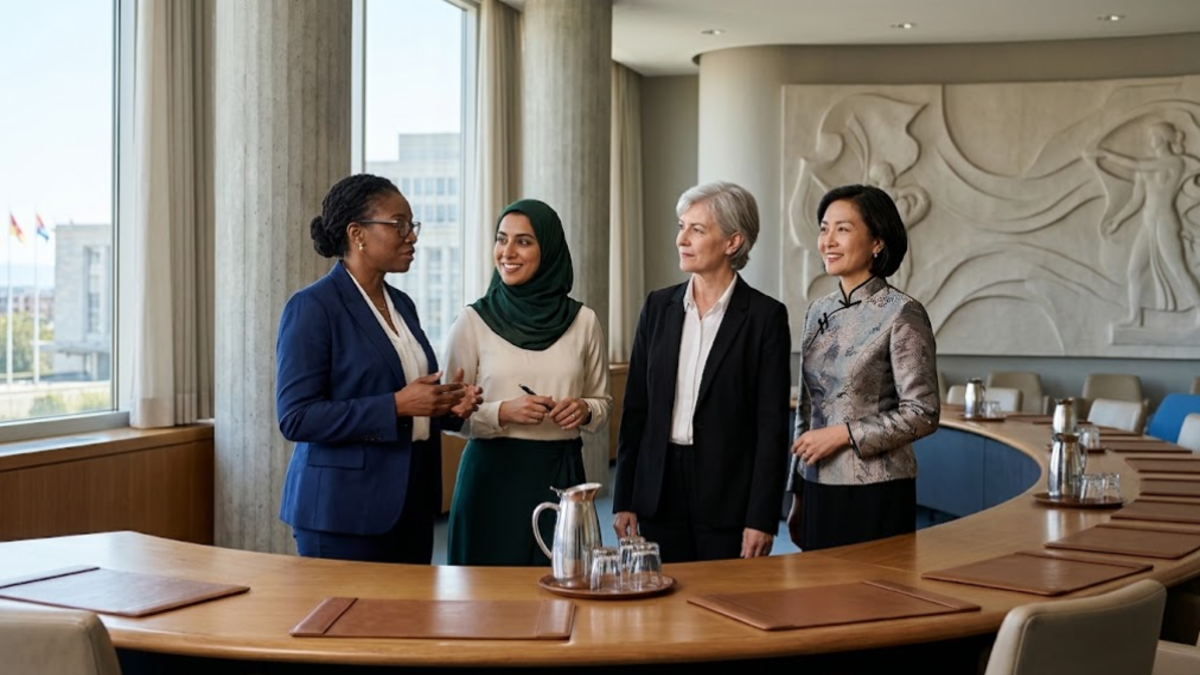
Women’s leadership, equality and the role of religious institutions in promoting women’s participation in public life took centre stage at an international gathering held at the United Nations Palais des Nations in Geneva on 29 October. The event, entitled Women, Leadership and the Paris Charter, brought together representatives of international human rights institutions, religious organisations and civil society to examine how principles of equality can translate into greater opportunities for women to lead and participate in decision-making.

Held during the 93rd session of the United Nations Committee on the Elimination of Discrimination against Women (CEDAW), the meeting connected international human rights standards with discussions about religious responsibility, social inclusion and women’s leadership.
At its centre was the Paris Charter, an initiative developed through a consultation process launched by the Grand Mosque of Paris in 2023. The discussion also introduced the Geneva Commitment for Women’s Leadership and Equality in Action, linking the debate to the wider objective of turning commitments into practical progress.

The Paris Charter, titled Islam and Citizenship, emerged from a multidisciplinary consultation initiated by Chems-eddine Hafiz, Rector of the Grand Mosque of Paris, in 2023.
The initiative brought together religious authorities and representatives of civil society to consider how Muslim religious discourse could engage with contemporary Western societies while respecting religious principles, citizenship and democratic values.
The resulting publication was released in February 2026. It contains three main elements:
The Paris Charter, setting out principles and recommendations.
A glossary explaining religious, historical, legal and sociological concepts.
Transcriptions of consultations with religious figures, academics, politicians and civil society representatives.
The Charter addresses several issues, including freedom of conscience, interreligious dialogue, equality between women and men, discrimination and extremism.
Its approach is particularly relevant to discussions about women’s leadership because it explicitly supports equality in rights and the participation of women in decision-making within Muslim institutions.
This is a significant dimension of the initiative: it places women’s participation within a broader discussion about citizenship, institutional responsibility and the relationship between religious convictions and fundamental rights.
Mosquée de Paris+1
The Geneva discussion took place against the background of an established international human rights framework.
One particularly relevant reference is the United Nations Committee on the Elimination of Discrimination against Women (CEDAW) General Recommendation No. 40, adopted on 23 October 2024.
The recommendation addresses equal and inclusive representation of women in decision-making systems. It calls for a shift towards 50-50 parity between women and men and recognises that women’s participation must extend across public and private institutions.
Its scope includes:
Political institutions and public administration.
Economic decision-making and corporate leadership.
International organisations and diplomatic representation.
Peace, security and governance.
The participation of women from different social and cultural backgrounds.
The recommendation also stresses that representation alone is insufficient. Women must have meaningful influence, equal opportunities to exercise authority and access to positions where decisions are actually made.
Docstore+1
This distinction is central to the debate surrounding the Paris Charter. Appointing women to visible positions does not automatically guarantee equality if institutional structures continue to limit their authority or participation.
Religious institutions can influence social attitudes, community relationships and the opportunities available to women.
Their involvement in discussions about equality is therefore relevant, particularly in communities where religious authorities play an important role in education, family life and public debate.
The United Nations’ Faith for Rights framework provides an additional reference for this engagement. Developed under the auspices of the Office of the High Commissioner for Human Rights, it establishes 18 commitments encouraging religious and civil society actors to promote human dignity, equality and human rights.
The framework recognises that religious beliefs and human rights can reinforce one another. It also encourages religious leaders to challenge discrimination and intolerance rather than allowing them to become justified through religious arguments.
ohchr.org
The Paris Charter’s approach connects with this wider framework by encouraging a discussion about how religious commitments can coexist with equality, citizenship and participation in contemporary societies.
However, meaningful progress requires more than declarations. Religious organisations must also examine their internal structures, leadership appointments, educational programmes and opportunities for women to exercise responsibility.
The 29 October meeting was organised by the Geneva Institute for Multilateralism, Human Rights & Faith (GIMHRF), within the framework of CEDAW’s 93rd session.
According to the Grand Mosque of Paris, the gathering included the participation of:
Nahla Haidar, Chair of the UN Committee on the Elimination of Discrimination against Women.
Chems-eddine Hafiz, Rector of the Grand Mosque of Paris.
Representatives of the Geneva Institute for Multilateralism, Human Rights & Faith.
Members of a French delegation of women leaders.
Representatives of international human rights and diplomatic institutions.
The programme formed part of a wider two-day visit by the Grand Mosque of Paris delegation to Geneva on 28 and 29 October.
During the visit, the Paris Charter was also presented to diplomatic and institutional representatives, including Deike Potzel, Ambassador of the European Union to the United Nations in Geneva, and representatives of France and Jordan.
On the second day, Chems-eddine Hafiz met Peggy Hicks, Director of the Thematic Engagement, Special Procedures and Right to Development Division at the Office of the UN High Commissioner for Human Rights. He presented her with the Charter.
These meetings placed the document within a wider international discussion about the relationship between religious engagement, human rights and equality.
Mosquée de Paris+1
One of the main challenges facing initiatives promoting women’s leadership is ensuring that commitments produce measurable results.
The Paris Charter provides a framework for discussion, but its wider influence will depend on how institutions interpret and implement its principles.
Several practical areas deserve attention:
1. Women’s participation in decision-making
Religious and civil society organisations can review their leadership structures to ensure that women have genuine opportunities to participate in institutional decisions.
2. Education and professional development
Training, mentoring and access to leadership opportunities can help women develop the experience and skills needed to assume positions of responsibility.
3. Institutional accountability
Organisations should be able to demonstrate how their commitments translate into policies, appointments and practical opportunities.
4. Cooperation with human rights institutions
Engagement with international organisations can help religious institutions connect their initiatives with established human rights standards.
5. Recognition of women’s diversity
Leadership opportunities should be accessible to women from different social, cultural and economic backgrounds, including those who face multiple forms of discrimination.
These priorities are consistent with the direction established by CEDAW General Recommendation No. 40, which calls for structural rather than merely symbolic changes in decision-making systems.
Docstore+1
Although the initiative originated with the Grand Mosque of Paris, its ambitions are not limited to France.
The institution has presented the Charter as a document that could be adopted, adapted or used as a reference by other Muslim institutions internationally.
Its potential relevance lies in addressing a question shared by many pluralist societies: how can religious identity, freedom of conscience, equal citizenship and women’s rights be respected within the same institutional framework?
The September communication from the Grand Mosque of Paris also highlighted the Charter’s reference in the UN Secretary-General’s report A/81/299, concerning efforts to combat religious intolerance, negative stereotypes and discrimination.
According to the institution, the report recognised the Charter’s emphasis on equality between women and men and the full participation of women in decision-making within Muslim institutions.
Mosquée de Paris
Nevertheless, international recognition should not be confused with formal adoption by the United Nations. The Charter remains an initiative originating from the Grand Mosque of Paris, rather than a UN convention or legally binding international instrument.
Its potential influence will depend on whether other institutions engage with its recommendations and translate them into meaningful changes.
The Geneva meeting offers a valuable opportunity to connect two areas that are sometimes discussed separately: religious engagement and women’s equality.
The editorial team considers that the Paris Charter’s most significant contribution is its willingness to address women’s rights and participation within a religious institutional framework, rather than treating these questions as matters belonging exclusively to political authorities or civil society organisations.
However, public commitments should be judged by their practical consequences.
Equality requires women to have access not only to educational and professional opportunities but also to positions where they can influence policies, shape institutional priorities and exercise authority.
The involvement of religious institutions in this process can be constructive when it is accompanied by transparency, accountability and respect for internationally recognised human rights standards.
Ultimately, the value of the Paris Charter will not be determined solely by its international visibility. Its lasting significance will depend on whether its principles encourage institutions to open decision-making structures, recognise women’s contributions and provide genuine opportunities for leadership.
1. Grand Mosque of Paris — At the Palais des Nations, the Grand Mosque of Paris defends women’s leadership and rights
https://www.grandemosqueedeparis.fr/post/au-palais-des-nations-la-grande-mosquee-de-paris-defend-le-leadership-et-les-droits-des-femmes
2. Grand Mosque of Paris — In Geneva, the Rector and his delegation promote the Paris Charter
https://www.grandemosqueedeparis.fr/post/a-geneve-le-recteur-et-sa-delegation-portent-la-charte-de-paris
3. Grand Mosque of Paris — Paris Charter cited in the UN Secretary-General’s report
https://www.grandemosqueedeparis.fr/post/communique-la-charte-de-paris-citee-dans-le-rapport-du-secretaire-general-des-nations-unies
4. Grand Mosque of Paris — Publication of the work on adapting religious discourse in Western societies
https://www.grandemosqueedeparis.fr/post/musulmans-en-occident-parution-des-travaux-du-groupe-de-reflexion-sur-l-adaptation-du-discours
5. United Nations CEDAW Committee — General Recommendation No. 40 (2024) on Equal and Inclusive Representation of Women in Decision-Making Systems
https://docstore.ohchr.org/SelfServices/FilesHandler.ashx?enc=CrhS01WdScmUT12VopKn23L58YXl6YjcSPDWDkdjast84rNZpKVg1vdAaeHC37KUxten%2FKjzJa5YrJAWyrTLag%3D%3D
6. Office of the UN High Commissioner for Human Rights — The Faith for Rights Framework
https://www.ohchr.org/Documents/Press/faith4rights-toolkit.pdf
….Read More
Contact: info@abnnews.net