Physical Address
304 North Cardinal St.
Dorchester Center, MA 02124
Physical Address
304 North Cardinal St.
Dorchester Center, MA 02124

Religions News Around the World
Religions News Around the World
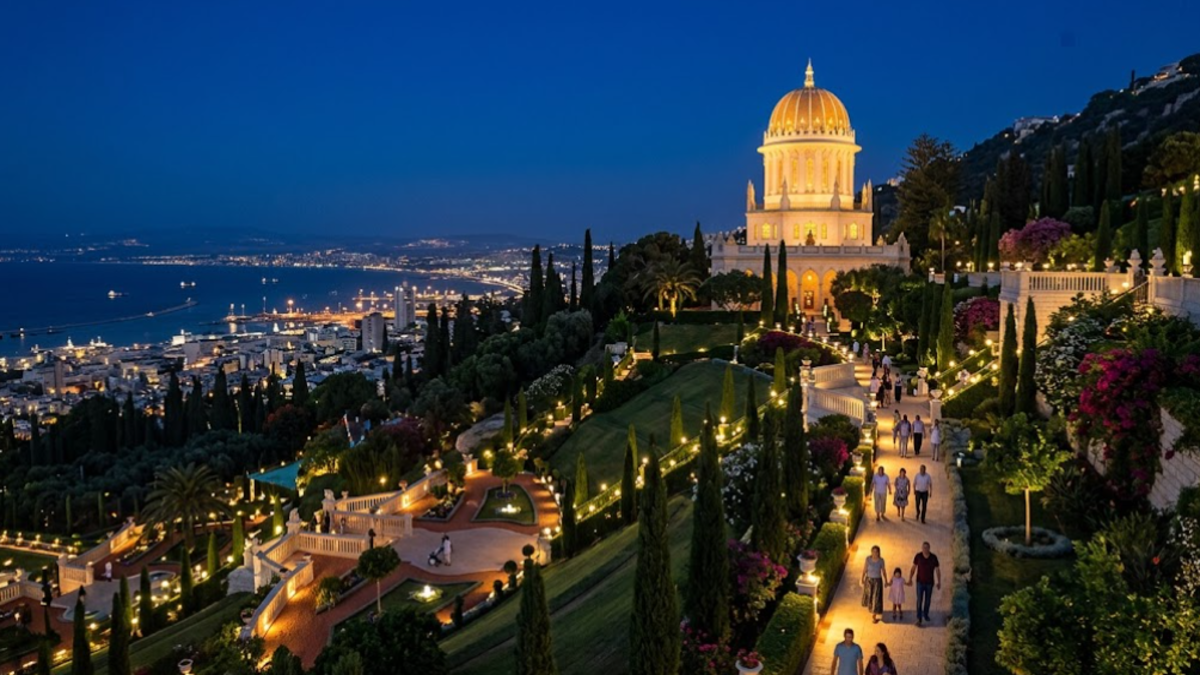
The illuminated terraces of the Shrine of the Báb on Mount Carmel in Haifa, Israel, welcomed close to 10,000 visitors over two evenings for Terraces by Night, an event celebrating beauty, spiritual reflection and human unity. Residents, international guests, families and dignitaries from diverse cultural, linguistic and religious backgrounds gathered to experience the gardens after dark, with many entering the Shrine for prayer and quiet contemplation.

As darkness settled over the mountain, lights traced the garden paths and illuminated the Shrine’s golden dome, transforming the terraces into a place of tranquillity and shared experience. For many visitors, the evening offered more than a chance to admire one of Haifa’s most recognisable landmarks. It became an opportunity to reflect on hope, peace and the connections that bring people together across differences.
The Shrine of the Báb occupies a central place in the Bahá’í Faith. The Báb, regarded by Bahá’ís as the Prophet-Herald of their religion, endured imprisonment and persecution before His execution in Iran in 1850. His remains were eventually brought to Mount Carmel, where they were laid to rest in 1909.

The contrast between that history and the Shrine’s illumination today gives the event a particular spiritual significance.
“The Báb, the Prophet-Herald of the Bahá’í Faith, endured long periods of imprisonment, at times deprived of even the light of a lamp,” said Ariane Sabet, Deputy Secretary-General of the Bahá’í International Community. Today, she observed, His Shrine shines forth as a place where people can experience togetherness and joy.
The symbolism of light was a recurring theme throughout the gathering. Visitors described it as a source of inspiration, an expression of hope and a reminder of humanity’s shared spiritual aspirations.
David Freeman, a representative of the Bahá’í International Community, reflected on light’s universal appeal, noting that it inspires and uplifts people regardless of their differences.
Over the two evenings, the event brought together people of different ages, backgrounds and beliefs. Families walked beneath towering cypress trees, while visitors explored the gardens, whose greenery and colourful bougainvillea took on a different character under the carefully arranged lighting.
The atmosphere encouraged people to slow down and appreciate their surroundings. Many entered the Shrine to pray, meditate or spend time in silence, while others enjoyed the gardens and the opportunity to meet people from different communities.
For Tjireya Tjitendero, Senior Advisor to the Bahá’í International Community, the gathering represents a meaningful opportunity for people to experience upliftment together. Reflecting on its development since its launch, she described Terraces by Night as a precious experience for those who travel from nearby communities and farther afield to attend.
The event’s appeal lies partly in its combination of spiritual significance and public participation. Rather than being limited to one community, it creates a setting in which people with different beliefs can share an experience of beauty and reflection.
Creativity also formed part of the programme. Art stations at the upper and lower entrances to the terraces invited visitors of all ages to create works inspired by illumination, hope and peace.
These activities gave children and adults a way to express their impressions of the evening. Alongside the illuminated gardens and opportunities for contemplation, the art stations helped make the gathering accessible to families and younger visitors.
Guests could also watch Vineyard of the Lord, a film introducing the history and teachings of the Bahá’í Faith and presenting an overview of Bahá’í Holy Places in the Haifa–‘Akká area.
Together, these elements offered different ways to engage with the occasion: through learning, artistic expression, personal reflection and conversation.
For many attendees, the most memorable aspect of the event was seeing people from different backgrounds sharing the same space in a spirit of appreciation.
Shai and Dafi, residents of Haifa, spoke about how moving it was to witness people finding common ground through a shared experience of beauty.
Dafi observed that sharing something beautiful with others can be uplifting, while Shai said that seeing unity alongside diversity gave her hope.
Eman, who travelled from ‘Akká, highlighted the fragrance of roses and the variety of trees in the gardens. She also appreciated the wider view of Haifa illuminated at night, describing the lights and atmosphere as a source of hope.
Nadi, a young man who invited his mother to attend, connected the experience with a broader purpose. He reflected on the importance of places that remind people of their common responsibility to love, unite and heal.
Tunes, who came from Tel Aviv, described the calm surrounding the gardens. For her, the illuminated landscape revealed beauty even in darkness, creating a feeling of light within the heart.
Although their experiences differed, the visitors shared a common appreciation for an environment that encouraged reflection and connection.
The event also highlighted the relationship between the Bahá’í Gardens and the wider city of Haifa.
Mayor Yona Yahav described the gardens as much more than a celebrated local attraction, calling them an integral part of the city’s identity and distinctive story. He said he had met thousands of visitors who came to enjoy the illuminated landscape and its special atmosphere.
Yahav also emphasised Haifa’s character as a city where different religions, cultures and communities live alongside one another. In his view, Terraces by Night reflected this diversity and the possibility of shared civic life.
The gardens have an international significance as well as a local one. The Shrine of the Báb and the Shrine of Bahá’u’lláh near ‘Akká were inscribed together on the UNESCO World Heritage List in 2008, recognising their outstanding universal value.
The terraces themselves combine landscape design, architecture and religious symbolism. Their illumination makes these features visible in a different way after dark, while the event gives residents and visitors an opportunity to experience the site in a setting centred on reflection and welcome.
The first Terraces by Night took place in 2019, marking the bicentenary of the birth of the Báb. What began as a special occasion has developed into a gathering that attracts visitors from nearby towns and cities as well as from farther afield.
Its central theme remains consistent: light as a symbol of spiritual insight, hope and the potential for greater understanding among people.
The event does not erase the differences among those who attend. Instead, it creates an opportunity to experience those differences alongside a shared appreciation for beauty, tranquillity and peace.
As visitors walked the illuminated paths, entered the Shrine or created artwork inspired by the evening, the terraces became a setting for both individual reflection and collective experience.
The significance of Terraces by Night therefore extends beyond its visual spectacle. Through the combination of sacred surroundings, public participation and encounters among people from diverse backgrounds, the gathering offers a practical reminder that beauty can open a space for dialogue, understanding and a renewed sense of hope.
1. Bahá’í World News Service — For bicentenary, Shrine of the Bab opens to thousands of visitors, community leaders — https://news.bahai.org/story/1365/bicentenary-shrine-bab-opens-thousands-visitors
2. The Bahá’í Faith — The Shrine of the Báb — https://www.bahai.org/the-bab/shrine
3. Bahá’í World — Symbols of Transformation: The Gardens and Terraces on Mount Carmel — https://bahaiworld.bahai.org/library/symbols-of-transformation/
….Read More
Contact: info@abnnews.net