Physical Address
304 North Cardinal St.
Dorchester Center, MA 02124
Physical Address
304 North Cardinal St.
Dorchester Center, MA 02124
Religions News Around the World
Religions News Around the World
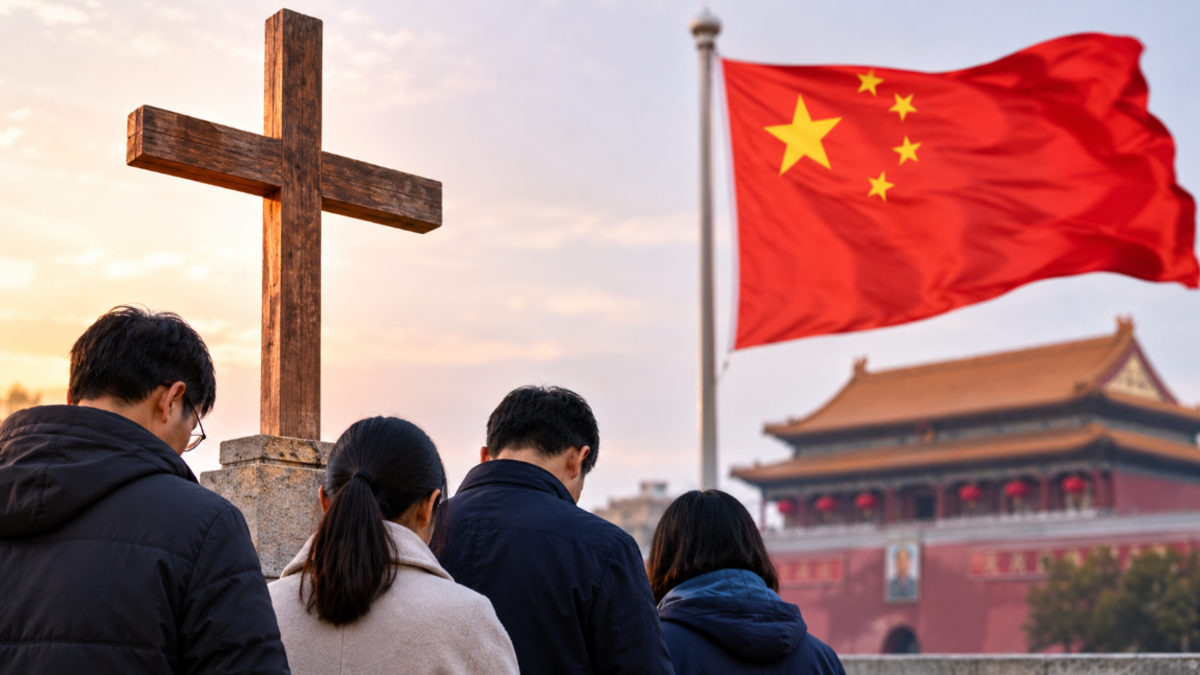
Religious freedom and the situation of Christians in China remain major human rights concerns, despite constitutional guarantees protecting the right to religious belief. Christians can attend officially registered churches, but religious activities outside the state-approved system face significant restrictions, including surveillance, administrative pressure and, in some cases, detention and imprisonment.

The central issue is not simply whether Christianity is permitted in China. It is the extent to which Christians can practise their faith, organise congregations, educate their children and conduct religious activities without being subjected to political control.
China’s official position is that religious freedom is protected by law and that religious affairs must be managed in accordance with national regulations. However, international religious freedom monitors report serious restrictions, particularly against Protestant house churches and Catholic communities that do not accept government oversight.

Article 36 of China’s Constitution explicitly recognises freedom of religious belief. It states that citizens have the right to hold religious beliefs and that government institutions and individuals must not force anyone to adopt or abandon a religion.
The same article also establishes limits on religious activities. It says the state protects what it considers normal religious activities and stipulates that religious organisations and religious affairs must not be controlled by foreign forces.
These provisions create an important distinction between the constitutional recognition of belief and the government’s regulation of how religion can be practised.
China officially recognises five religions:
Buddhism
Catholicism
Protestantism
Islam
Taoism
Religious organisations are expected to operate within the country’s regulatory framework and, generally, through officially recognised structures.
The government maintains that these requirements protect public order, national security and social stability. Critics argue that the regulations give authorities extensive power to restrict religious independence.
Christianity in China exists through two broad forms of religious organisation: officially registered churches and congregations that meet independently outside the state-approved system.
The officially recognised Protestant structure operates through the Three-Self Patriotic Movement and the China Christian Council. These organisations work within the government’s regulatory framework.
However, many Protestant Christians choose to worship in independent congregations commonly known as house churches. Some meet in private homes, while others have larger congregations and established religious communities.
Their lack of registration can expose pastors and members to administrative penalties, restrictions on meetings and, in more serious cases, criminal proceedings.
The situation has attracted particular attention from the U.S. Commission on International Religious Freedom (USCIRF). Its 2026 annual report, covering developments during 2025, documented continued arrests of members of underground churches and serious restrictions on independent religious activity.
Catholics in China also face a distinction between officially recognised and underground communities.
The Chinese Catholic Patriotic Association operates within the state-controlled religious system. Some Catholics, however, have historically maintained communities outside that structure because of disagreements concerning government involvement in Church affairs and the appointment of bishops.
The relationship between the Vatican and Beijing is particularly important.
In 2018, the Holy See and China reached a provisional agreement concerning the appointment of bishops. The agreement was intended to address a long-standing division between officially recognised and underground Catholic communities.
Nevertheless, the arrangement has not resolved all tensions. Human Rights Watch reported in April 2026 that underground Catholic communities continued to face pressure to join the officially recognised church, alongside surveillance and restrictions.
These developments illustrate that the challenges facing Christians in China are not limited to one denomination.
One of the most significant issues affecting religious communities is the Chinese Communist Party’s policy known as the Sinicization of religion.
The policy seeks to ensure that religious beliefs, institutions and practices conform to the country’s political, social and cultural framework as defined by the authorities.
The Chinese government presents Sinicization as a way to ensure that religions adapt to Chinese society and remain independent of foreign control.
However, USCIRF argues that the policy goes beyond cultural adaptation and imposes political requirements on religious organisations.
According to the commission, government authorities have sought to incorporate Communist Party ideology into religious institutions, influence religious leadership and control religious teaching.
For Christians, this raises fundamental questions about the independence of churches, the content of religious education and the freedom of pastors to preach without political interference.
The issue is particularly sensitive when government requirements conflict with Christian beliefs or the authority of religious institutions.
Developments involving several Protestant congregations illustrate the difficulties faced by Christians who refuse to operate under government-approved structures.
One prominent example is Zion Church, an independent Protestant congregation founded by Pastor Ezra Jin Mingri.
In October 2025, Chinese authorities detained nearly 30 pastors, preachers and members associated with the church in a coordinated operation across several locations. The case attracted international attention because of the scale of the arrests and the charges brought against church members.
There have since been important developments:
July 2026: Pastor Ezra Jin was released after more than 260 days in detention and reunited with his family in the United States.
Eight other Zion Church leaders: According to the Congressional-Executive Commission on China (CECC), these individuals remained in detention in its August 2026 report.
Early Rain Covenant Church: Authorities continued taking action against this independent Protestant congregation, including raids and detentions in June 2026.
Golden Lampstand Church: Its pastor, Yang Rongli, received a 15-year prison sentence in connection with a case in which authorities prosecuted members for alleged fraud.
These cases demonstrate why the release of an individual pastor should not automatically be interpreted as a broader improvement in religious freedom.
The CECC, a bipartisan commission established by the US Congress, reported that pressure on independent Protestant congregations continued even after Ezra Jin’s release.
The commission also documented the detention of church leaders Li Yingqiang and Dai Zhichao, who remained in custody in its August report.
The cases are particularly significant because they concern religious leaders and congregations whose activities are not necessarily associated with violence or public disorder, but with their decision to organise outside the state-approved religious system.
The challenges facing Christians extend beyond church buildings and Sunday services.
Religious education, access to Christian materials and the use of digital platforms are also subject to government regulation.
Religious activities involving minors are particularly sensitive.
According to USCIRF’s 2026 annual report, restrictions remain in place on minors participating in religious activities or receiving religious education, including within registered religious communities.
This creates difficulties for Christian families who want to introduce their children to the Bible, organise religious instruction or involve them in church activities.
For many believers, the issue concerns not only the right to attend religious services but also the ability to pass their faith on to the next generation.
Digital platforms have become another area of concern.
In September 2025, China’s National Religious Affairs Administration issued an Online Code of Conduct for Religious Clergy. According to USCIRF and the CECC, the rules tightened government control over religious expression on the internet, including online activities conducted outside government-approved websites.
The measures affect the ability of religious leaders to reach congregations through digital channels, publish religious content and organise online services.
The case of Zion Church attracted particular attention because the congregation had developed a substantial online presence and maintained connections with Christians in different parts of the country.
The growing use of digital technology therefore presents a new challenge for independent churches: religious communication that can reach people across geographical boundaries is also subject to state supervision.
China’s Constitution recognises freedom of religious belief, but international human rights standards also protect the freedom to manifest one’s religion individually or collectively, in public or private.
Article 18 of the Universal Declaration of Human Rights recognises the right to freedom of thought, conscience and religion. It includes the freedom to change one’s religion or belief and to manifest it through teaching, practice, worship and observance.
The International Covenant on Civil and Political Rights (ICCPR) provides further protection through Article 18. China has signed the covenant but has not ratified it. Consequently, it is important to distinguish its signature from full ratification and the obligations that follow from becoming a state party.
The central disagreement concerns the limits that governments may place on religious activity.
States can impose certain restrictions when they are necessary and legally justified to protect public safety, order, health, morals or the fundamental rights and freedoms of others. However, restrictions should not become a mechanism for compelling religious communities to accept a particular political ideology.
For Christians in China, the key question is whether religious communities can exercise their faith independently while respecting legitimate laws, without being required to subordinate their religious convictions to political objectives.
International religious freedom organisations argue that current restrictions frequently cross that boundary.
The Chinese government rejects accusations that it systematically persecutes Christians and other religious communities.
In its official white paper, China’s Policies and Practices on Protecting Freedom of Religious Belief, published in April 2018, the State Council Information Office maintained that citizens have the right to choose their religion, change their beliefs or remain non-religious.
The document also defended the principle of independence and self-management of religious affairs, arguing that religious organisations must not be subject to foreign control.
The government presents its regulatory approach as necessary to maintain social stability, prevent illegal activities and ensure that religious organisations comply with national laws.
This official position is an important part of the debate. However, the existence of constitutional guarantees and government statements does not, by itself, establish that religious freedom is fully respected in practice.
The available evidence from USCIRF, the CECC and human rights organisations points to continuing restrictions on independent Christian communities.
International attention has increasingly focused on religious freedom in China.
The U.S. Commission on International Religious Freedom recommended in its 2026 annual report that China be designated again as a Country of Particular Concern because of what it described as systematic, ongoing and particularly serious violations of religious freedom.
The recommendation is significant, but it must be distinguished from an official designation by the US Department of State.
The Congressional-Executive Commission on China has also documented arrests, restrictions on religious gatherings and pressure on independent Protestant congregations.
Human Rights Watch has raised concerns about the treatment of underground Catholic communities and the pressure placed on them to join officially recognised structures.
International organisations and religious freedom advocates have called for the release of people detained for peacefully practising their faith and for greater protection of religious independence.
Nevertheless, international criticism has not yet produced a fundamental change in the regulatory environment faced by independent Christian communities.
The situation of Christians in China highlights a fundamental distinction between recognising religious belief in law and protecting religious freedom in everyday life.
A person may be permitted to identify as Christian, but genuine religious freedom requires more than the ability to hold a private belief. It also includes the freedom to worship, organise a congregation, teach religious principles and maintain religious institutions without undue political interference.
From ABN News’ perspective, the treatment of independent Protestant churches and underground Catholic communities deserves continued international attention.
The release of Pastor Ezra Jin is a positive development for his family and congregation. However, the continued detention of other church leaders and the restrictions documented by international monitoring bodies demonstrate that the broader problem remains unresolved.
Religious communities should be able to operate peacefully without being forced to place political loyalty above their religious convictions.
Respect for national laws and public order does not remove a government’s responsibility to protect fundamental human rights.
The measure of religious freedom should ultimately be whether believers can practise their faith without fear of arbitrary detention, intimidation or discrimination.
Yes. Protestantism and Catholicism are among the five officially recognised religions. However, religious organisations are subject to government registration and supervision, and independent congregations face significant restrictions.
Yes. Christians can attend officially registered churches. However, independent Protestant and underground Catholic communities may face restrictions, surveillance and pressure from authorities.
House churches are Protestant congregations that operate outside the officially recognised religious structures. Some meet in private homes, while others have larger congregations. Their unregistered status can expose members and leaders to administrative or criminal proceedings.
Sinicization refers to the Chinese government’s policy of adapting religious institutions and practices to its understanding of Chinese society and national priorities. Critics argue that it also imposes Communist Party ideology on religious organisations and undermines their independence.
International monitoring organisations have documented cases involving pastors and Christians detained or imprisoned in connection with independent religious activities. Individual cases may involve different criminal allegations, and the circumstances and legal grounds should be examined separately.
1. State Council of the People’s Republic of China — Constitution of the People’s Republic of China, Article 36
https://english.www.gov.cn/archive/laws_regulations/2014/08/23/content_281474982987458.htm
2. State Administration for Religious Affairs — Regulations on Religious Affairs
https://www.sara.gov.cn/static/content/xxgk/flfg/2018-10-08/1306305917129588736.html
3. State Council Information Office — China’s Policies and Practices on Protecting Freedom of Religious Belief
https://english.www.gov.cn/archive/white_paper/2018/04/04/content_281476100999028.htm
4. U.S. Commission on International Religious Freedom (USCIRF) — 2026 Annual Report, China Chapter
https://www.uscirf.gov/sites/default/files/2026-03/USCIRF_2026_AR_3326_NEW.pdf
5. Congressional-Executive Commission on China (CECC) — China Monitor #7: China’s War on Religion: Pastor Jin Released as Suppression of House Church Worship Continues
https://www.cecc.gov/publications/china-monitor/china-monitor-7/
6. U.S. Commission on International Religious Freedom — U.S.-China Summit Must Address China’s Religious Freedom Repression, September 18, 2026
7. Human Rights Watch — China: Pressure on Catholics Escalates, April 15, 2026
https://www.hrw.org/news/2026/04/15/china-pressure-on-catholics-escalates
8. United Nations Treaty Collection — International Covenant on Civil and Political Rights: Status of China
https://treaties.un.org/pages/ViewDetails.aspx?chapter=4&mtdsg_no=IV-4&src=IND
9. Office of the United Nations High Commissioner for Human Rights — Universal Declaration of Human Rights, Article 18
https://www.ohchr.org/en/UDHR/Documents/60UDHR/DECLARATION.pdf