Physical Address
304 North Cardinal St.
Dorchester Center, MA 02124
Physical Address
304 North Cardinal St.
Dorchester Center, MA 02124
Religions News Around the World
Religions News Around the World
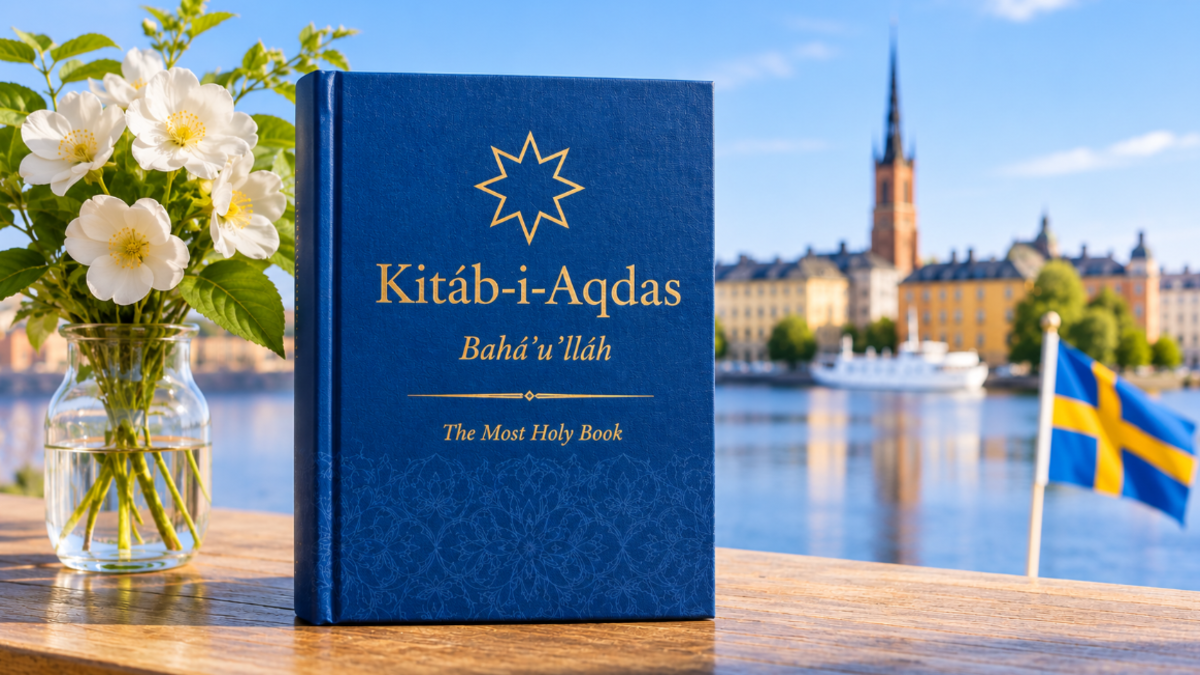
The Bahá’í community in Sweden has published the first complete Swedish translation of the Kitáb-i-Aqdas, the Most Holy Book of the Bahá’í Faith. The publication marks the culmination of more than three decades of translation work, making one of the faith’s central sacred texts available in its entirety to Swedish-speaking readers.

The announcement represents an important development for the preservation and accessibility of Bahá’í literature. It also reflects years of collaboration between translators, reviewers and members of Sweden’s Bahá’í institutions to ensure that the text conveys the meaning and literary qualities of the original Arabic.
The Swedish translation project has its origins in an earlier effort completed in 1994, when an initial version was translated from the authorized English edition of the Kitáb-i-Aqdas.

However, the work did not end there. Over the following decades, the Bahá’í community continued translating other sacred writings into Swedish, gradually building a foundation of terminology and linguistic experience that would support the preparation of a complete edition of the Most Holy Book.
The final translation required extensive examination of both language and meaning. Translators and reviewers repeatedly revisited passages, discussed questions concerning the relationship between the English rendering and the original languages, and worked to maintain consistency in important religious and theological terms.
According to the Bahá’í World News Service, approximately 15 people contributed to different stages of the undertaking.
The group was brought together by Sweden’s National Spiritual Assembly of the Bahá’ís and included translators and members of the Bahá’í Publishing Trust of Sweden.
Translating a sacred text involves more than finding equivalent words in another language. It requires conveying the meaning, tone and deeper implications of the original while ensuring that the result reads naturally in the target language.
Nader Stenberg, from the Bahá’í Publishing Trust of Sweden, explained that understanding the meaning must come first. He emphasized the importance of producing language that is accurate, fluent, beautiful and poetic enough to capture the different dimensions of the text.
This approach was particularly relevant to the Kitáb-i-Aqdas, whose religious laws and spiritual teachings are closely interconnected.
The translation process therefore involved collective consultation and repeated review rather than simply transferring the wording of an existing edition into Swedish.
The completed Swedish edition was announced during a five-day gathering attended by more than 200 participants. The event focused on family life and its role as a foundation for society.
The programme included a presentation on the history of the Kitáb-i-Aqdas and a discussion involving people who had participated in the translation.
The gathering provided an opportunity to consider how spiritual principles can influence everyday relationships, family life and wider social development.
The discussions also addressed the connection between personal spiritual growth and the responsibilities individuals have towards their communities.
Roland Stenberg, one of the translators, emphasized the value of studying the Bahá’í writings collectively. He explained that reading, discussing and reflecting on the texts can help people develop a deeper understanding of their teachings and apply that understanding in society.
His comments reflected a central idea associated with the publication: sacred writings are not intended simply to be preserved as historical or religious documents, but to provide guidance for individual and collective life.
The Kitáb-i-Aqdas is the principal book of laws of the Bahá’í Faith, written by Bahá’u’lláh in Arabic around 1873, while He was imprisoned in the city of ‘Akká, now in present-day Israel.
Known as the Most Holy Book, it sets out laws and spiritual principles concerning the relationship between human beings and God, as well as the responsibilities that shape individual and collective life.
Its contents extend beyond religious observances. The book addresses matters connected with family relationships, community life, moral conduct and the development of society.
The first authorized English translation was published in 1992. It was accompanied by explanatory notes, supplementary writings and a collection of questions and answers that help readers understand the text.
The Bahá’í Reference Library provides access to the English edition, including the complete text and supplementary materials.
The publication has significance beyond the completion of a long translation project. Making a sacred text available in a reader’s own language can help remove linguistic barriers to religious study and encourage a more direct engagement with its teachings.
For Swedish-speaking Bahá’ís, the complete edition provides access to the Most Holy Book without depending exclusively on translations into other languages.
It may also be of interest to researchers, students of religion and readers exploring the relationship between religious traditions, language and social development.
The experience of the Swedish translation team illustrates the complexity of this work. Accuracy is essential, but so are clarity, consistency and the ability to preserve the character of the original writing.
Nikan Bergsmo Namdar, Secretary of Sweden’s National Spiritual Assembly, connected the publication with the wider question of what sustains a flourishing society. She argued that institutions and social structures need a deeper spiritual foundation, describing spirituality as an essential force in transforming the human heart.
The publication therefore represents both a literary achievement and an opportunity for further reflection on the role of spiritual principles in contemporary society.
The Swedish publication forms part of a broader international effort to make Bahá’í sacred writings accessible to people in different linguistic and cultural settings.
Previous editions of the Kitáb-i-Aqdas in other languages demonstrate the importance attached to this work. The publication of the Swahili edition in Tanzania in 2024 and the Polish edition in 2024 are examples of similar efforts to expand access to the text.
These projects also demonstrate that translating religious literature is a continuing process involving linguistic expertise, theological understanding and cooperation between different contributors.
The Swedish edition adds another language to the growing body of translations, strengthening opportunities for readers to explore the teachings of Bahá’u’lláh in their own language.
The completion of the Swedish Kitáb-i-Aqdas is a significant achievement for the Bahá’í community and for the wider preservation of religious literature.
Beyond the practical benefit of making the text available in Swedish, the project demonstrates the value of long-term collaboration and careful translation. More than three decades of work have helped produce an edition intended to preserve both the meaning and literary character of an important sacred text.
From an editorial perspective, the most meaningful aspect of this achievement is its contribution to accessibility. Religious and philosophical writings become more approachable when readers can study them in their native language, without unnecessary linguistic barriers.
The publication also offers a reminder that translating a sacred work is not simply a publishing exercise. It is an intellectual and cultural undertaking that can connect generations of readers with ideas that continue to influence individual lives and communities.
1. Bahá’í World News Service (BWNS) — Bahá’í Most Holy Book published in Swedish — November 5, 2026
Read the original announcement
2. Bahá’í Reference Library — The Kitáb-i-Aqdas: The Most Holy Book
Read the official text and publication information
3. Bahá’í World News Service — Tanzania: Bahá’í Most Holy Book published in Swahili
Read the report on the Swahili edition
4. Bahá’í World News Service — The Kitáb-i-Aqdas: Bahá’í Most Holy Book published in Polish