Physical Address
304 North Cardinal St.
Dorchester Center, MA 02124
Physical Address
304 North Cardinal St.
Dorchester Center, MA 02124

Religions News Around the World
Religions News Around the World
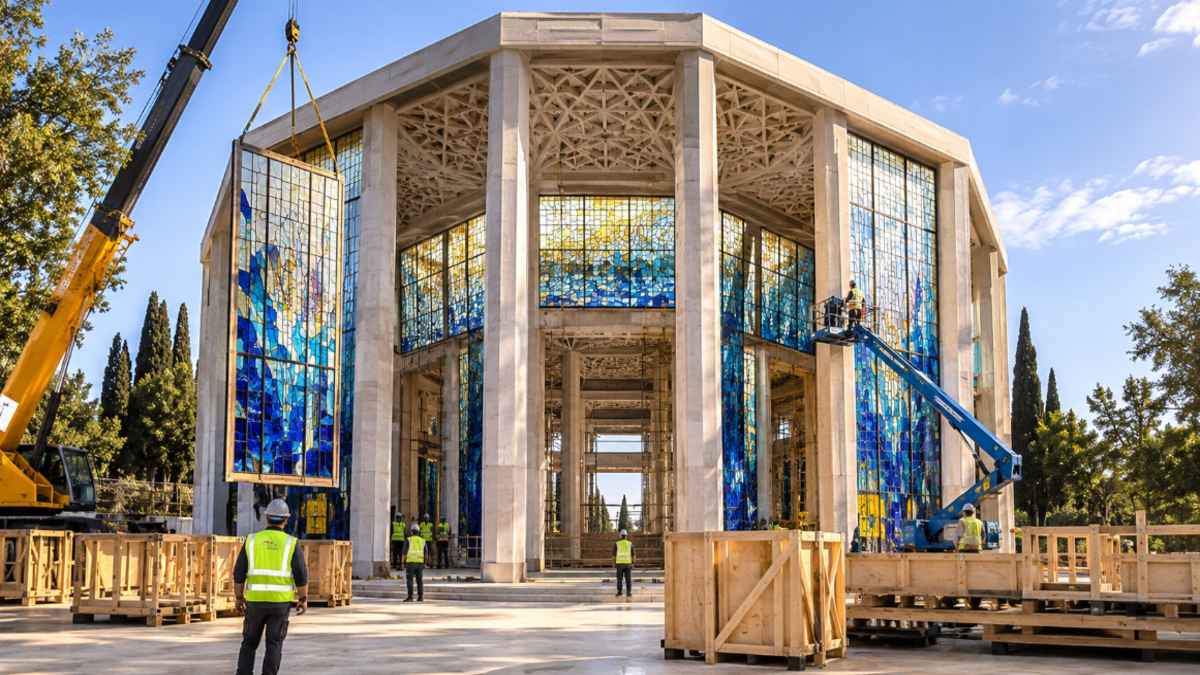
The installation of stained-glass panels has begun at the future Shrine of ‘Abdu’l-Bahá in Haifa, Israel, marking a significant milestone in the construction of one of the Bahá’í World Centre’s most important architectural projects.

Announced on November 23, 2026, by the Bahá’í World News Service (BWNS), the development brings a long-awaited element of the central edifice into place. The eight large glass panels will surround the building, combining distinctive colours and textures with a carefully designed balance between natural light and privacy.
The installation is taking place alongside ongoing marble work on the columns and skylights beneath the structure’s trellis ceiling.

The central building of the Shrine has an eight-sided design, with four sides containing doors and four without. The stained-glass panels will form an important part of its architectural appearance, enclosing the structure while allowing light to enter.
The panels have two different heights, adapted to the building’s openings:
Four doorless sides: The glass panels rise approximately 11 metres from the floor to the trellis ceiling.
Four sides above the doors: Shorter panels measure approximately 6 metres and extend upwards to meet the trellis.
The first installation phase covers four of the eight panels. These consist of two panels for the sides without doors and two positioned above entrances.
The arrangement is designed to integrate the glass into the overall structure rather than treat it as a separate decorative feature.
The stained glass has been developed through eight individual compositions, each with variations in the mixture, distribution and intensity of colour.
Khosrow Rezai, project manager for the Shrine, explained to BWNS that blue is the predominant colour, particularly in the lower sections. Higher up, the glass becomes more translucent and predominantly white, with selected touches of yellow incorporated into one of the panels.
The gradual transition is both an aesthetic and practical decision.
The deeper colours and textures near the base provide a more pronounced visual effect, while the lighter upper sections allow greater amounts of natural light to enter the building. This arrangement also helps maintain the privacy of people inside the Shrine.
The result is an architectural feature intended to combine visual beauty, illumination and the contemplative character of the sacred space.
The panels were designed and manufactured by artisans in several countries before being transported to the Bahá’í World Centre by land and sea.
Their size and weight make installation a particularly demanding operation, requiring specialist equipment and careful coordination.
The construction photographs released by BWNS show teams preparing the protective wooden crates, positioning lifting machinery and using vacuum equipment to handle the large glass surfaces.
The process requires precision to position each panel safely within the openings of the central edifice.
The largest panels, measuring more than 11 metres in height, illustrate the scale of the architectural work involved.
The stained-glass project is progressing in coordination with other construction activities at the central building.
Workers are continuing to install marble on the columns and on the skylights located beneath the trellis. These elements form part of the wider architectural composition, bringing together different materials, surfaces and sources of natural light.
The work follows earlier construction milestones, including the completion of the main concrete structure and the beginning of marble installation.
In June 2026, BWNS reported that the glass panels had already been fabricated and delivered to the construction site, awaiting installation by a specialist team. The commencement of the current installation phase therefore represents the next step in a process that has involved extensive preparation.
The Shrine of ‘Abdu’l-Bahá is being constructed as the place where His sacred remains will be interred.
For the Bahá’í community, ‘Abdu’l-Bahá holds a central spiritual position as the exemplar of the Bahá’í teachings, particularly their emphasis on love for humanity, unity and service to society.
The future Shrine is intended to welcome pilgrims and visitors, providing a place where people can approach its sacred threshold.
Speaking about the project’s significance, Rezai reflected on the personal connection that generations of people around the world have developed with ‘Abdu’l-Bahá.
He described the construction project as something that had already existed in people’s hearts long before physical construction began.
His remarks underline that the project is not viewed solely as an architectural undertaking. For many members of the Bahá’í community, it also represents the fulfilment of a deeply meaningful spiritual aspiration.
The beginning of the stained-glass installation marks substantial progress, but it does not mean that the entire Shrine is complete.
The first phase involves four panels, while the remaining glass elements form part of the wider installation programme. Marble work and other activities at the central edifice are also continuing.
BWNS has not announced a definitive opening date in its November 23 update. Consequently, the completion schedule and the date when pilgrims and visitors will be able to enter the Shrine should not be assumed.
Further updates are expected through the Bahá’í World News Service as construction advances.
The installation of the stained-glass panels is significant because it brings together several aspects of the Shrine’s design that have been developed over an extended construction period.
The combination of blue tones, translucent upper sections and carefully controlled natural light demonstrates how architectural decisions can serve both practical and spiritual purposes.
From our perspective, the most interesting feature is the relationship between light and privacy. Rather than simply adding colour to the building, the glass has been designed to influence the atmosphere inside while preserving the contemplative character of the space.
The international collaboration behind the panels also reflects the scale of craftsmanship involved in creating an architectural project of this importance to the worldwide Bahá’í community.
1. Bahá’í World News Service — Shrine of ‘Abdu’l-Bahá: Installation of stained glass begins — November 23, 2026
Read the original announcement and view construction photographs
2. Bahá’í World News Service — Shrine of ‘Abdu’l-Bahá: Intricate work on central edifice proceeds in earnest — June 10, 2026
Read the previous construction update
3. Bahá’í World News Service — Coverage of Construction Work of the Shrine of ‘Abdu’l-Bahá