Physical Address
304 North Cardinal St.
Dorchester Center, MA 02124
Physical Address
304 North Cardinal St.
Dorchester Center, MA 02124

Religions News Around the World
Religions News Around the World
HAIFA – ABN News: Bahá’í educational programs are helping young people in communities across India, Kenya and Zambia develop practical abilities, confidence and a stronger sense of responsibility toward the people around them. How are these efforts changing the way young people and their communities think about education, service and their future?

Experiences shared by participants from the three countries reveal a common pattern: education becomes more meaningful when young people are encouraged not only to advance academically, but also to consider how their knowledge can contribute to the well-being of their communities.
The experiences were discussed in a recent episode of the Bahá’í World News Service podcast series “In Conversation,” which examines the practical application of Bahá’í principles to efforts aimed at building peaceful societies.

The discussion brought together Victor Jidayi Mabale, an Auxiliary Board member from Kenya; Martha Moghbelpour, a member of the Bahá’í National Spiritual Assembly of India; Fungai Bangajena, an Auxiliary Board member in Zambia; and Vahid Kaumba, who participates in community-building initiatives in Zambia.
Their accounts describe communities in which families, elders, institutions and young people themselves are gradually taking greater responsibility for creating conditions in which youth can develop their abilities and contribute to collective progress.
In Kenya, the development of young people has increasingly become a concern shared by an entire village, according to Mr. Mabale.
He explained that village elders are beginning to recognize that they have a role in supporting younger generations, while families also contribute to creating an environment in which young people can develop their potential.
Religion, he said, can also play a role by reinforcing the understanding that every human being possesses inherent nobility.
That idea has practical consequences. Rather than viewing young people simply as recipients of education or support, the approach described in the podcast encourages them to become active participants in the development of their communities.
For Mr. Mabale, the experiences emerging in Kenya are part of a broader pattern visible in other parts of the world. Young people are learning to connect different areas of their lives, while communities are learning how to provide the conditions that allow those abilities to emerge.
The process does not depend exclusively on formal institutions. Families, community leaders, religious institutions and young people themselves all have a role.
This shared responsibility is also visible in the experience described from India, where a relatively small group of young people became involved in initiatives that eventually benefited a much wider section of their village.
Ms. Moghbelpour explained that community efforts often begin with only a handful of individuals.
In the Indian village she described, approximately ten young people were already involved in facilitating children’s classes and youth groups. Their activities took on a new dimension when schools closed during the pandemic.
Rather than allowing children to fall behind, the young people organized tutorial groups. The initiative addressed an immediate educational need while also revealing another challenge in the community: many children did not have books of their own.
The discovery prompted the group to consider a longer-term response.
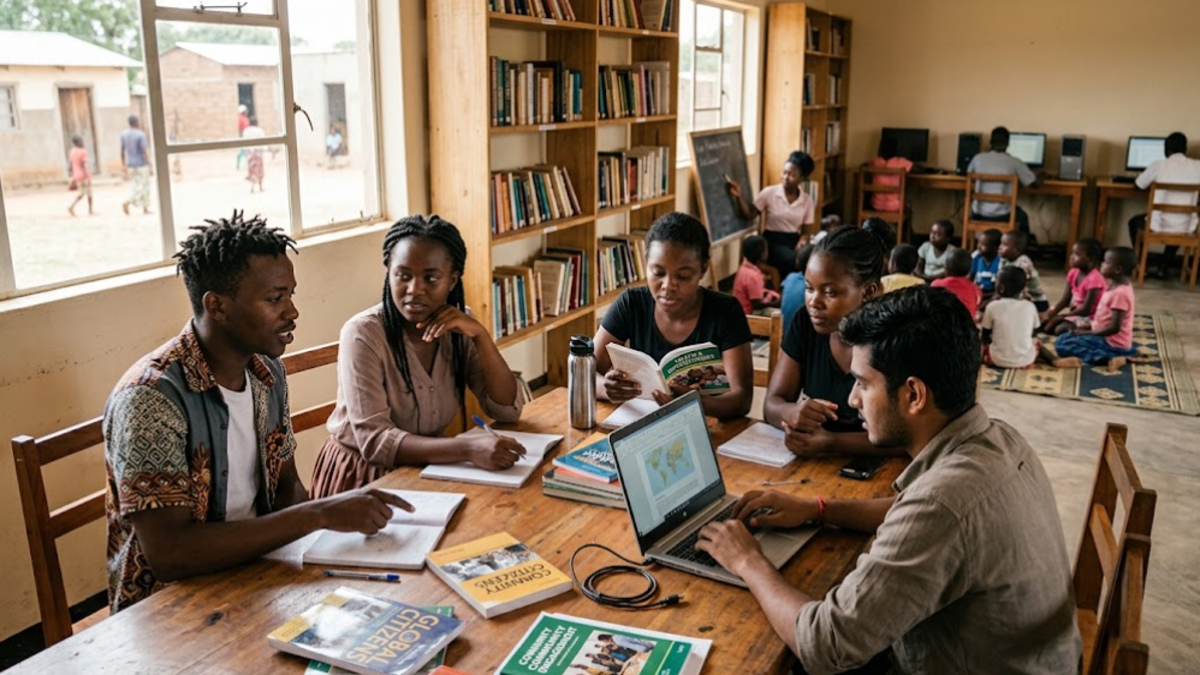
Once restrictions were eased, the young people invited families throughout the village to contribute books toward the creation of a community library. The initiative was not established as a project belonging to a small group alone. Parents and community leaders came together to discuss the purpose of the library and consider how it could serve the village.
That process of consultation helped give the wider community a role in establishing and using the facility.
The library subsequently developed into more than a place for books. Evening tutorial classes were held there, while groups of mothers began gathering to participate in spoken English classes.
The experience demonstrates how a response to one educational problem can create opportunities for other forms of learning.
It also illustrates the importance of young people taking initiative while receiving encouragement from the wider community.
The effects of the initiative extended beyond the original group of young people.
One participant decided to become a teacher and established a pre-primary school on the rooftop of his home. Another studied computer science and later completed a master’s degree before returning to his village to establish a computer center.
These developments reflect a wider understanding of education as something that can strengthen a community rather than simply provide an individual route toward employment.
The young people involved did not follow identical paths. Instead, their interests and studies developed into different forms of service.
For Ms. Moghbelpour, the most encouraging aspect is the interaction between youth initiative and community support.
She emphasized that progress becomes particularly exciting when communities and institutions create supportive conditions, but she also stressed that young people themselves take responsibility and help one another move forward.
The experience suggests that community development does not necessarily begin with large-scale projects or extensive resources. It can start with relationships, trust and a small number of people who decide to respond to a need around them.
That approach also creates space for young people to see themselves as contributors whose ideas and abilities can benefit others.
In Zambia, the discussion focused partly on the difficulties that young people can face when financial pressures affect their education.
Mr. Bangajena described how some young people in his village become discouraged during the early stages of their studies. Financial difficulties within their families can limit what they believe is possible, particularly when they receive little encouragement beyond their immediate homes.
However, conversations about the progress of young people have gradually become part of village life.
That change has helped communicate a different message to youth: support does not have to come only from their families. The wider community can also take an interest in their development.
The shift is significant because financial challenges can affect more than a student’s ability to continue studying. They can also influence a young person’s sense of possibility and confidence about the future.
When the community begins to regard the development of its young people as a collective concern, those individuals may begin to see themselves differently.
Instead of carrying the responsibility alone, they become part of a wider conversation involving families, community members and institutions.
The Zambian experience therefore reinforces a theme that appears throughout the podcast: creating opportunities for young people requires more than academic instruction. It requires an environment in which they are encouraged to persevere, reflect and consider how their abilities can serve others.
Mr. Kaumba described another dimension of the experience in Zambia.
Young people in his community are increasingly asking a fundamental question about their education: what is it ultimately for, and whom should it serve?
That reflection has influenced decisions about fields of study.
Some young people have reconsidered their academic direction after comparing their interests and studies with the needs of their villages. One example involved a young person who turned toward food science and nutrition with the health of the community in mind.
Such decisions can also influence others.
When young people begin to connect their education with the practical needs of their communities, their choices can stimulate similar reflection among their peers.
The emphasis is not simply on selecting a profession. It is on developing an understanding of how knowledge and skills can contribute to collective well-being.
That perspective gives education a broader social purpose.
Academic achievement remains important, but it becomes connected to questions of responsibility, service and the needs of others.
The experiences described in Zambia show how these conversations can gradually influence the choices young people make and the way they understand their relationship with their communities.
Across Kenya, India and Zambia, the accounts share several similarities despite the different circumstances in which they emerged.
Mr. Mabale observed that the stories from different places appear to contain a common thread. Young people are advancing while learning to think coherently about different aspects of life, while communities are also learning how to provide conditions that allow their potential to develop.
This relationship between individual growth and community development is central to the experiences discussed in the podcast.
Young people are not treated as passive beneficiaries of community action. They contribute to identifying needs, organizing responses and developing initiatives.
At the same time, the community does not leave them to manage these challenges alone.
Parents, elders, institutions and other residents become part of an environment that encourages young people to continue learning and serving.
The Indian library provides one example of this interaction. A group of young people responded to an educational challenge, families contributed books, and parents and community leaders participated in discussions about how the library should function.
The resulting facility then supported additional activities, including tutorials and English classes.
The experience shows how an initiative can evolve when different sections of a community participate in shaping it.
The stories also point to the importance of creating opportunities for young people before their potential becomes constrained by discouragement or a lack of resources.
In Kenya, community elders are increasingly recognizing their responsibility toward youth. In India, young people have turned friendships and educational activities into initiatives benefiting children, mothers and other residents. In Zambia, communities are beginning to discuss how young people can receive broader support and how education can respond to local needs.
Although the circumstances differ, each experience places relationships at the center of progress.
The approach described by the participants does not present education as an isolated activity taking place only in classrooms.
Learning takes place through children’s classes, youth groups, tutorial sessions, language classes, university studies and practical initiatives such as schools and computer centers.
It also takes place through consultation and reflection.
Young people learn by responding to real circumstances, while communities learn by examining how they can better support the younger generation.
This creates a process in which educational development and community development reinforce each other.
The podcast discussion highlights several qualities that can emerge when young people are encouraged to connect learning with service.
They develop practical abilities by organizing classes, establishing initiatives and responding to needs around them.
They also develop attitudes of responsibility, cooperation and perseverance.
The examples from India illustrate how young people responded to the disruption caused by school closures rather than simply waiting for conditions to improve. Their tutorial groups helped children continue learning, and the experience led them to identify the shortage of books as another issue requiring attention.
In Zambia, young people’s consideration of fields such as food science and nutrition demonstrates another form of reflection: education can be evaluated according to how it responds to the needs of others.
In Kenya, meanwhile, the growing involvement of village elders demonstrates that supporting youth can become a shared responsibility rather than an issue left entirely to individual families.
These experiences suggest that the development of young people can influence the development of the wider community at the same time.
The accounts shared by the participants ultimately present youth development as a collective process.
Young people need opportunities to learn, but they also need relationships that encourage them to persevere and environments in which their efforts can have practical consequences.
Communities, meanwhile, benefit when young people apply their knowledge and energy to challenges that affect everyone.
The examples from the three countries show that this process can begin on a modest scale.
A small group can organize tutorial classes. Families can contribute books. Parents and community leaders can consult about a library. A young person can establish a school at home. Another can return after advanced studies to create a computer center.
Each initiative responds to a specific circumstance, but together they illustrate a broader pattern.
Education can become a means through which young people understand their own abilities, identify the needs around them and develop the confidence to act.
The podcast episode forms part of the “In Conversation” series, which brings together individuals exploring the practical application of Bahá’í principles in efforts to build peaceful societies.
What are Bahá’í educational programs?
They include educational and community-building activities that help young people develop qualities, attitudes and practical abilities connected with service to others.
Which countries are featured in the discussion?
The experiences discussed come from India, Kenya and Zambia.
How are young people contributing to their communities?
They are facilitating classes, organizing tutorials, creating educational facilities and considering how their studies can address local needs.
What is the main message of the discussion?
The participants emphasize that young people and their communities can work together to create conditions that allow youth potential to develop and contribute to collective well-being.
… Read more
Contact: info@abnnews.net