Physical Address
304 North Cardinal St.
Dorchester Center, MA 02124
Physical Address
304 North Cardinal St.
Dorchester Center, MA 02124
Religions News Around the World
Religions News Around the World
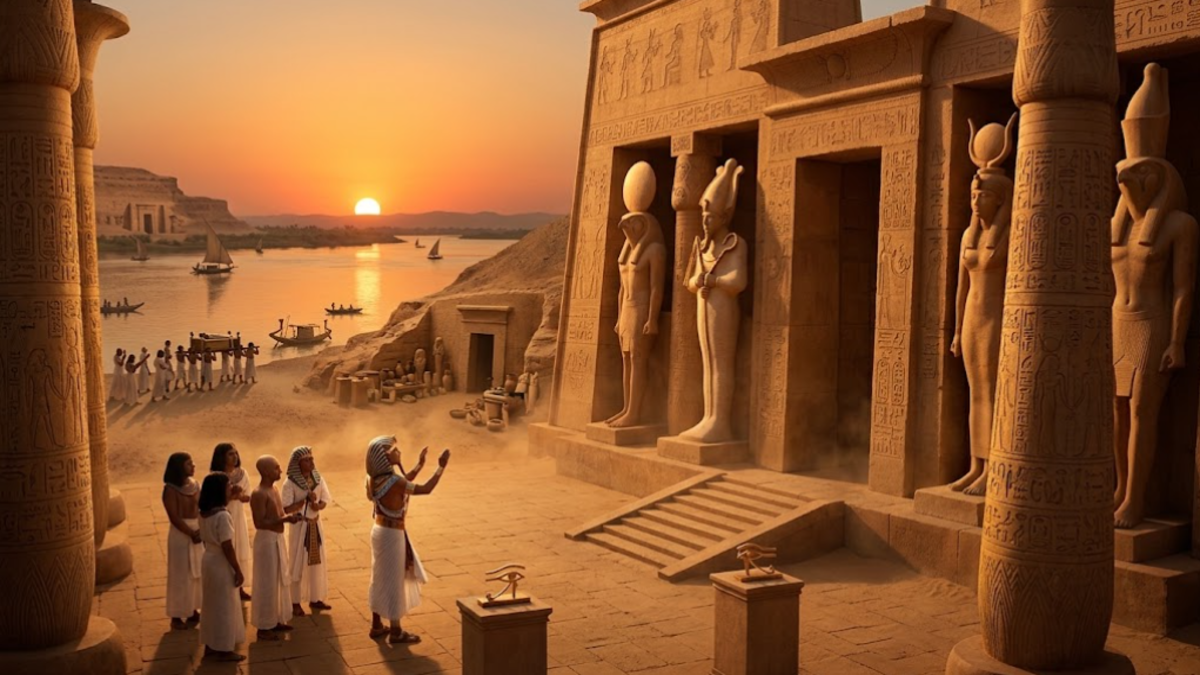
Cairo – ABN News: History of Ancient Egyptian Religion

The History of Ancient Egyptian Religion stretches across thousands of years and reveals a civilization in which gods, kings, temples, death and the natural world formed a single religious system. Ancient Egyptians did not follow one fixed creed throughout their history. Their beliefs changed as cities gained influence, dynasties rose and fell, and new gods entered the religious landscape.
Recent archaeological discoveries are also giving researchers fresh evidence about how Egyptians understood death and the afterlife. Excavations at Marina El Alamein, for example, have uncovered tombs and funerary objects showing how Egyptian traditions continued to interact with Greek and Roman customs long after the pharaonic period.

From the worship of the sun god Ra to the powerful cult of Osiris and the enduring popularity of Isis, what can the latest archaeological evidence tell us about the long and complex History of Ancient Egyptian Religion?
Religion was deeply connected to the environment in ancient Egypt. The Nile provided water, food and transportation, while the annual flood supported agriculture. The sun determined the rhythm of daily life, and the desert represented a stark contrast to the fertile river valley.
Egyptian religious thought therefore connected divine power with natural forces. Gods could represent the sun, the sky, fertility, death, childbirth, wisdom, war or the Nile itself.
One of the most important ideas was ma’at, a concept associated with order, balance, truth and justice. Egyptians believed that the universe required constant maintenance. Human beings, rulers and gods all had roles in preserving this balance.
The pharaoh occupied a special position within this system. He was not simply a political leader. Royal authority had a religious dimension, and the king was expected to maintain harmony between the human and divine worlds.
The Egyptians created numerous local religious traditions. A god who began as a local deity could eventually become nationally important. This helps explain why the Egyptian pantheon contains so many gods and why their importance changed over time.
The ancient religious system was therefore not a simple list of gods. It was a network of beliefs that evolved alongside Egyptian society.
Ancient Egyptian religion contained several creation traditions rather than one universally accepted story. Different religious centers developed their own explanations of how the universe began.
At Heliopolis, the ancient city known as Iunu, the creator god Atum played a central role. Egyptian religious texts associated Atum and the sun with the emergence of the world from the primordial waters known as Nun.
The Egyptian Ministry of Tourism and Antiquities notes that Heliopolis was an important center of solar worship and that its religious traditions connected Ra-Atum with the creation of the gods Shu and Tefnut, followed by Geb and Nut.
Geb represented the earth, while Nut represented the sky. Their relationship became part of a larger divine family that included Osiris, Isis, Seth and Nephthys.
Other cities developed their own theological systems. Memphis emphasized Ptah, a creator deity associated with craftsmanship and intellectual creation. Thebes elevated Amun, who eventually became one of the most powerful gods in the Egyptian religious world.
These traditions did not necessarily replace one another. Egyptians could accept several creation stories at the same time because religious thought was flexible and often combined different divine identities.
This flexibility became one of the defining characteristics of Egyptian religion.
The sun occupied a central position in Egyptian religious thought. Each day, the sun appeared to travel across the sky before disappearing in the west. Egyptians interpreted this cycle through religious imagery involving death, darkness and rebirth.
Ra became one of the most prominent solar gods. He could also be combined with other deities, producing forms such as Amun-Ra and Ra-Horakhty.
Solar symbolism appeared throughout Egyptian architecture. Obelisks represented rays of sunlight, while temple orientations often reflected cosmic ideas.
At Abu Simbel, for example, the temple of Ramesses II contains a sanctuary where sunlight reaches the innermost statues on particular days of the year. The official Egyptian monuments authority describes the sanctuary as containing Amun-Ra, Ra-Horakhty, Ptah and a deified form of Ramesses II.
The relationship between the sun and kingship was equally important. Pharaohs associated themselves with divine power and presented their rule as part of the cosmic order.
The sun’s daily disappearance and return also offered Egyptians a powerful metaphor for resurrection.
Few stories had a greater influence on Egyptian funerary religion than the story of Osiris.
Osiris was associated with kingship, death and regeneration. According to the mythological tradition, Seth attacked Osiris and took his life. Isis, the wife of Osiris, played a central role in restoring him and protecting their son Horus.
The story gave religious meaning to death. The deceased could hope for renewal, just as Osiris experienced restoration.
Isis became one of the most important goddesses in Egyptian history. She was associated with motherhood, protection and magical power, while Horus became closely connected with kingship.
The relationship between Isis, Osiris and Horus also helped explain the religious role of the pharaoh. The living king could be associated with Horus, while deceased kings were connected with Osiris.
The influence of this tradition survived for centuries. The temple complex at Philae, dedicated largely to Isis, remained an important center of worship long after many earlier Egyptian temples had declined. The Egyptian Ministry of Tourism and Antiquities records that the temple remained active until the reign of the Byzantine emperor Justinian I and preserves one of the last dated hieroglyphic inscriptions.
The endurance of the Isis cult demonstrates how resilient Egyptian religious traditions could be.
Ancient Egyptian temples were not simply places where ordinary people gathered for weekly worship. Many functioned as sacred institutions in which priests performed rituals intended to sustain relationships between humans and the gods.
Priests purified themselves before entering restricted areas. They presented food, clothing and other offerings to divine images. Ritual activity followed carefully established traditions.
Karnak provides one of the clearest examples of this religious system. The vast complex at Thebes developed over many centuries and became a major center of the cult of Amun.
The official Egyptian monuments authority describes Karnak as a complex containing several temple precincts, including those associated with Amun, Mut and Montu. It also notes the importance of the Opet Festival, during which sacred processions connected Karnak with Luxor Temple.
The temple itself represented a model of the cosmos. Its architecture, religious imagery and rituals all contributed to the idea that the temple was a bridge between the human and divine worlds.
The priesthood also accumulated wealth and influence. As major temples received land, offerings and royal support, religious institutions became important economic and political forces.
The Middle Kingdom brought major changes to Egyptian religious life.
The period followed political fragmentation and the reunification of Egypt under rulers associated with Thebes. The rise of Thebes increased the importance of its local god, Amun.
According to the Egyptian Ministry of Tourism and Antiquities, evidence for Amun’s major cult center at Karnak dates to the Middle Kingdom, after which the temple became one of the wealthiest religious establishments in Egypt.
The period also saw continuing development of beliefs surrounding death and the afterlife.
Funerary practices were never static. Egyptians modified burial customs, texts and objects over time. Religious literature expanded, and ideas about the individual’s journey after death became increasingly detailed.
The deceased needed protection from dangers in the afterlife. Amulets, spells, coffins and funerary texts all formed part of this protective system.
Religion therefore influenced not only temples but also household practices and burial traditions.
During the New Kingdom, Egypt became a major power in the ancient Near East. Wealth generated by the empire supported monumental construction, particularly at Thebes.
Amun became exceptionally powerful during this period. His priests controlled substantial resources, while kings repeatedly expanded temples dedicated to him.
The Egyptian monuments authority identifies Karnak as the principal center of the Theban cult of Amun and notes that successive rulers added buildings, ritual equipment and other features to the complex.
This period also produced some of Egypt’s most famous temples and tombs.
At Deir al-Bahari, royal mortuary complexes connected kingship, death and divine worship. The area itself was sacred to Hathor, a goddess strongly associated with motherhood, protection and royal symbolism.
The temple of Hatshepsut illustrates this relationship. The monument served a funerary purpose while also presenting the queen’s authority through religious imagery and association with the gods.
Religion and politics were therefore inseparable in royal Egypt.
One of the most unusual episodes in Egyptian religious history occurred during the reign of Akhenaten.
The king promoted the Aten, the visible solar disk, and reduced the traditional prominence of many other gods. He established a new royal center at Akhetaten, modern Amarna.
The change disrupted established religious institutions, particularly the powerful priesthoods associated with traditional gods.
After Akhenaten’s death, later rulers restored many older religious traditions. The cults of gods such as Amun returned to prominence, and references to Akhenaten’s religious reforms were deliberately removed from numerous monuments.
The episode demonstrates that Egyptian religion could change dramatically when royal authority intervened.
At the same time, it shows that religious traditions had deep institutional roots. The restoration of the older gods indicates that Egyptian society did not permanently abandon its established religious framework.
Death was one of the central concerns of Egyptian religion.
Egyptians believed that a person’s existence continued beyond physical death, but successful passage into the afterlife required preparation. Bodies were preserved, tombs were equipped with objects, and religious texts provided protection and guidance.
Mummification became an important part of this process. The preservation of the body reflected the belief that physical remains remained connected to the person’s continued existence.
Recent archaeological discoveries continue to reveal how varied Egyptian funerary traditions could be.
At Marina El Alamein, archaeologists uncovered 18 tombs dating to the Ptolemaic and Roman periods, along with funerary objects that included gold sheets placed in the mouths of some deceased individuals. Reports describe these objects as “golden tongues,” associated with the idea of enabling the dead to speak in the afterlife. A rare gold Eye of Horus amulet was also found.
The discoveries are particularly significant because they demonstrate the survival of Egyptian religious concepts during periods when Greek and Roman cultural influence was strong.
Funerary religion did not simply disappear when foreign rulers took control of Egypt. Instead, local traditions interacted with new beliefs.
Alexander the Great’s conquest of Egypt began a new phase in the country’s religious history. Greek rulers governed Egypt while adopting many aspects of Egyptian royal and religious traditions.
This produced an increasingly complex religious environment.
Egyptian gods were sometimes identified with Greek deities. New combinations emerged, while traditional Egyptian gods continued to receive worship.
The Ptolemaic and Roman periods provide especially strong evidence of religious blending.
Marina El Alamein offers a vivid example. Archaeologists have found Egyptian funerary features alongside objects connected with Greek and Roman culture, including material associated with Aphrodite. The site reflects the multicultural character of an important Mediterranean city.
The golden tongue discoveries add another dimension. They show that older Egyptian beliefs concerning the afterlife could remain meaningful even as cultural influences changed.
This religious adaptability helps explain why Egyptian traditions survived for so long.
Ancient Egyptian religion did not end suddenly.
Some temples remained active during the Greek and Roman periods. Priests continued to perform rituals, traditional gods remained part of local religious life, and temples received additions from foreign rulers.
Edfu Temple, dedicated to Horus, illustrates this continuity. Construction began under Ptolemaic rule and continued for generations before the temple was completed. Its reliefs and inscriptions preserve a detailed picture of Egyptian religious traditions during a period of strong Greek influence.
Philae provides another example of religious endurance. The cult of Isis remained active into the late Roman period, making it one of the last major Egyptian religious traditions to survive before the spread of Christianity transformed the country’s religious landscape.
The transition was gradual. Some Egyptian temples were closed or converted into Christian places of worship, while older religious imagery was sometimes removed or altered.
By the end of antiquity, the temple-centered religious system that had shaped Egyptian civilization for millennia had largely disappeared.
Yet its influence did not vanish.
The History of Ancient Egyptian Religion remains one of the most closely studied subjects in archaeology because it connects political power, art, architecture, language and everyday life.
Every new excavation can add another piece to that story.
Recent work at Egyptian archaeological sites continues to demonstrate that religious traditions were not frozen in one period. Discoveries from coastal cemeteries, temples and urban centers reveal how beliefs changed while retaining important older elements.
The evidence also challenges the idea that ancient Egyptian religion was a simple collection of myths about animals and gods. It was a sophisticated system that addressed questions about creation, justice, kingship, death, rebirth and the structure of the universe.
Temples provided institutions for worship. Priests maintained rituals. Kings presented themselves as guardians of cosmic order. Families prepared the dead for another existence.
At the center of these traditions was the belief that life, death and renewal formed part of a larger cosmic cycle.
That idea explains the extraordinary attention Egyptians devoted to temples, tombs, statues and funerary objects. It also explains why their religious traditions continued to evolve for thousands of years.
Modern archaeology is still uncovering evidence that makes this history more complicated and more human.
The discovery of a golden funerary tongue, a protective Eye of Horus amulet or a temple inscription is not merely an isolated archaeological curiosity. Each object provides evidence about what people feared, hoped for and believed would happen after death.
That is why the ancient Egyptian religious tradition continues to attract scholars and the public alike.
Ancient Egyptian religion centered on maintaining cosmic order, honoring the gods and preparing for continued existence after death.
There was no single god who remained supreme throughout all periods. Ra, Amun, Osiris, Isis and Horus were among the most influential deities at different times and places.
Temples served as sacred centers where priests performed rituals, presented offerings and maintained the relationship between the divine world and Egyptian society.
Yes. Traditional Egyptian religious practices continued for centuries under Greek and Roman rulers, often blending with foreign religious traditions before gradually declining during the spread of Christianity.
… Read more
Contact: info@abnnews.net