Physical Address
304 North Cardinal St.
Dorchester Center, MA 02124
Physical Address
304 North Cardinal St.
Dorchester Center, MA 02124

Religions News Around the World
Religions News Around the World
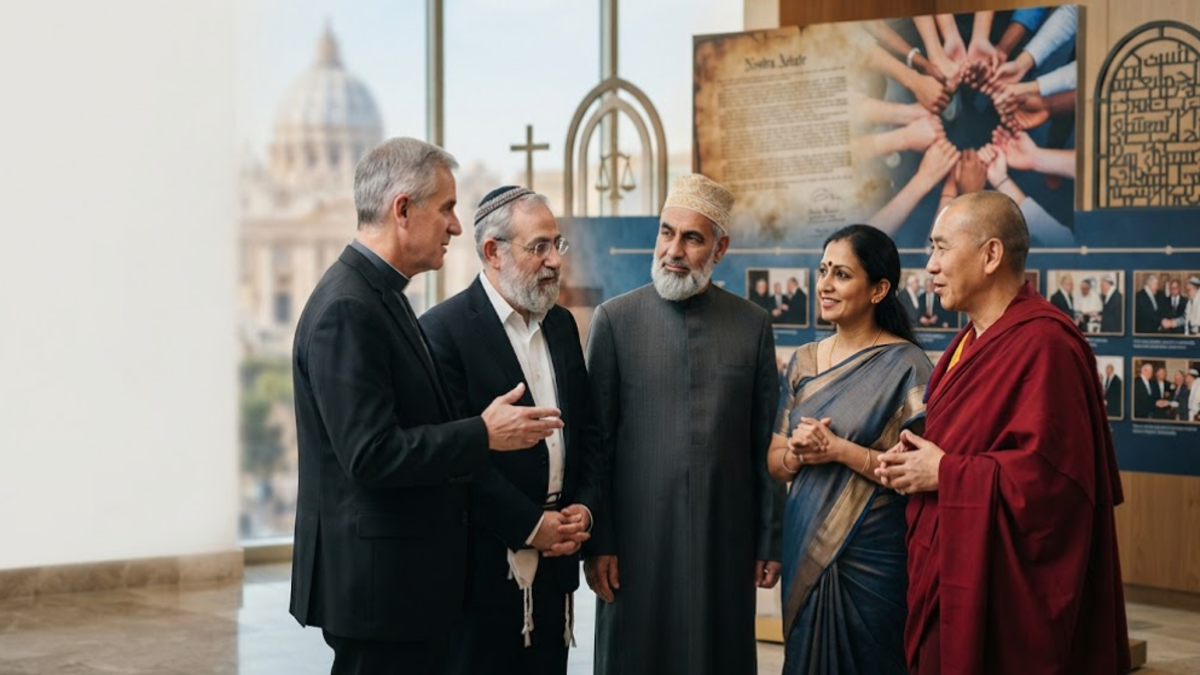
Sixty years after the Second Vatican Council adopted Nostra Aetate, the Catholic Church’s relationship with other religions looks markedly different. The short declaration, approved on 28 October 1965, helped move Catholic engagement with Jews and other religious communities toward a model based on respect, dialogue and cooperation. In September 2026, three Vatican dicasteries published a new assessment describing the declaration as having “opened a new chapter” in relations between Catholics, Jews and followers of other faiths.

The transformation has been especially visible in Catholic-Jewish relations, but it has also extended to Muslims, Hindus, Buddhists, Sikhs, Jains, Zoroastrians and followers of other traditions. Yet the Vatican’s latest assessment also makes clear that dialogue remains unfinished, with religious extremism, war, migration, secularization and social tensions continuing to test relations between faith communities.
Nostra Aetate, formally the Declaration on the Relation of the Church to Non-Christian Religions, was one of the Second Vatican Council’s key texts on relations with other faiths.

The declaration stated that the Church rejects nothing that is true and holy in other religions and called on Catholics to approach followers of other traditions with respect. It addressed Judaism, Islam, Hinduism and Buddhism while also expressing a broader rejection of discrimination based on religion.
Its section on Judaism was particularly significant.
The declaration emphasized the spiritual relationship between Christians and Jews, rejected collective responsibility of Jews for the death of Christ and condemned antisemitism. The Vatican’s 2026 anniversary document notes that the text originally emerged from efforts to address the consequences of antisemitism and the Holocaust before expanding into a wider framework for interreligious dialogue.
That historical starting point matters. Nostra Aetate was not simply a statement about being polite toward other religions. It represented a reassessment of how Catholics should understand and relate to people whose religious traditions differ from their own.
One of the clearest changes since Vatican II has been the creation of permanent structures for interreligious engagement.
Dialogue became increasingly organized through Vatican institutions, meetings between religious leaders, theological exchanges, educational initiatives and joint statements. The Vatican’s current Dicastery for Interreligious Dialogue continues this work and publishes regular messages and documents concerning relations with different religious traditions.
The change can therefore be measured not only through official language but through institutional practice.
Interreligious dialogue became something that could be sustained over decades rather than an occasional meeting between individual religious leaders.
The impact of Nostra Aetate is particularly clear in Catholic-Jewish relations.
The declaration established a new theological foundation for recognizing Christianity’s relationship with Judaism. Subsequent decades brought further Vatican documents and initiatives addressing Jewish-Christian relations, antisemitism and the Holocaust.
Pope Leo XIV reaffirmed this direction during the 60th-anniversary commemoration in October 2025, saying that the Church does not tolerate antisemitism and that it must be confronted because of the Gospel itself.
The significance goes beyond relations between religious institutions. It also influenced Catholic education and public discourse by encouraging Catholics to understand Judaism through the shared biblical heritage rather than inherited stereotypes.
The Vatican’s latest assessment says that durable friendships between religious leaders, joint educational and social projects and common statements during humanitarian crises have become among the visible fruits of the post-Nostra Aetate period.
Although Judaism was central to the origins of Nostra Aetate, the declaration’s reach became much broader.
The Vatican now describes decades of dialogue and cooperation with Muslims as well as followers of Hinduism, Buddhism, Jainism, Sikhism, Shinto, Taoism, Confucianism, Zoroastrianism and traditional African religions.
This expansion changed the meaning of interfaith relations within Catholic institutions.
Dialogue increasingly became about more than theological discussion. Religious leaders and communities began cooperating on questions such as peace, poverty, migration, humanitarian crises and care for the environment.
A 2025 statement by the Holy See at the United Nations described interreligious dialogue as a shared journey toward mutual respect, justice and peace, while linking it to the protection of religious freedom.
The Vatican’s latest assessment places Nostra Aetate alongside the Second Vatican Council’s declaration Dignitatis Humanae, which addressed religious freedom.
The connection is straightforward: meaningful dialogue is difficult to sustain if people are not free to practice their religion without coercion.
The 2026 Vatican document therefore stresses that respect for other religions must include respect for religious freedom and specifically notes the situation of Christians living as minorities in other countries.
This adds an important practical dimension to interfaith relations. Dialogue is not only about meetings between religious leaders; it also concerns the conditions in which religious communities live.
One of the most important points in the Vatican’s current assessment is that interfaith dialogue does not seek to create a single global religion.
The document explicitly rejects the idea of leveling all religious beliefs into one system. Instead, it presents dialogue as a way of building a fraternal society capable of accepting genuine differences.
That distinction helps explain why dialogue can continue even when religions disagree on fundamental theological questions.
The goal is not necessarily agreement. It is the ability to coexist, understand one another, oppose discrimination and work together where interests and moral responsibilities overlap.
| Area | Change since Nostra Aetate |
|---|---|
| Catholic-Jewish relations | Greater theological recognition, structured dialogue and explicit rejection of antisemitism |
| Muslim-Christian relations | More permanent institutional dialogue and practical cooperation |
| Relations with other religions | Wider engagement with numerous religious traditions |
| Education | Greater emphasis on overcoming stereotypes and learning about other faiths |
| Social cooperation | Joint initiatives addressing humanitarian and social concerns |
| Religious freedom | Increasingly treated as an essential condition for genuine interfaith relations |
| Peacebuilding | Religious dialogue increasingly connected with efforts to prevent violence and strengthen coexistence |
These developments do not mean that religious prejudice has disappeared. Nor do they demonstrate that dialogue has solved political or religious conflicts.
They show instead that the basic framework has changed.
The Vatican’s anniversary document is notably cautious about the challenges that remain.
It points to persistent resistance and misunderstanding and calls for a stronger “pedagogy of dialogue”. The document identifies religious extremism, war, migration, secularization and ecological and social crises as issues that continue to affect interreligious relations.
This is perhaps the most important qualification to any assessment of the past six decades.
A change in official teaching cannot automatically change attitudes among millions of people. Political conflicts can deepen religious divisions, while historical grievances can survive long after institutions have changed their language.
There is also a continuing challenge for religious communities themselves: how to remain faithful to their own beliefs while taking another tradition seriously.
For the Catholic Church, the answer has been to distinguish dialogue from doctrinal compromise. The Vatican’s approach does not require participants to abandon their identities. Instead, it asks them to meet without treating difference itself as a reason for hostility.
The 60th anniversary comes at a moment when religion remains closely connected with international politics, migration, identity and conflict.
At the Vatican’s 2025 commemoration, Pope Leo XIV described Nostra Aetate as a seed of hope whose fruits include understanding, friendship, cooperation and peace. He called on religious communities to pass that spirit of friendship and collaboration to future generations.
The message was reinforced by the Vatican’s 2026 assessment, which argues that dialogue must increasingly become an educational task, particularly for younger generations. Its purpose is to overcome fear and prejudice and develop a culture of encounter.
That emphasis may prove crucial. The long-term success of interfaith relations cannot depend only on meetings between senior religious figures. It must also reach schools, universities, places of worship and ordinary communities.
The most important legacy of Nostra Aetate is not that religious differences disappeared. They did not.
Its lasting achievement is that the Catholic Church developed a substantially different framework for approaching those differences.
The shift from distance and suspicion toward sustained dialogue created institutions, relationships and habits that would have been difficult to imagine in earlier decades. Catholic-Jewish relations provide the clearest example, but the same approach has gradually extended across a much wider religious landscape.
At the same time, six decades of experience show that declarations have limits. Dialogue becomes meaningful only when it changes education, challenges prejudice, protects religious freedom and produces cooperation beyond ceremonial encounters.
The unfinished task is therefore practical: turning the principles of Nostra Aetate into everyday relationships capable of withstanding political polarization, extremism and conflict.
Sixty years on, its central legacy is not agreement between religions. It is the conviction that profound disagreement does not have to prevent human beings from meeting, listening and working together.
Nostra Aetate is a declaration of the Second Vatican Council on the Catholic Church’s relationship with non-Christian religions. It was promulgated on 28 October 1965.
It emphasized the shared spiritual heritage of Christians and Jews, rejected collective Jewish responsibility for Christ’s death and condemned antisemitism. It became a major foundation for modern Catholic-Jewish dialogue.
No. It addressed relations with non-Christian religions more broadly and included specific sections concerning Islam, Hinduism and Buddhism.
No. The Vatican’s current approach presents dialogue as a way to build understanding and peaceful coexistence while respecting genuine differences between religious traditions.
The Vatican identifies religious extremism, war, migration, secularization, social tensions and ecological crises among the challenges facing interreligious dialogue today. It also stresses the need for better education in dialogue among younger generations.
….Read More
Contact: info@abnnews.net