Physical Address
304 North Cardinal St.
Dorchester Center, MA 02124
Physical Address
304 North Cardinal St.
Dorchester Center, MA 02124

Religions News Around the World
Religions News Around the World
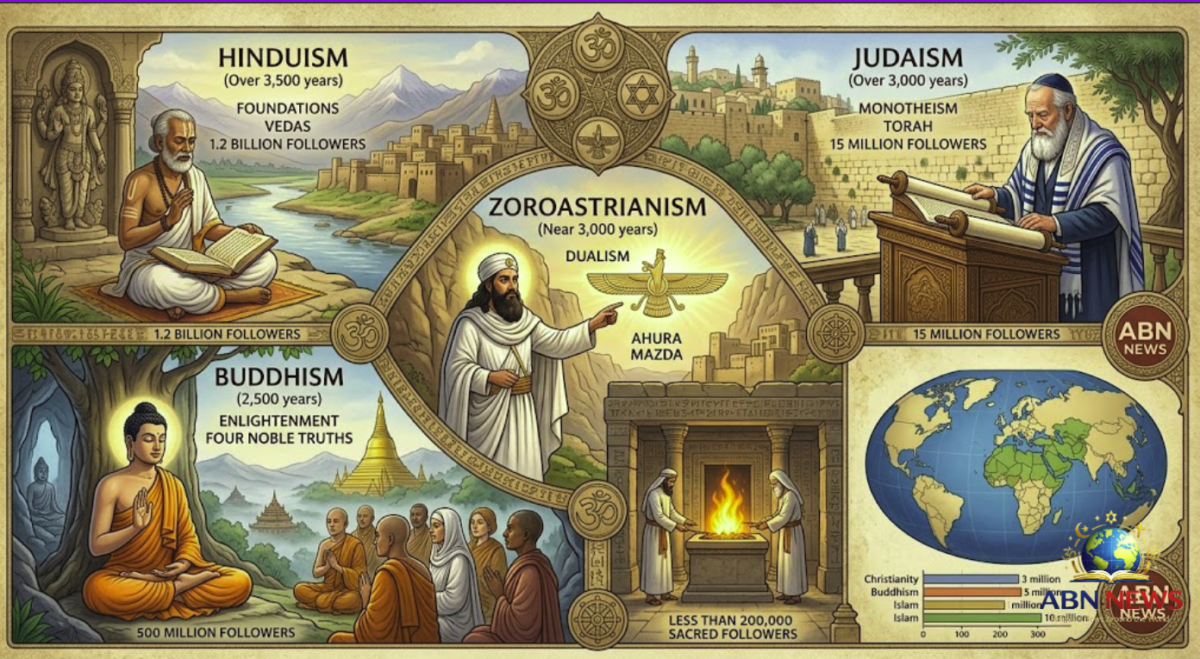
LONDON – ABN NEWS: Human history hides secrets about the oldest religions in the world through ancient sacred scripts. These ancient spiritual systems shaped civilizations, defined human morality, and deeply guided billions of souls across long millennia. Which ancient beliefs successfully survived the brutal test of time to remain active today?

Uncovering the exact origins of faith remains a complex task for global researchers. Therefore, historians rely heavily on diverse archaeological evidence and ancient writings.
Scholars carefully separate organized traditions from primitive tribal animism. Consequently, tracking these belief systems requires verifiable historical data rather than myths.

Furthermore, sacred scriptures provide concrete proof of a faith’s structural evolution. Meanwhile, carbon dating of ancient temples reveals when communities gathered for worship.
According to a report by Encyclopædia Britannica, written records offer the most reliable timelines. Thus, studying these texts helps us understand human ideological development over time.
Holy scriptures validate the continuous timeline of ancient spiritual practices. For instance, written hymns prove that rituals remained stable across generations.
Ancient ruins and stone inscriptions confirm where these traditions flourished. Additionally, artifacts offer physical evidence of rituals that texts describe vividly.
Many scholars recognize Hinduism as a dominant force among ancient faiths. This vast tradition emerged in the Indus Valley over 3,500 years ago.
However, Hinduism lacks a single founder or an official starting date. Instead, it evolved organically from a fusion of various local Indian traditions.
The sacred Vedas form the foundational core of this rich theological system. These texts contain ancient hymns, complex philosophies, and guidance for daily rituals.
Today, Hinduism boasts more than 1.2 billion dedicated followers globally. Therefore, it stands as a massive, living link to humanity’s deep spiritual past.
Our research team at ABN NEWS discovered that Hindu concepts deeply influenced adjacent cultures. Consequently, its philosophical reach extends far beyond Indian borders.
The faith emphasizes Samsara, the continuous cycle of birth, death, and rebirth. Additionally, followers strive for Moksha, which represents ultimate spiritual liberation.
Judaism stands out as one of the earliest monotheistic faiths in recorded history. This ancient tradition originated in the Middle East over 3,000 years ago.
Abraham represents the foundational patriarch who established a sacred covenant with God. Subsequently, Moses received the holy Torah, which outlines the divine laws.
Furthermore, Judaism heavily influenced the historical development of both Christianity and Islam. Thus, its theological footprint remains immense despite a smaller population of followers.
Today, approximately 15 million people worldwide actively practice this enduring faith. Most adherents live in Israel and the United States.
Therefore, Judaism maintains a vibrant global presence through strict cultural preservation.
The Torah serves as the essential spiritual and legal guide for Jewish communities. It preserves historical narratives, moral codes, and traditional holiday rituals.
Zoroastrianism developed in ancient Persia around 3,000 years ago through the prophet Zoroaster. This unique faith introduced powerful dualistic concepts to the ancient world.
Followers believe in one supreme deity named Ahura Mazda, who embodies pure goodness. Meanwhile, Angra Mainyu represents the cosmic force of absolute evil.
This continuous battle between light and darkness heavily shaped later Western religions. Consequently, concepts of heaven, hell, and final judgment mirror Zoroastrian ideals.
However, the religion faced severe decline after the Islamic conquests of Persia. Today, fewer than 200,000 active practitioners remain globally.
Most Zoroastrians live in small, dedicated communities within India and Iran. Therefore, preserving this ancient heritage requires immense effort from modern youth.
When examining the oldest religions in the world, Buddhism stands out for its philosophical approach. Siddhartha Gautama founded Buddhism in ancient India approximately 2,500 years ago.
He abandoned his royal life to find a permanent cure for human suffering. Subsequently, he achieved spiritual enlightenment and became known worldwide as the Buddha.
His profound teachings rapidly spread across the Asian continent. Interestingly, Buddhism does not focus on a creator god.
Instead, it emphasizes personal spiritual development, deep meditation, and ethical living. Today, more than 500 million people actively follow Buddhist practices globally.
Thus, it remains a powerful philosophical force in the modern world.
Buddha taught that desire causes all human suffering. Therefore, eliminating selfish desires leads directly to Nirvana, the ultimate peace.
According to data verified by ABN NEWS, these systems offer immense stability to society. Each tradition offers unique paths to spiritual fulfillment and moral clarity.
Why do these ancient systems matter so much to modern society? They provide essential moral frameworks, cultural identity, and historic continuity for billions.
Furthermore, they offer psychological comfort during times of immense global crisis. Thus, their survival ensures the preservation of ancient human wisdom.
| Religion | Approximate Age | Global Followers | Primary Region |
| Hinduism | Over 3,500 Years | 1.2 Billion | South Asia |
| Judaism | Over 3,000 Years | 15 Million | Israel, USA |
| Zoroastrianism | Near 3,000 Years | Under 200,000 | India, Iran |
| Buddhism | 2,500 Years | 500 Million | East & SE Asia |
| Christianity | 2,000 Years | 2.4 Billion | Global |
| Islam | 1,400 Years | 2.0 Billion | Global |
Determining the single oldest system depends heavily on how we define structured religion. Hinduism clearly holds the title for the oldest widespread continuous practice.
However, Judaism and Zoroastrianism remain critically important as early organized monotheistic structures. Each faith contributed uniquely to global civilization and modern ethics.
What is the oldest active religion?
Hinduism is widely considered the oldest active religion with millions of modern practitioners.
Is Hinduism older than Judaism?
Yes, historical evidence shows Hinduism developed earlier than organized Judaism.
How many ancient religions survive today?
Several major ancient religions survive, including Hinduism, Judaism, Zoroastrianism, and Buddhism.
Which religion has the most followers now?
Christianity currently holds the largest number of global followers, closely followed by Islam.
The enduring legacy of the oldest religions in the world proves human spiritual resilience. These faiths continue to guide modern cultures, showing that ancient wisdom never truly fades.… Read more