Physical Address
304 North Cardinal St.
Dorchester Center, MA 02124
Physical Address
304 North Cardinal St.
Dorchester Center, MA 02124

Religions News Around the World
Religions News Around the World
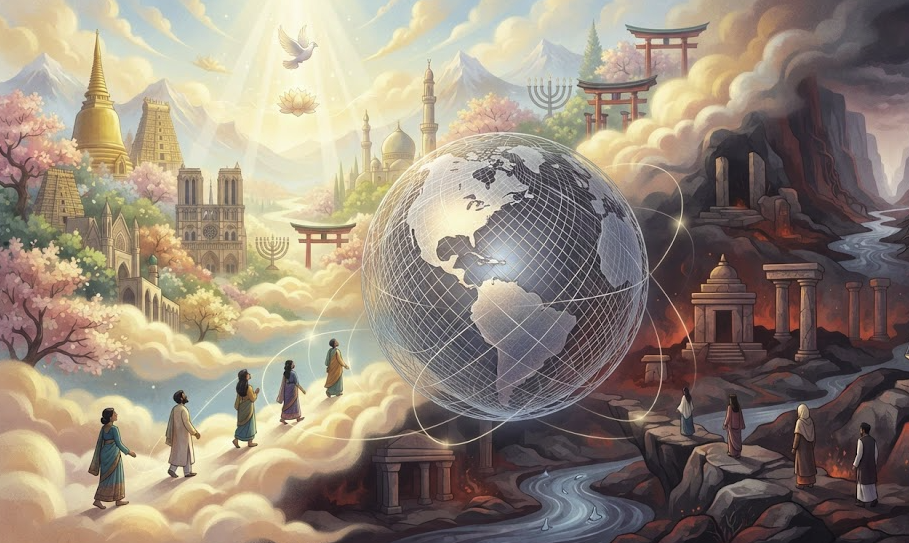
London – ABN NEWS: Views of Heaven and Hell Across 30 World Religions and Belief Systems

Heaven and hell in world religions remain among the most discussed spiritual concepts across human history. Different religions and belief systems describe the afterlife in different ways, with some traditions focusing on paradise and punishment, while others emphasize rebirth, spiritual progress, or liberation from suffering. How do the world’s major faiths understand what may happen after death?
The three major Abrahamic religions — Christianity, Islam, and Judaism — share historical connections but have different interpretations of the afterlife.

In Christianity, many traditions describe heaven as eternal life with God and hell as separation from God or a place of punishment. Christian views differ between denominations regarding the nature and duration of hell.
In Islam, paradise (Jannah) is described as a reward for faith and righteous actions, while hell (Jahannam) is described as a place of punishment for those who reject faith and commit wrongdoing. Interpretations of these concepts vary among Islamic schools.
Judaism contains different views about the afterlife. Some Jewish traditions focus on the World to Come (Olam Ha-Ba), while others place greater emphasis on life, moral responsibility, and the relationship between humans and God.
The official information published by the Vatican explains that Christian teachings about eternal life are connected to faith in God and resurrection.
Many Eastern religions approach the afterlife differently from Abrahamic traditions. Instead of focusing only on eternal destinations, they often discuss cycles of existence, spiritual development, and liberation.
In Hinduism, many traditions teach the concept of reincarnation, where the soul experiences different lives based on karma. The ultimate goal in many Hindu traditions is moksha, a state of liberation from the cycle of rebirth.
Buddhism generally teaches rebirth rather than an eternal soul. Many Buddhist traditions describe different realms of existence, including suffering realms and more peaceful realms, while the highest goal is reaching enlightenment and freedom from the cycle of rebirth.
Jainism also teaches reincarnation and karma. The ultimate goal is liberation (moksha), achieved through spiritual purification and overcoming attachment.
Sikhism teaches belief in one God and describes liberation from the cycle of rebirth through devotion, ethical living, and remembering God.
Religions and spiritual traditions around the world have developed diverse ideas about what happens after death.
In Zoroastrianism, traditional teachings describe a final judgment in which good and evil are separated. Paradise and punishment are connected to moral choices during life.
Bahá’í teachings describe the soul as continuing after death and emphasize spiritual growth rather than a physical description of heaven or hell.
Shinto traditions in Japan include beliefs about spirits and ancestors. Views about the afterlife can vary depending on cultural practices and individual beliefs.
Taoism includes different perspectives on spiritual existence, immortality, and harmony with the natural order. Interpretations differ between Taoist traditions.
Confucianism traditionally focuses more on ethical life, family responsibility, and social harmony than detailed descriptions of heaven and hell.
The following overview presents general views. Individual believers and communities may interpret these teachings differently.
| Religion or belief system | General view of the afterlife |
|---|---|
| Christianity | Heaven with God; hell or separation from God depending on tradition |
| Islam | Paradise (Jannah) and hell (Jahannam) based on faith and actions |
| Judaism | The World to Come and different interpretations of the afterlife |
| Hinduism | Reincarnation, karma, and liberation (moksha) |
| Buddhism | Rebirth, different realms, and enlightenment |
| Sikhism | Liberation through devotion and righteous living |
| Jainism | Rebirth, karma, and liberation of the soul |
| Zoroastrianism | Judgment, reward, and punishment |
| Bahá’í Faith | Spiritual continuation and progress of the soul |
| Shinto | Spiritual connection with ancestors and spirits |
| Taoism | Spiritual harmony and different ideas of immortality |
| Confucianism | Focus on moral life and social harmony |
| Indigenous spiritual traditions | Diverse beliefs connected to ancestors, nature, and spirits |
| Ancient Egyptian beliefs | Judgment after death and an eternal existence |
| Ancient Greek beliefs | Various realms including the underworld |
| Norse traditions | Different destinations after death depending on beliefs |
| Aztec beliefs | Different afterlife paths depending on circumstances |
| Mayan beliefs | Spiritual worlds connected to death and existence |
| Rastafari | Different interpretations connected to spiritual life and identity |
| Unitarian Universalism | Diverse individual beliefs about the afterlife |
| Scientology | Spiritual continuation and the nature of the being |
| Spiritism | Reincarnation and spiritual evolution |
| New Age beliefs | Spiritual growth, energy, and continuation after death |
| Wicca | Different views including cycles of nature and spiritual existence |
| Animist traditions | Connection between humans, spirits, and nature |
| African traditional religions | Ancestors, spirits, and continued relationships |
| Native American traditions | Diverse beliefs involving spirits and ancestors |
| Baha’i-inspired movements | Spiritual development after death |
| Modern secular humanism | Often focuses on life meaning rather than an afterlife |
| Atheist perspectives | Generally reject belief in heaven or hell |
Ideas about heaven and hell developed through different historical, cultural, and philosophical experiences. Some religions emphasize reward and punishment, while others focus on transformation, reincarnation, or spiritual freedom.
Although these traditions differ, many share common themes, including moral responsibility, compassion, justice, and the search for meaning.
No. Some religions focus on paradise and punishment, while others teach reincarnation, liberation, or spiritual continuation.
Christianity, Islam, and some other traditions include concepts of paradise, although interpretations differ.
No. Some belief systems do not include a concept of hell or eternal punishment.
They developed through different histories, cultures, philosophies, and spiritual teachings.
The world’s religions and belief systems offer many different explanations about heaven, hell, and existence after death. While their teachings vary significantly, many traditions share a focus on morality, spiritual growth, and the meaning of human life.… Read more
Contact: info@abnnews.net