Physical Address
304 North Cardinal St.
Dorchester Center, MA 02124
Physical Address
304 North Cardinal St.
Dorchester Center, MA 02124
Religions News Around the World
Religions News Around the World
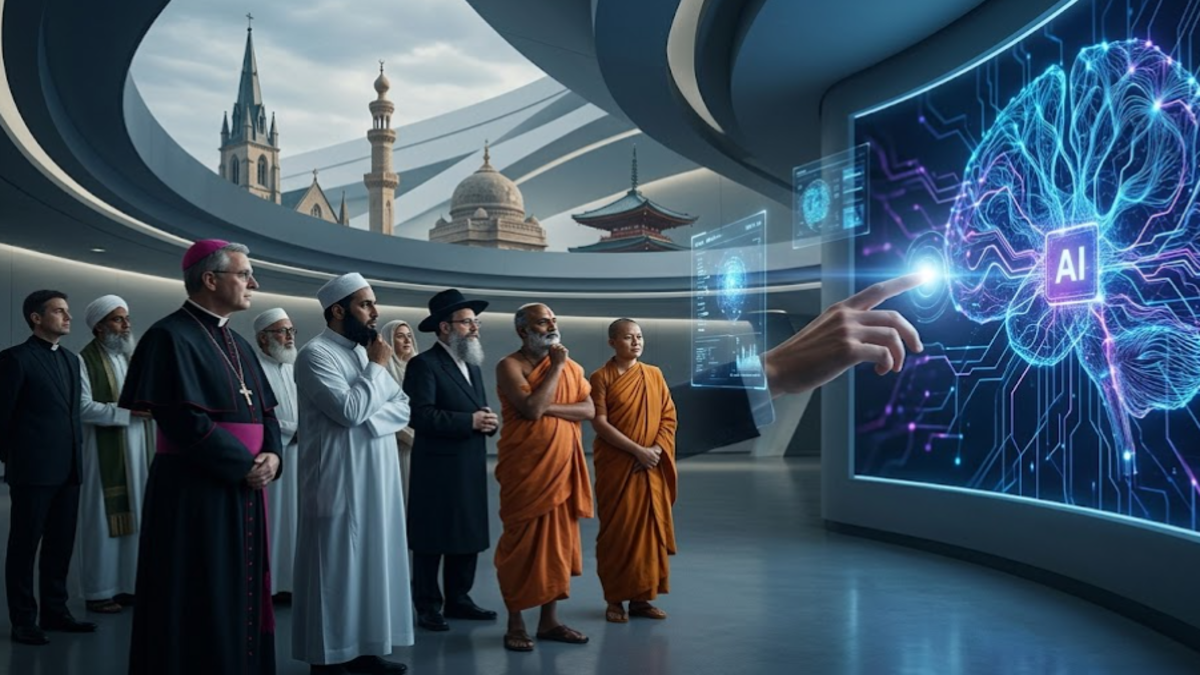
ROME – ABN News: Religion in the Age of Artificial Intelligence is becoming one of the defining debates of the digital era, as religious leaders, theologians, technology experts and governments confront questions about human dignity, truth, work, responsibility and the limits of machines. From the Vatican’s growing engagement with artificial intelligence to wider discussions about AI-generated religious guidance, the central question is no longer whether faith communities should respond to AI, but how they should do so without allowing technology to replace human conscience, spiritual relationships and moral judgment. What happens to religion when machines begin to influence the way people understand truth, morality and even themselves?

Religion in the Age of Artificial Intelligence enters a new phase
The relationship between religion and technology has never been simple. Throughout history, religious communities have responded to major technological changes by asking whether new inventions would strengthen human life or threaten essential values.

Artificial intelligence has brought that discussion into sharper focus.
Unlike earlier technologies, AI does not merely extend human physical capabilities. It can generate language, imitate conversation, analyse enormous amounts of information and produce answers that often appear authoritative. As a result, people increasingly turn to AI systems for advice, education and explanations on subjects that once depended almost entirely on teachers, scholars, priests, imams, rabbis and other religious authorities.
That development has created a new challenge for faith communities.
The Vatican has emerged as one of the most visible religious institutions addressing the issue. In June, the Holy See reported the first meeting of its Interdicasterial Commission on Artificial Intelligence, a body designed to coordinate work across Vatican departments dealing with doctrine, culture, education, communication and human development.
The commission also involves the Pontifical Academies for Life, Sciences and Social Sciences. Its stated objective is to encourage a vision of AI that protects human dignity, promotes the common good and supports the mission of the Church.
The move reflects a broader shift. Religious institutions are no longer discussing AI only as a technological development. They are increasingly treating it as a question about humanity itself.
The Vatican’s approach focuses on a fundamental distinction: AI can process information, but it does not possess the human experience that gives religious life its meaning. Faith involves relationships, conscience, responsibility, suffering, hope and community. These are areas in which religious leaders argue that technology should remain a tool rather than become an authority.
The debate has become particularly urgent because AI systems can sound confident even when they produce inaccurate or misleading information. In matters of religion, where interpretations can influence personal decisions and deeply held beliefs, the consequences may be significant.
Religion in the Age of Artificial Intelligence and the question of human dignity
Pope Leo XIV has placed artificial intelligence at the centre of his social and ethical agenda.
His first encyclical, Magnifica humanitas: On Safeguarding the Human Person in the Time of Artificial Intelligence, was presented at the Vatican in May. The document addresses the social consequences of AI and calls for technology to serve humanity rather than concentrate power in the hands of a few.
The encyclical links AI with several major concerns, including truth, the dignity of work, social justice and peace.
The Pope’s intervention comes at a moment when governments and technology companies are racing to develop increasingly powerful AI systems. Religious leaders have increasingly warned that technological progress should not become an end in itself.
The Vatican’s position is that innovation must remain connected to the protection of the human person.
That argument extends beyond Catholic teaching. Across different religious traditions, similar questions are emerging about what makes human beings unique and whether technology can ever replicate the spiritual and moral dimensions of human life.
AI can generate a sermon, but it cannot experience faith. It can summarise a sacred text, but it does not participate in a religious community. It can imitate empathy in a conversation, but it does not live through grief, hope or personal sacrifice.
Those distinctions are becoming increasingly important as people experiment with AI-generated spiritual content.
Religious communities now face a practical dilemma. AI can help translate texts, organise information, support education and make religious resources more accessible. At the same time, excessive dependence on automated systems could weaken the human relationships at the heart of religious life.
The issue is particularly sensitive for younger generations, who have grown up surrounded by digital technology and may naturally view AI assistants as convenient sources of information.
The challenge for religious institutions is therefore not simply to reject AI. Instead, many are trying to teach people how to use it responsibly while preserving the human relationships that technology cannot replace.
Faith leaders confront AI’s impact on work and society
The debate about AI and religion also extends well beyond churches, mosques, synagogues and temples.
One of the most serious concerns involves employment.
Artificial intelligence is already changing workplaces, raising fears that automation could eliminate jobs or fundamentally alter the role of workers. Religious leaders have traditionally played an important role in debates about economic justice, and AI has brought those concerns back to the centre of public discussion.
At a Vatican event connected to the release of Pope Leo XIV’s encyclical, Anthropic co-founder Christopher Olah argued that AI development needs oversight beyond the technology industry. Reuters reported that Olah highlighted concerns about large-scale job disruption, the distribution of the economic benefits of AI and the difficulty of understanding how increasingly complex systems operate.
His participation was significant because it brought together perspectives that do not always meet in the same room.
Technology companies focus heavily on innovation and competition. Governments concentrate on regulation and national interests. Religious institutions approach the issue from questions of morality, human dignity and the common good.
The growing conversation between these groups suggests that AI governance is becoming a multidisciplinary issue.
For religious thinkers, the central question is not simply how many jobs AI may replace. It is what happens to a society when work loses its traditional role in giving people purpose, identity and a sense of contribution.
That concern resonates with long-standing religious teachings about the value of human labour.
If machines perform more cognitive tasks, societies will need to reconsider how people understand productivity and human worth. A person’s value, religious traditions argue, cannot depend solely on economic output.
The debate also raises concerns about inequality. If advanced AI technologies remain concentrated among a small number of companies and countries, the benefits could become unevenly distributed.
The Vatican has repeatedly argued that technological development must serve the whole of humanity.
That message was reinforced in July when Archbishop Ettore Balestrero, the Holy See’s Permanent Observer to the United Nations in Geneva, called for robust governance of AI during the UN’s first Global Dialogue on AI Governance.
He argued that effective governance should ensure that technological progress respects human dignity and the common good. The statement reflected the Vatican’s growing effort to participate in international discussions about how AI should be regulated.
The religious question: Can AI become a spiritual authority?
Perhaps the most sensitive issue in the debate is the possibility that people may begin treating AI systems as religious authorities.
Generative AI can answer questions about sacred texts within seconds. It can explain religious terminology, compare traditions and generate prayers or reflections. For someone who feels uncomfortable approaching a religious leader, an AI chatbot may appear less intimidating and more accessible.
But accessibility does not guarantee reliability.
AI systems can make mistakes, invent references or present disputed interpretations as established facts. Religious traditions often contain centuries of scholarship and internal debate, meaning that a short automated answer may conceal important differences between schools of thought.
This creates a particular problem when users ask AI systems for religious rulings or guidance on deeply personal matters.
The technology may provide an answer, but it cannot assume responsibility for the consequences.
That distinction is central to the emerging debate.
Religious authority traditionally involves accountability. A priest, imam, rabbi, monk or scholar belongs to a community and operates within a recognised tradition. Their advice can be questioned, discussed and challenged.
An AI system has no equivalent form of spiritual accountability.
This does not mean AI has no role in religious education. On the contrary, it may become a useful tool for people seeking introductory information or exploring texts and traditions.
The challenge lies in maintaining a clear boundary between technological assistance and religious authority.
Recent discussions within Catholic circles have repeatedly emphasised that AI should support human intelligence rather than replace it. That principle could become relevant across many faith traditions as more people use AI to explore questions of belief.
From Seoul to Rome, religious communities examine AI ethics
The debate is not confined to the Vatican.
In South Korea, religious communities have also begun examining the ethical implications of artificial intelligence. Vatican News reported that around 250 people, many of them women religious, attended a special lecture in Seoul focused on AI ethics and faith.
The event, held at Jeongdong Franciscan Church Cathedral, explored questions about responsibility, wisdom and human dignity.
The gathering illustrates how religious communities are adapting to a rapidly changing technological environment.
For many faith groups, the goal is not to compete with AI but to ensure that people remain capable of making moral decisions independently.
That concern is particularly relevant in education.
As students gain access to AI tools capable of writing essays, answering questions and completing assignments, educators are increasingly asking what happens to learning when technology does too much of the intellectual work.
The same question applies to religious education.
If an AI system can instantly produce a theological explanation, will people still engage deeply with sacred texts? If a chatbot can generate a prayer, will believers continue to seek communal prayer? If an algorithm can simulate a conversation about grief or spiritual doubt, will people still turn to human religious communities?
There are no simple answers.
Technology can make knowledge more accessible, but religious traditions often argue that knowledge alone is not the same as wisdom.
The distinction is important because AI is designed to generate useful responses, while religion deals with questions that often have no simple or measurable solution.
Faith involves uncertainty. It involves interpretation. It involves relationships between people and their communities.
Those elements are difficult to reduce to algorithms.
Religion faces the rise of synthetic voices and digital truth
Another major concern involves trust.
AI-generated images, audio and video can make it increasingly difficult to distinguish genuine statements from fabricated ones. Religious institutions, like governments and media organisations, face the risk that synthetic content could be used to spread false claims or manipulate public opinion.
The problem is especially serious for religious communities because faith often depends on trust in testimony, tradition and shared experience.
An AI-generated recording that appears to show a religious leader making a controversial statement could quickly circulate online before anyone verifies it.
The consequences could extend beyond individual believers.
False information can deepen divisions between religious communities, fuel hostility and create confusion about what leaders actually said.
For this reason, religious institutions are increasingly interested in questions of digital literacy.
The Vatican’s wider approach to AI reflects this concern. Its emphasis on truth and human dignity suggests that the technological debate cannot be separated from the information environment in which people now live.
The challenge is becoming more complex as AI-generated material becomes increasingly realistic.
People will need stronger habits of verification. Religious organisations will need to communicate clearly through trusted channels. Journalists will have to remain vigilant about manipulated content.
The issue also highlights an unexpected connection between religion and journalism.
Both rely on a commitment to truth.
As AI makes content production easier, the value of verification may increase rather than decline. In a world where anyone can generate convincing text, audio or images, audiences may place greater importance on sources that can demonstrate accountability.
The future of religion may depend on human relationships
The most striking message emerging from recent religious discussions about AI is that the future may not be about choosing between faith and technology.
Instead, it may be about deciding what role technology should play.
AI can assist with research. It can translate documents. It can help people discover information about religious traditions. It can support accessibility and education.
But religious leaders increasingly argue that technology must remain subordinate to human judgment.
That principle is particularly visible in the Vatican’s efforts to create a coordinated approach to AI. The Interdicasterial Commission brings together different areas of expertise because the technology affects almost every dimension of modern life.
The debate also reflects a wider concern about the meaning of progress.
For decades, technological advancement was often presented as an unquestionable good. AI is forcing societies to ask more complicated questions.
Progress for whom?
Who controls the technology?
Who benefits from it?
Who carries the risks?
And what happens to the human qualities that cannot easily be measured?
Religion has traditionally addressed precisely these questions.
Its role in the AI era may therefore be less about predicting the future and more about helping societies decide what kind of future they want.
The Vatican’s latest initiatives indicate that religious institutions intend to remain part of that conversation.
At the same time, the debate is likely to spread across faith traditions and geographical boundaries. The questions raised by AI are universal: human dignity, responsibility, truth, work, community and moral choice.
Artificial intelligence may change how people communicate, learn and work. It may even change how people search for spiritual information.
But the emerging consensus among many religious voices is that AI should not become a substitute for conscience, community or genuine human relationships.
The technology can provide answers. Religion, however, continues to ask what those answers mean.
That distinction may ultimately define Religion in the Age of Artificial Intelligence.
FAQ
Can AI replace religious leaders?
AI can provide information and generate religious content, but it cannot replace the human relationships, accountability and spiritual community associated with religious leadership.
Can people use AI to learn about religion?
Yes. AI can be useful for introductory research and education, but users should verify important religious information against trusted primary sources and qualified scholars.
Why is the Vatican concerned about AI?
The Vatican has focused on AI because of its potential effects on human dignity, work, truth, social justice, peace and the common good.
What is the biggest religious concern about AI?
One major concern is that people may give AI too much authority, allowing automated systems to influence moral and spiritual decisions that require human judgment and responsibility.
… Read more
Contact: info@abnnews.net