Physical Address
304 North Cardinal St.
Dorchester Center, MA 02124
Physical Address
304 North Cardinal St.
Dorchester Center, MA 02124

Religions News Around the World
Religions News Around the World
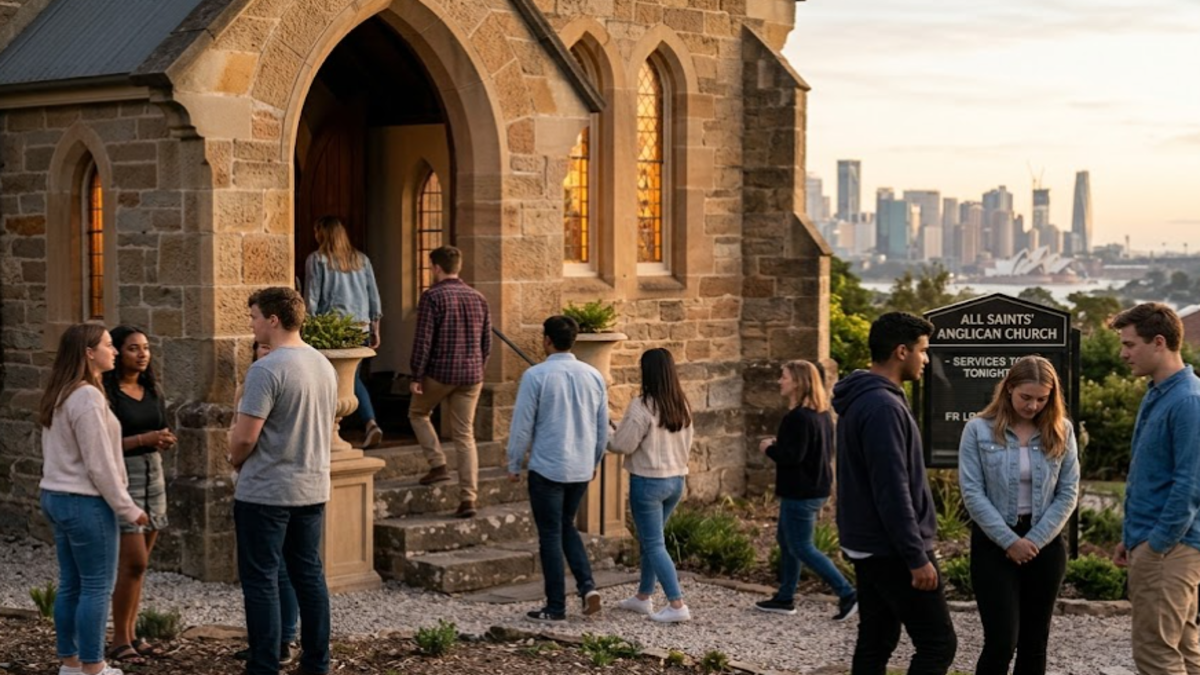
CANBERRA – ABN News: Religious Revival in Australia is attracting fresh attention as reports of younger Australians exploring Christianity and returning to churches emerge alongside a much broader national shift away from traditional religious affiliation. Could Australia be witnessing a new chapter in its complicated relationship with faith?

Australia’s relationship with religion is entering a period of renewed debate.
For decades, the dominant story has been one of secularisation. Churches have faced declining attendance, Christian affiliation has fallen, and a growing share of Australians now describe themselves as having no religion.

Yet recent reports suggest that the picture may be more complicated than a simple retreat from faith.
Some churches and Christian organisations are reporting increased interest among younger Australians, including members of Generation Z. In parts of the country, campus ministries, student Christian groups and local congregations say they are seeing more young people seeking community, purpose and answers to questions about meaning.
The emerging trend has prompted some observers to describe a possible religious revival in Australia.
The phrase, however, requires caution.
Australia’s official population data do not yet demonstrate a nationwide religious resurgence. The latest Census figures show that Christianity remains the country’s largest religious affiliation, but its share of the population has fallen significantly. At the same time, the proportion of Australians reporting no religion has continued to rise.
The Australian Bureau of Statistics reported that 43.9 per cent of Australians identified as Christian in the 2021 Census, down from 52.1 per cent in 2016 and 61.1 per cent in 2011. The same Census recorded 38.9 per cent of the population as having no religion, compared with 30.1 per cent in 2016 and 22.3 per cent in 2011.
Those figures make any claim of a national revival difficult to establish.
But they do not necessarily explain every change taking place at the local level.
Religious affiliation is not the same as religious practice. A person may identify with a religion without regularly attending services, while another person may explore spirituality without formally changing their Census response.
That distinction is becoming increasingly important as churches attempt to understand why some young Australians appear to be showing renewed curiosity about faith.
Recent Australian media reports have highlighted signs of growing interest in Christianity among younger people.
One report focused on Gen Z Australians who are returning to churches or becoming more involved in Christian communities. The trend has been described as a reversal of the long decline in youth religious participation, although the scale and permanence of the shift remain uncertain.
The reported movement appears particularly visible in student and university communities.
Christian groups operating around campuses have described greater engagement from young people who are looking for spaces where they can discuss questions about identity, relationships, mental health, uncertainty and the future.
For some participants, the attraction is not simply doctrinal.
Community appears to be a major factor.
Young Australians have grown up during a period marked by social media, political uncertainty, economic pressure and the disruption caused by the pandemic. For some, these experiences have encouraged questions that do not have easy practical answers.
Religious communities can offer a structured environment in which those questions can be explored.
Churches also provide something that many young people say is increasingly difficult to find: face-to-face community.
That does not mean every young person attending a church service is becoming a committed Christian. Some may be exploring, others may be searching for friendship, and some may simply be curious.
Nevertheless, the interest has caught the attention of religious leaders and observers who believe that a generation often described as increasingly secular may still have a strong appetite for spiritual questions.
The development also challenges assumptions about the future of religion.
For years, many commentators expected younger Australians to continue the country’s secular trajectory. The Census data certainly show that younger age groups are more likely to report no religion. In 2021, almost half of Australians aged between 25 and 34 reported having no religion.
At the same time, isolated movements in the opposite direction can coexist with a broader secular trend.
A small but highly committed group of young believers could become increasingly visible without changing the religious profile of the entire country.
That distinction may be central to understanding what is happening.
The strongest available evidence comes from Australia’s national Census.
According to the Australian Bureau of Statistics, Christianity remained the most common religious affiliation in the country in 2021, with 43.9 per cent of Australians identifying as Christian.
Catholics accounted for 20 per cent of the population, while Anglicans represented 9.8 per cent.
Islam was reported by 3.2 per cent of Australians, while Hinduism accounted for 2.7 per cent. Buddhism represented 2.4 per cent.
At the same time, 38.9 per cent of Australians reported having no religion.
The figures illustrate the scale of Australia’s religious transformation.
In 1971, 86.2 per cent of Australians reported Christianity as their religious affiliation, according to historical Census data published by the ABS. Over the following decades, that proportion declined steadily.
The share reporting no religion moved in the opposite direction.
In 1971, 6.7 per cent of Australians reported no religion. By 2021, the figure had reached 38.9 per cent.
The change has been especially pronounced during the past two decades.
The ABS has also stressed that the Census question measures religious affiliation rather than religious practice. That means the figures cannot, by themselves, determine how often Australians attend religious services or how strongly they practise their faith.
This is an important qualification when examining reports of renewed religious interest.
A person who attends church for the first time in years may still be counted under the same religious affiliation in the Census. Similarly, a person who begins exploring Christianity but does not formally identify as Christian may remain in the no-religion category.
As a result, changes in religious curiosity can occur before they appear in official affiliation statistics.
That may be one reason why recent reports of renewed interest have attracted attention even though the broader national numbers continue to point towards secularisation.
The reasons behind renewed interest in religion are difficult to measure.
There is no single explanation that applies to everyone.
For some Australians, faith provides a sense of purpose in an increasingly uncertain world. For others, religious communities offer social connections that are difficult to find elsewhere.
The pandemic also appears to have influenced the way some people think about meaning and community.
Periods of isolation forced many people to reconsider their relationships, priorities and beliefs. Young adults in particular experienced major disruption during formative years.
The consequences extended beyond education and employment.
The experience also raised questions about loneliness, mortality and the nature of community.
Religious institutions were not immune to those changes. Churches, mosques, synagogues and other faith communities had to adapt to restrictions and, in many cases, move parts of their activities online.
As society returned to normal routines, some people began looking for stronger forms of personal connection.
For religious communities, that created an opportunity.
Churches that emphasise relationships, service and community may appeal to people who are dissatisfied with increasingly digital forms of social interaction.
The renewed interest reported among some young Australians may therefore reflect several factors at once.
Faith can provide a framework for understanding personal struggles. Religious communities can offer friendship and support. Worship can create a sense of belonging. And religious traditions can provide continuity in a rapidly changing society.
Yet the motivations of younger Australians should not be oversimplified.
Some are attracted to traditional Christian teaching. Others may be interested in spirituality without wanting formal membership in a church.
Still others may attend religious gatherings because they value the community but remain uncertain about their beliefs.
The diversity of motivations makes it difficult to describe the phenomenon as a conventional revival.
It may instead represent a broader reopening of the conversation about faith.
The signs of renewed religious interest exist alongside powerful evidence of continuing secularisation.
The Census trend is clear.
Christian affiliation has declined substantially over the past half-century, while the number of people reporting no religion has increased.
The change is not limited to one city or one denomination.
Australia has also become more religiously diverse, with Islam, Hinduism and other religions increasing their share of the population. The ABS says the country is becoming more religiously diverse as traditional Christian affiliation declines.
This creates a more complex religious landscape.
Australia is not simply moving from Christianity to atheism.
Some Australians are leaving organised religion. Others are joining non-Christian religions. Some maintain religious beliefs outside formal institutions. And a smaller group may be returning to organised religion after years away.
The distinction between religious identity and religious practice is therefore becoming increasingly important.
A person may describe themselves as Christian because of family tradition while rarely attending church.
Another person may attend church every week but have only recently adopted Christianity.
Someone else may reject formal religious labels while maintaining a strong spiritual life.
These different experiences can exist within the same statistical category.
That is why the idea of a religious revival should be approached as a question rather than a settled conclusion.
There are genuine signs of renewed interest in some communities.
But there is not yet enough evidence to conclude that Australia as a whole has reversed its long-term movement toward secularisation.
The more defensible interpretation is that Australia’s religious landscape is becoming increasingly fragmented.
Some parts of society are moving further away from organised religion.
At the same time, other groups are becoming more committed to faith.
The reported interest among younger Australians could nevertheless have significant consequences for religious organisations.
If even a relatively small proportion of young people become more active in churches, their influence may extend beyond their immediate congregations.
Young believers often bring different expectations to religious institutions.
They are accustomed to digital communication, open discussion and greater individual choice. They may be less willing to accept institutional authority without question.
For churches, that creates both an opportunity and a challenge.
A congregation that wants to attract younger Australians must compete not only with other religious groups but also with a wide range of online communities and social networks.
The young people who are exploring faith may also expect religious organisations to address contemporary issues directly.
Questions about mental health, loneliness, relationships, technology, artificial intelligence, war, inequality and climate change are part of the world in which they live.
Religious institutions that engage with those questions may have a stronger chance of retaining their interest.
The challenge is equally significant for the wider religious community.
A revival cannot be measured only by attendance at special events or temporary increases in curiosity.
A genuine revival would require sustained participation, deeper commitment and the emergence of new religious communities over time.
That is something only future data can establish.
For now, the evidence suggests that some young Australians are reassessing assumptions about religion that once appeared settled.
The development is particularly striking because it is occurring in a country where the long-term statistical trend has moved strongly in the opposite direction.
The renewed debate over religion also reflects a wider question facing Australian society.
What happens when people feel disconnected from traditional institutions but still want a sense of belonging?
For some, the answer is found in politics or activism.
For others, it is sport, volunteering, cultural organisations or online communities.
And for a growing number of people in some communities, religion may once again be part of the answer.
Recent reporting on the Australian religious landscape has pointed to a renewed interest in Christianity, including Catholicism, while also connecting the development to a broader international discussion about the future of faith.
The argument is not that Australia has suddenly become a religious country again.
Instead, it suggests that the assumption that religion will inevitably disappear may be too simplistic.
Religion has demonstrated an ability to adapt.
It can operate through traditional congregations, university groups, digital platforms and informal networks.
Young people may encounter faith through social media before entering a church.
They may discover religious ideas through friends rather than family.
They may also move between periods of belief and doubt.
This flexibility makes the future difficult to predict.
The traditional institutions of religion may continue to lose members while new forms of religious participation emerge.
That possibility would represent a significant change from the conventional narrative of Australian secularisation.
It would also explain why a country with almost 10 million people reporting no religion can simultaneously experience reports of growing interest in faith among specific groups.
Both realities can be true.
The coming years will show whether the current interest develops into something larger.
The next national Census will provide another major opportunity to assess changes in religious affiliation.
Until then, researchers and religious organisations will continue to watch indicators such as church attendance, baptisms, conversions, participation in student ministries and engagement with faith communities.
These measures may provide a more detailed picture than Census affiliation alone.
For now, Australia’s religious story is one of transition rather than clear reversal.
The country remains more secular than previous generations, and the proportion of Australians reporting no religion has increased sharply.
Christianity remains the largest religious affiliation, but its share has declined.
At the same time, reports from churches and Christian organisations indicate that some younger Australians are showing renewed interest in faith, community and spirituality.
The most significant development may therefore be the emergence of a more complicated religious landscape.
Australia may not be experiencing a nationwide religious revival in the traditional sense.
But neither is faith disappearing from public life.
Instead, religion appears to be undergoing a period of reinvention.
For some Australians, the future will be increasingly secular.
For others, faith may become more important precisely because the wider culture is becoming less religious.
And for a younger generation searching for identity, purpose and community, the question of faith may be returning to the conversation in unexpected ways.
The real test will be whether today’s curiosity becomes tomorrow’s commitment.
There are signs of renewed interest in faith among some groups, particularly younger Australians, but national Census data still show a long-term decline in Christian affiliation and a rise in people reporting no religion.
Recent reports indicate growing interest in Christianity among some Gen Z Australians, including increased engagement with churches and Christian student groups. The broader youth population, however, remains more likely to report no religion than older generations.
The 2021 Census recorded Christianity as the largest religious affiliation at 43.9 per cent, while 38.9 per cent of Australians reported no religion.
Reported reasons include a search for meaning, community, personal connection and answers to questions about life and uncertainty. Individual motivations vary, and there is no single explanation for renewed religious interest.