Physical Address
304 North Cardinal St.
Dorchester Center, MA 02124
Physical Address
304 North Cardinal St.
Dorchester Center, MA 02124

Religions News Around the World
Religions News Around the World
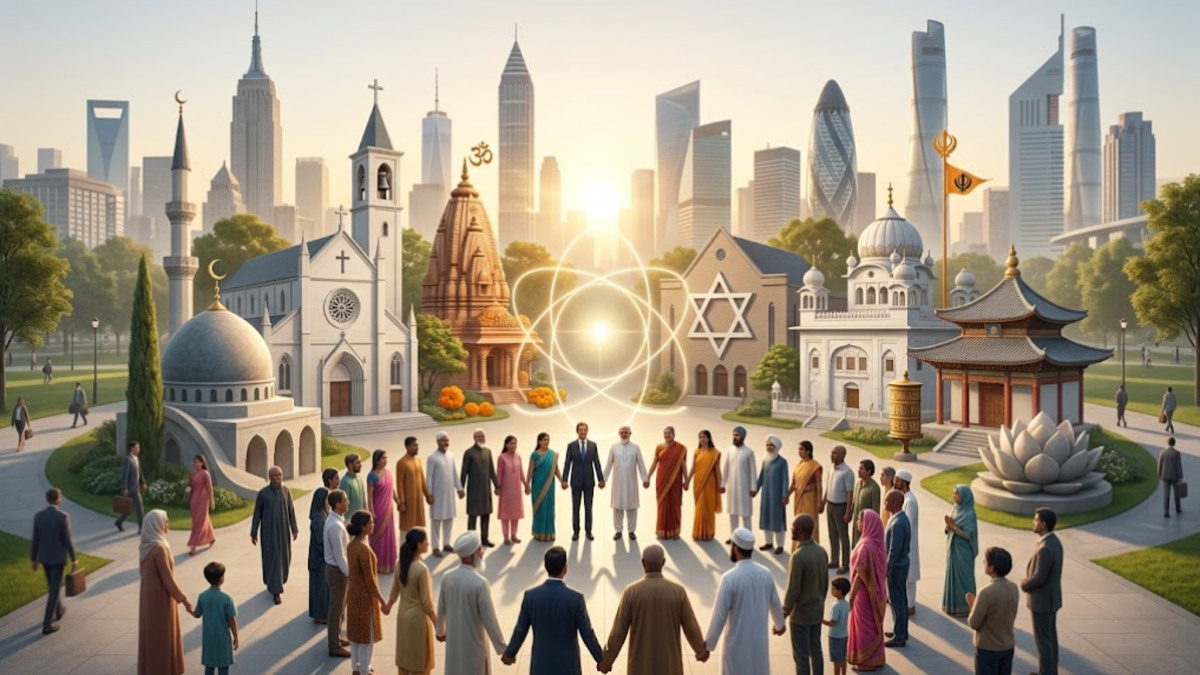
NEW DELHI – ABN News: Concept of God Across Religions remains one of the central questions shaping religious identity, personal conscience and public life, and today’s international religion coverage shows how differently communities understand the divine while continuing to negotiate how those beliefs should coexist. From a disputed Hindu interfaith event in New York to a court ruling protecting an interfaith couple in India, and from Christian debates over worship in Rome to renewed tensions around sacred communities in Jerusalem and Myanmar, what do these developments tell us about the way different religions understand God, ultimate reality and the place of faith in society?

One of the most significant religion stories in today’s news comes from India, where debates over religious freedom and pluralism have again brought competing understandings of faith into public view.
The U.S. Commission on International Religious Freedom has raised concerns about the American visit of Mohan Bhagwat, chief of the Rashtriya Swayamsevak Sangh, or RSS. The organization has urged the U.S. government to consider targeted sanctions against RSS members and Indian officials whom it says bear responsibility for religious-freedom violations, including the possible revocation of Bhagwat’s visa. The commission identifies itself as a U.S. governmental advisory body whose recommendations are not binding.

The controversy surrounds a planned event in New York called the “Universal Oneness Celebration.” Organizers describe the gathering as a forum focused on Hindu heritage, unity and interfaith dialogue, with more than 200 Hindu-American organizations reported to be participating. The RSS says the gathering offers an opportunity for open dialogue and presents itself as a cultural movement centered on Hindu unity.
Critics, however, argue that the event raises questions about the difference between religious identity and political ideology. New York Mayor Zohran Mamdani has said he does not support the event, while also acknowledging that the city may not have jurisdiction to cancel a private gathering. He described his concern in terms of an exclusionary vision that, in his view, conflicts with a pluralistic understanding of India.
The dispute matters to any discussion of the Concept of God Across Religions because Hinduism does not reduce the divine to one universally accepted theological formula. Hindu traditions contain devotional worship of particular deities, philosophical accounts of Brahman as ultimate reality, and schools that relate the personal and impersonal dimensions of the divine in different ways. Scholars of comparative religion therefore caution against treating Hinduism as though it has one single doctrine of God shared by every Hindu community.
At the same time, today’s Indian news also carries a very different story about religious coexistence. The Allahabad High Court has held that an adult couple in an interfaith relationship has a constitutional right to live together and that the right to personal liberty does not depend on the religion professed by either partner. The court directed police to examine any genuine threat to the couple’s safety.
That ruling moves the question from theology into constitutional life. It asks whether citizens can maintain relationships across religious boundaries without their beliefs becoming a reason for state or social interference. In practice, that is one of the most difficult questions facing plural societies: how can people remain deeply committed to their own understanding of God while recognizing the freedom of others to follow a different path?
Judaism, Christianity and Islam stand within the Abrahamic family and share a fundamental commitment to monotheism: the belief in one God. Yet even among these traditions, the meaning of divine unity, revelation, salvation and humanity’s relationship with God differs significantly. Comparative philosophy of religion stresses that agreement on the existence of one God does not eliminate major theological differences between traditions or within them.
In Judaism, God stands at the center of covenant, law, creation and the moral relationship between God and the people of Israel. Jewish theology places strong emphasis on divine unity and rejects the idea that God can be divided into multiple persons. The concept of God therefore links belief directly to ethical responsibility, community identity and the interpretation of sacred history.
Christianity also teaches one God, but most Christian traditions understand the one God through the doctrine of the Trinity: Father, Son and Holy Spirit. Christian belief also identifies Jesus Christ with the divine in a way that distinguishes Christianity from both Judaism and Islam.
Today’s Vatican coverage offers a clear example of how Christian belief connects theology with worship. Pope Leo XIV, speaking about the Second Vatican Council’s liturgical reforms, said active participation in worship helps believers enter into a deeper relationship with God. He described the liturgy as a living expression of the Church’s tradition and emphasized that worship should not leave believers as passive observers.
The Vatican’s daily reading for Aug. 27 likewise places God at the center of Christian life through themes of grace, faithfulness, vigilance and relationship with Christ. The text presents God not simply as an abstract philosophical principle but as a personal reality to whom believers respond through faith and conduct.
Islam shares with Judaism and Christianity the conviction that there is one God, Allah, but Islamic theology gives particular emphasis to tawhid, the absolute oneness of God. Muslim belief rejects any division within God and rejects the worship of anything alongside the Creator.
That difference becomes especially important when religion enters public debates. A faith community may see its understanding of God as the foundation for moral obligations, while a secular legal system must protect people who reject that faith or follow another one.
The challenge does not arise because religions necessarily oppose coexistence. It arises because religious beliefs often make claims about truth, duty and human dignity that believers regard as deeply consequential. Public institutions then have to protect freedom without turning religious conviction into a license for coercion.
The Concept of God Across Religions becomes more complex when the comparison moves beyond the Abrahamic traditions.
Hinduism contains a remarkable range of theological approaches. Some traditions focus devotion on a personal deity such as Vishnu, Shiva or Devi. Others emphasize Brahman as ultimate reality, while different philosophical schools explain the relationship between Brahman, the individual self and the world in sharply different ways. The Stanford Encyclopedia of Philosophy notes that Hindu traditions cannot easily be placed into a single category such as simple monotheism or polytheism because their concepts of ultimate reality and divine manifestation vary considerably.
That diversity helps explain why the word “God” can sometimes create confusion when journalists compare religions. A Hindu devotee speaking about Krishna, a Vedanta philosopher discussing Brahman and a Shaiva devotee speaking about Shiva may all use religious language that points toward different theological frameworks.
Today’s religion bulletin provides a smaller but striking example of the range within Hindu spirituality. It reports on musician Ray “Raghunath” Cappo, a Hare Krishna devotee whose religious life influenced the punk movement known as “Krishnacore.” His story reflects a form of devotional Hindu practice in which spiritual discipline, scripture and personal transformation combine with an unconventional cultural setting.
Buddhism raises an even more important distinction. Many Buddhist traditions do not depend on belief in a creator God. Instead, Buddhist teachings focus on suffering, impermanence, karma, liberation and the transformation of consciousness. Some Buddhist cosmologies include gods or heavenly beings, but these beings do not automatically function as an all-powerful creator in the sense found in classical monotheistic theology. Philosophical studies therefore frequently classify Buddhism as non-theistic rather than simply atheistic.
Sikhism, by contrast, affirms one God and places divine unity at the heart of its tradition. Sikh teachings emphasize devotion, remembrance of God, equality and service. The idea of one divine reality does not stand apart from human responsibility; instead, devotion should shape conduct toward other people.
Together, these traditions show why a global discussion of God cannot rely on a single definition. Some religions describe a personal creator. Others speak of ultimate reality in philosophical terms. Some place less emphasis on a creator entirely. Others understand divine unity through devotion, revelation, discipline or ethical action.
The relationship between religious belief and public life becomes especially visible in Jerusalem, where communities linked to Judaism, Christianity and Islam live alongside some of the world’s most important sacred places.
The Associated Press reported today that a Jerusalem court acquitted a Jewish man accused of attacking a Catholic nun after accepting an insanity defense and ordered psychiatric hospitalization for up to six years. The court found evidence that he carried out the attack but accepted medical findings that he was psychotic at the time.
The incident has alarmed Christian communities in Jerusalem. Clergy and advocates told AP that verbal abuse and spitting have become increasingly common in the Old City, where Christians, Jews and Muslims regularly encounter one another around sites considered sacred by their respective traditions. Researchers cited in the report said harassment against Christians in the city has increased sharply, while an Israeli official described efforts to develop practical measures to protect Christian visitors and residents.
The deeper issue is not simply whether people believe in one God or several forms of divine reality. Sacred traditions attach meaning to land, memory, ritual and identity. When another group appears to threaten that identity, theological language can become intertwined with fear and political conflict.
A similar lesson emerges from the Rohingya crisis. Today’s Religion Media Centre bulletin reports that tens of thousands of predominantly Muslim Rohingya refugees in Bangladesh have demanded a safe return to Myanmar. The refugees continue to face uncertainty over whether conditions in Rakhine State can support a voluntary, safe and sustainable return.
The Rohingya story demonstrates another dimension of the religious question. A belief in God, divine justice or sacred human dignity can influence how communities understand persecution and hope. Yet religious identity alone does not determine political outcomes. Institutions, governments, laws and armed conflicts also shape the fate of religious minorities.
Today’s religion news also shows that religious differences do not always produce conflict. They can encourage dialogue, intellectual curiosity and cooperation.
The planned New York gathering around Hindu identity was presented by organizers as an interfaith event, even as it became the subject of intense criticism. That contrast is important. A gathering can invoke “oneness” while participants and critics disagree strongly over what pluralism should mean in practice.
The Archbishop of Kisumu in Kenya has also called for ecumenism and interreligious dialogue, arguing that a divided Christian community cannot credibly serve as an instrument of peace. His appeal reflects a broader religious principle: communities do not need to erase theological differences before they can cooperate on peace, justice and human dignity.
This idea has deep roots in comparative religious thought. Philosophers studying religious pluralism have long observed that different traditions may disagree over ultimate truth while still sharing ethical concerns, human experiences and obligations toward others. Such comparisons do not require declaring all religions identical. They require taking their differences seriously without turning difference itself into a justification for hostility.
The central news lesson from Aug. 27 is therefore not that every religion secretly believes the same thing about God. The evidence points in the opposite direction.
Religions differ profoundly in their understandings of divine unity, incarnation, revelation, sacred reality, the creator, human destiny and spiritual liberation. Yet those differences coexist with recurring concerns about compassion, responsibility, justice, service and the dignity of the human person.
The question for modern societies is how those beliefs enter public life.
When worship deepens a person’s sense of responsibility, religion can become a source of service and solidarity. When religious identity becomes a tool for exclusion, it can intensify social divisions. Today’s news offers examples of both possibilities, often within the same broad religious traditions.
The most responsible way to discuss the Concept of God Across Religions is therefore to resist easy comparisons. One God does not automatically mean one theology. Many divine names do not necessarily mean unrelated ideas. And the absence of a creator God does not mean the absence of a serious spiritual worldview.
What matters for journalism is accuracy: understanding what believers actually claim, distinguishing religion from political ideology, and recognizing that every major tradition contains internal diversity.
For readers seeking a deeper look at the religious-freedom dispute involving India and the RSS, the commission’s official statement provides the primary source.
As today’s developments show, the question of God is never confined to theology textbooks. It appears in courts, houses of worship, political debates, family relationships, sacred cities and conversations between communities. The world’s religions may disagree over ultimate reality, but their public influence remains unmistakable.
Monotheism teaches that there is one God. Polytheistic traditions recognize multiple deities, although some traditions interpret those deities as expressions or manifestations of a deeper ultimate reality.
Many Buddhist traditions do not teach belief in a supreme creator God. Buddhism can include gods or heavenly beings, but its central teachings focus on liberation from suffering rather than worship of a creator.
Hinduism contains several theological approaches. Some traditions worship personal deities, while others emphasize Brahman as ultimate reality. The relationship between God, the world and the individual differs between Hindu schools.
Ideas about God influence worship, ethics, identity, family life, law and public debates about religious freedom. Today’s news shows that theology can have direct consequences for how communities live together.
… Read more
Contact: info@abnnews.net