Physical Address
304 North Cardinal St.
Dorchester Center, MA 02124
Physical Address
304 North Cardinal St.
Dorchester Center, MA 02124

Religions News Around the World
Religions News Around the World
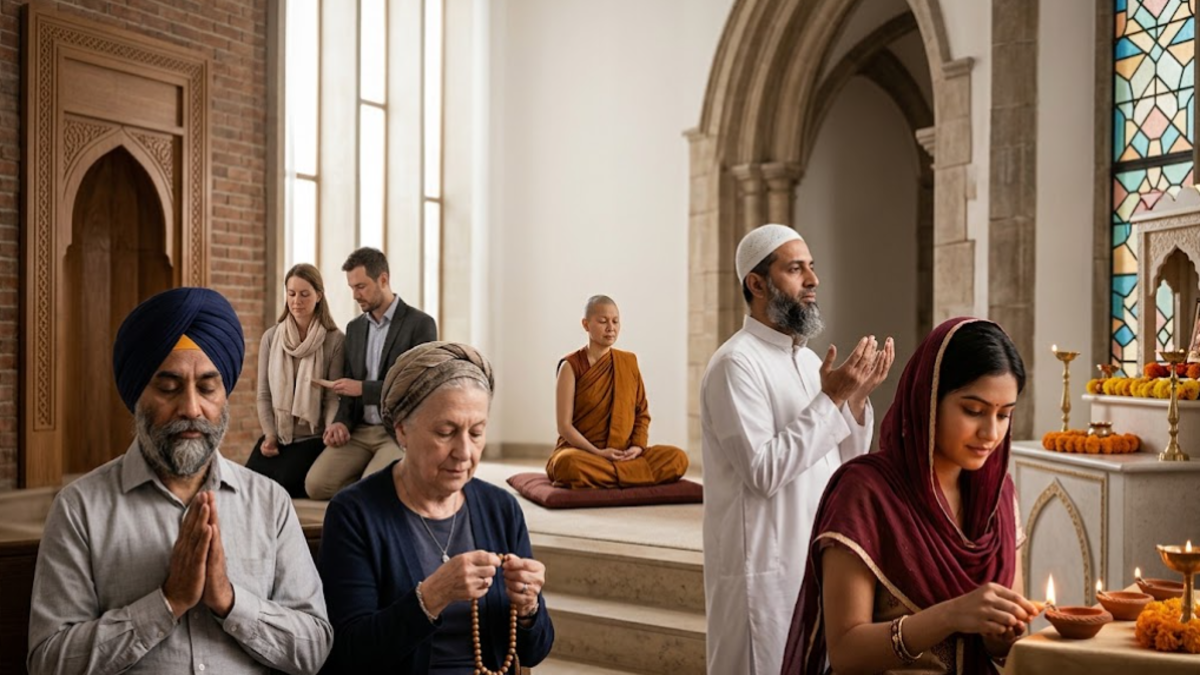
NEW DELHI – ABN News: Why Do Religions Have Rituals?

Religious rituals remain among the most visible and enduring features of spiritual life, from daily prayers and fasting to festivals, pilgrimages, funerals, weddings and communal ceremonies. A discussion in New York today has again placed the relationship between religion, ritual and spiritual discipline in the spotlight, while recent research continues to examine why people devote time, effort and emotion to repeated sacred practices. So, why do religions have rituals, and what purpose do these practices serve beyond ceremony?
Rituals give religious beliefs a practical form. A person may hold an abstract belief about God, the sacred, morality or the meaning of life, but ritual turns that belief into something that can be performed through words, movement, objects, time and shared participation.

That connection between belief and action appeared prominently in comments reported from New York involving Rashtriya Swayamsevak Sangh chief Mohan Bhagwat. Speaking about religious harmony, Bhagwat said that religions in today’s world are often defined by their rituals and argued that ritual discipline has a role in following a religious path toward divinity. He also stressed that the larger purpose of religion is to lead people toward truth.
The remarks highlight an important distinction. Ritual is not necessarily the final objective of religion. For believers, it can function as a means through which religious teachings become part of everyday life.
A prayer repeated each morning, a fast observed during a sacred period, a pilgrimage undertaken at a particular stage of life or a ceremony marking birth and death can all establish a rhythm around religious values.
Rituals also create boundaries between ordinary and sacred time. A particular day, place, meal or gesture can acquire religious significance because a community repeatedly associates it with worship or remembrance.
This pattern appears across very different traditions. Some rituals involve silence and meditation. Others involve music, chanting, movement, food, fire, water, clothing or collective prayer. Their forms differ considerably, but repetition and shared meaning remain common features.
Researchers who study ritual generally describe it as a structured and socially transmitted pattern of behavior. Its actions often follow an established sequence and carry symbolic meaning rather than serving only an obvious practical purpose.
That helps explain why religious rituals can survive for generations. People do not simply repeat an action because it is physically necessary. They repeat it because the action has acquired meaning within a community.
One of the strongest explanations for ritual concerns social connection.
Religion is not only a relationship between an individual and a belief system. In many traditions, it is also a relationship between individuals who recognize the same stories, values, symbols and practices.
A ritual brings those people together and gives them a common activity. Instead of merely saying that they belong to the same community, participants demonstrate that belonging by doing something together.
Scientific research has found evidence supporting this social function. A study examining collective religious ritual in rural South India found a lasting relationship between participation in religious ritual and social cohesion.
Other research has found that ritual participation can influence how people perceive members of their own group. In an experimental study involving children, participation in a collective ritual increased behaviors associated with identifying and signaling membership in the group. The researchers also observed greater attention toward people outside the group.
These findings do not mean that every ritual automatically produces harmony. Ritual can strengthen internal bonds while also making group boundaries more visible. That is one reason scholars distinguish between the positive social functions of ritual and its potential to reinforce divisions.
For religious communities, however, the bonding function remains important.
A congregation that prays together, a family that observes a festival together or a community that gathers for a funeral is doing more than following instructions. Members are sharing time, emotion and memory.
The repetition matters because communities change. Individuals are born, grow older and die, while generations replace one another. Ritual provides a structure through which a community can pass traditions from one generation to the next.
Children learn not only what a community believes but also how its members behave when those beliefs matter most.
A religious ceremony can therefore become a form of cultural education. The participant learns the words, gestures and sequence, but also learns what the community considers sacred, important or worthy of remembrance.
Another reason religions rely on rituals is that beliefs can be difficult to maintain as purely abstract ideas.
A religious principle may call for compassion, gratitude, humility, remembrance or devotion. Ritual gives believers a recurring opportunity to practice those principles.
Fasting, for example, can connect a physical experience with a spiritual discipline. Giving to others can turn an ethical principle into a concrete action. Prayer can create a regular period of reflection. Pilgrimage can transform an idea about sacred history into a physical journey.
The ritual does not necessarily have the same meaning for every participant. One person may experience it primarily as worship, another as family tradition, another as community identity and another as a moment of personal reflection.
That variation does not make the ritual meaningless. It demonstrates how religious practices can operate at several levels simultaneously.
Researchers have also examined the psychological effects of participating in rituals. Studies have associated collective ritual with social bonding, emotional responses and feelings of connection, although researchers caution that outcomes depend on the type of ritual and the circumstances in which people perform it.
A study of a festival in Japan similarly found associations between ritual participation, belief and social cohesion. The researchers reported that active participation was positively related to feelings of social cohesion, while the relationship between ritual, belief, anxiety and prosocial behavior was more complex.
This complexity is important. Ritual should not be treated as a simple psychological formula in which every ceremony produces the same result.
Its effect depends on the people involved, the meaning they attach to the practice, the wider community and the social environment.
Repetition is one of the defining characteristics of ritual.
Religious traditions often ask followers to perform particular actions at particular times. Daily prayers, weekly worship, annual festivals and ceremonies connected with major stages of life create a recurring calendar.
That repetition can make religious identity part of ordinary life.
Without repeated practice, a religious tradition could remain primarily an intellectual system. Ritual places beliefs into schedules, homes, places of worship and family life.
The repeated nature of ritual also helps preserve traditions when circumstances change.
A community may migrate to another country, adopt new technologies or experience major social changes, yet continue a familiar ceremony. The ritual becomes a portable expression of identity.
This can be particularly significant for minority communities. Shared practices can provide continuity when members live far from one another or encounter a surrounding culture with different traditions.
Research on ritual and community has repeatedly pointed to social solidarity and belonging as important functions of religious practice.
The emotional dimension is also significant. People often encounter rituals at moments of uncertainty or transition: birth, marriage, illness, death, mourning, initiation and major changes in social status.
These are precisely the moments when people may seek structure and reassurance.
A ritual does not necessarily remove uncertainty. Instead, it can give people an established way to respond to uncertainty.
Human beings live with uncertainty. People cannot control every event, predict every outcome or fully understand everything that happens around them.
Religious traditions have historically offered frameworks for responding to such uncertainty, and ritual forms an important part of those frameworks.
The act of repeating a familiar sequence can provide a sense of order. Participants know what happens next, who takes part, what words are spoken and what symbols are used.
That predictability can be particularly powerful during emotionally difficult events.
Consider a funeral. The people attending cannot change the fact of death, but a religious funeral can provide a recognized sequence of actions for mourning. Prayer, readings, silence, burial practices, memorial gatherings and other customs give grief a social structure.
The same principle can apply to celebrations.
A wedding ritual does not simply announce a marriage. It places the relationship within a wider social and cultural framework and allows family members and friends to witness the transition.
Religious rituals therefore often operate at the intersection of personal experience and collective life.
Religious rituals frequently use physical objects because symbols can communicate meanings that ordinary language cannot fully capture.
Candles, water, food, clothing, religious texts, sacred buildings, images, beads and other objects can become central parts of ritual practice.
The object itself may be ordinary in another context. Its religious meaning comes from the tradition surrounding it.
The same is true of places.
A building can be more than a physical structure when a community considers it sacred. A particular river, mountain, shrine, temple, church, mosque, synagogue or pilgrimage destination may become connected with generations of religious memory.
Ritual activates those meanings.
When people return repeatedly to the same place or use the same symbols, they reinforce the connection between physical experience and religious identity.
This also explains why changes to ritual can sometimes provoke strong reactions within religious communities. Altering a ritual may appear to change more than a sequence of actions. For participants, it can feel like changing a connection with ancestors, scripture, history or community identity.
Modern life has changed how people communicate, work and participate in communities, but it has not eliminated ritual.
Religious practices can adapt to new circumstances while retaining recognizable structures.
Digital communication, for example, has allowed religious communities to maintain forms of worship and connection when physical gatherings become difficult. Research into digital religion has increasingly examined how technology affects religious authority, participation and ritual expression.
At the same time, rituals are not limited to religion.
Graduation ceremonies, national commemorations, sporting events, military ceremonies, weddings and public memorials all contain ritual elements. They often involve repeated gestures, shared symbols, formal sequences and collective emotion.
That wider presence suggests that ritual may answer a broader human need.
People use structured collective activities to mark important moments, express identity and create shared memories.
A recent psychological review of collective gatherings describes the phenomenon of shared emotional intensity as something that can strengthen collective identity, social cohesion and well-being. The research also notes that such effects can extend beyond the immediate event.
This does not make religious rituals interchangeable with secular events. Religious believers attach theological and spiritual meanings to their practices that secular ceremonies do not necessarily share.
It does, however, help explain why ritual remains such a powerful feature of human societies.
It can be tempting to describe ritual simply as habit. But the two are not identical.
A habit may be something an individual repeats automatically. A ritual usually carries a shared meaning and follows rules recognized by a community.
That distinction is crucial to understanding religion.
When believers repeat a prayer, participate in a festival or observe a ceremony, they may be reaffirming a relationship with God, honoring ancestors, remembering a sacred event, fulfilling a religious obligation or strengthening their connection with a community.
The outward action may appear simple, but the meaning behind it can be layered.
Recent cognitive research has also examined why rituals can persist even when their practical cause-and-effect relationship is unclear. Researchers argue that culturally transmitted beliefs, social rewards and expectations can reinforce ritual behavior and help stabilize shared norms across generations.
In other words, rituals can survive because people learn not only how to perform them but also what those actions are supposed to mean.
That process begins early.
Children watch adults. They imitate movements, learn words and gradually understand which actions belong to their group. Through this process, ritual becomes part of cultural learning.
The renewed discussion surrounding religious harmony and ritual offers a useful reminder that ritual remains central to how many people understand religious identity.
Bhagwat’s comments in New York placed ritual within a broader argument about religious discipline and the search for truth.
Meanwhile, scientific research approaches the same subject from another direction. Instead of asking whether a ritual is spiritually true, researchers can examine what ritual does socially and psychologically.
The two perspectives do not necessarily have to conflict.
A believer may understand prayer as an act of devotion to God. A social scientist may examine how praying together strengthens community ties. Both descriptions can refer to the same event while answering different questions.
That distinction is particularly important when discussing religion in a diverse society.
No single explanation can account for every ritual or every believer. Religious traditions have developed across different cultures and historical periods, and their practices carry meanings that cannot always be reduced to psychology or sociology.
Yet the evidence shows that ritual performs several recognizable functions.
It can preserve tradition, teach values, express devotion, create community, mark transitions, provide structure during uncertainty and strengthen a shared sense of identity.
For many believers, these social and psychological functions are not the reason they perform a ritual in the first place. They are consequences that exist alongside the spiritual meaning of the practice.
The central question, therefore, may not be whether religions need rituals because rituals are useful. Instead, it may be that human beings have repeatedly found ritual to be one of the most effective ways to transform beliefs into lived experience.
The evidence points to four broad explanations.
First, rituals express belief. They give physical form to ideas about the sacred.
Second, rituals build community. Shared actions allow people to experience belonging rather than merely describe it.
Third, rituals preserve tradition. Repetition allows religious knowledge and identity to move from one generation to another.
Fourth, rituals organize important moments. They give communities established ways to respond to birth, marriage, death, celebration, uncertainty and transition.
These functions overlap. A single ceremony can perform all four at once.
That is why rituals have remained important even as societies have changed.
For religious believers, the deepest meaning may remain spiritual: worship, obedience, remembrance, gratitude or a search for divine truth. For researchers, rituals also provide a window into how humans create communities, transmit culture and cope with uncertainty.
The continuing presence of ritual suggests that the practice is not merely an ancient religious leftover. It remains a living part of human social life.
Why do religions use rituals?
Religions use rituals to express beliefs, practice devotion, preserve traditions and bring communities together.
Do all religions have rituals?
Most major religious traditions include ritual practices, although their forms, meanings and frequency vary widely.
Can rituals affect communities?
Yes. Research has associated collective ritual with social bonding, group identity and cohesion, although the effects vary by context.
Are rituals only found in religion?
No. Secular societies also use rituals in ceremonies such as graduations, weddings, memorials, national events and sporting occasions.
… Read more
Contact: info@abnnews.net