Physical Address
304 North Cardinal St.
Dorchester Center, MA 02124
Physical Address
304 North Cardinal St.
Dorchester Center, MA 02124

Religions News Around the World
Religions News Around the World
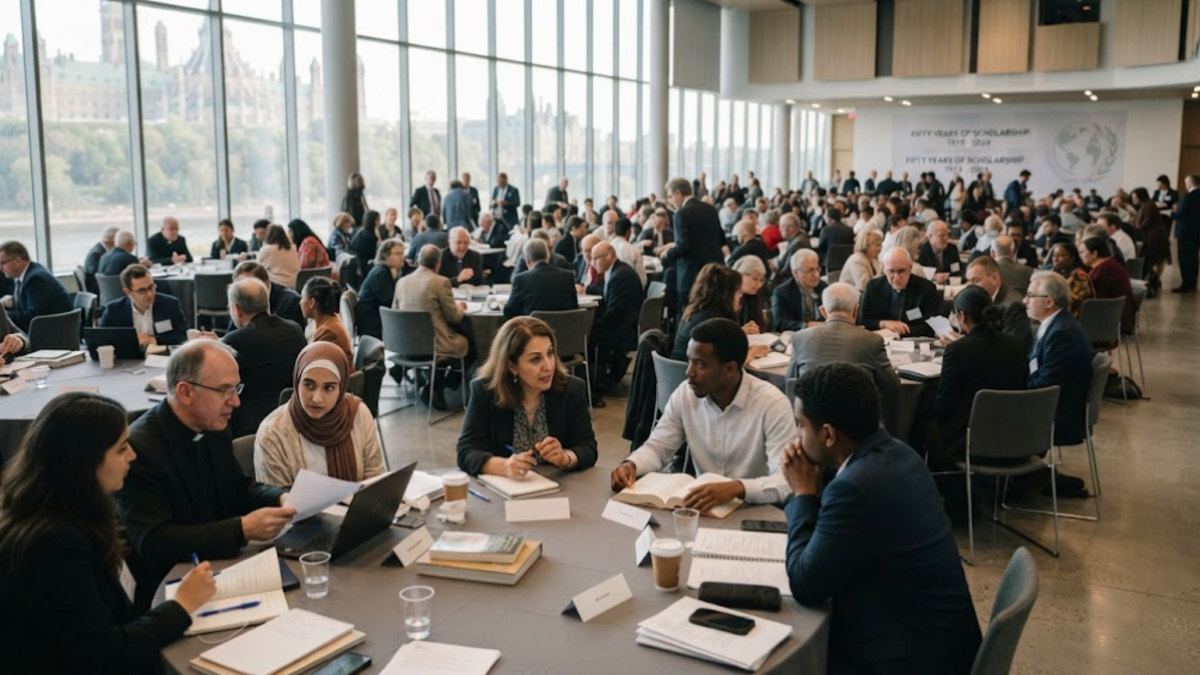
OTTAWA – ABN News: The Association for Bahá’í Studies marked its 50th annual conference in Ottawa with a gathering of about 2,100 participants focused on scholarship, consultation, service and the generation of knowledge for the common good. How has the Association’s approach to scholarship evolved over five decades?

The conference, held last month, brought together academics, professionals, students and others interested in exploring questions at the intersection of the Bahá’í teachings and different areas of human endeavor.
The program opened with 16 two-day seminars covering subjects including health, technology, media, education, the arts, mental health, scientific inquiry and community-engaged research.

A parallel program organized by the Institute for Studies in Global Prosperity brought together young people aged 15 to 21 to examine the relationship between their studies, work, service and contribution to society.
Shabnam Koirala-Azad, chairperson of the Association’s executive committee, described its purpose as creating opportunities for academics, professionals and other participants to bring principles from the Bahá’í Revelation into serious conversation with academic and professional discourses.
Todd Smith, secretary of the executive committee, emphasized that the relationship works in both directions. Engagement with knowledge from diverse fields can also deepen participants’ understanding of the Bahá’í writings.
Speaking on behalf of the National Spiritual Assembly of the Bahá’ís of the United States, Saphira Rameshfar described an approach in which intellectual rigor is brought into harmony with spiritual perception, service and consultation.
She said knowledge is a resource for the advancement of civilization.
The Association was established in 1975 by the National Spiritual Assembly of the Bahá’ís of Canada. At the time, the Canadian Bahá’í community was exploring ways in which insights from the Bahá’í teachings could contribute to intellectual life in universities and other institutions of higher learning.
Its first annual conference took place the following year at Cedar Glen in Bolton, Ontario, with 80 participants.
From its early years, the Association developed publishing activities, lectures, conferences, campus initiatives and other spaces for intellectual engagement with the Bahá’í teachings and questions facing society.
David Smith, who participated in the Association’s early development and later served as a member of the Board of Counsellors in North America, recalled the possibility of people searching for answers to social and technological challenges encountering insights from the Bahá’í teachings in settings of higher learning. He described the Association as “this instrument of learning.”
The Association expanded its mandate across North America in 1981, followed by the opening of the Centre for Bahá’í Studies in Ottawa the next year.
During the 1980s, symposia and dialogues created opportunities for Bahá’í perspectives to be considered alongside other areas of scholarship and contemporary social thought.
The Journal of Bahá’í Studies was established in 1988, providing another avenue through which scholarship could contribute to the intellectual life of the Bahá’í community and wider academic conversations.
Roshan Danesh, a former member of the executive committee, said the Association also helped create settings for scholarship on the Bahá’í Faith outside Persian- and Arabic-language contexts, at a time when such work remained limited.
He said the Association’s focus extended beyond studying the Bahá’í Faith itself to examining its teachings in relation to contemporary thought, helping establish what he called “points of intersection” between Bahá’í thought and wider fields of knowledge.
Pierre-Yves Mocquais, a former executive committee member and professor emeritus at the University of Calgary, highlighted the Association’s willingness to experiment.
“The one thing that to me is remarkable about the Association for Bahá’í Studies is the fact that it has all along experimented,” he said.
The evolution involved more than an increase in the Association’s activities. Participants also reconsidered the spaces and methods through which scholarship could take place.
Julia Berger, another former executive committee member, recalled early “fishbowl conversations,” in which people from similar fields explored questions in their disciplines through the lens of Bahá’í principles and experience.
She described the subsequent process as a “steadfast, dogged commitment to iteration and reflection,” which contributed over time to the more intensive seminars held throughout the year and around the annual conference.
David Smith recalled a movement away from a conference culture centered mainly on lectures toward settings in which participants became more directly involved in sustained inquiry.
The conference included examples of how this approach to scholarship can influence specific areas of inquiry.
Valentina Muraleedharan, a geographer and educator, helped facilitate a seminar on participatory action research, an approach in which communities take an active role in investigating their own social reality and considering responses to conditions they identify.
She contrasted this with research that begins with an outside researcher arriving with a question already defined. Participatory approaches recognize that people within a community possess knowledge of their own experience that outside expertise cannot simply replace.
Dr. Muraleedharan connected this approach with the Bahá’í principle of the oneness of humanity.
“There’s no insider/outsider when it comes to doing research with a community,” she said. “Rather, one sees themselves as part of that community, and the challenges they face as their own challenges.”
She also emphasized the importance of participation in achieving what she described as a just research process and outcome.
“Who is participating in that research becomes really important to achieving a just outcome and a just process,” she said.
Jasmine Miller-Kleinhenz, a molecular biologist and member of the executive committee, described another example involving population health.
Her earlier work focused on treatments for an aggressive form of breast cancer that appeared disproportionately among certain groups of women. She said common explanations sometimes pointed toward ancestry or characteristics presumed to be inherent in those populations, while the scientific evidence did not adequately support those assumptions.
Reflecting on the Bahá’í conception of humanity as one family led her to examine the conditions in which people live, including access to nutritious food, education and green space.
The focus of her research consequently moved from molecular processes within individuals toward the social and physical environments surrounding them.
“It can’t just be something nice that I do on the side,” she said of applying spiritual principles to daily life. “It also has to shape my research questions.”
Technology was another area in which participants examined assumptions underlying established approaches.
Adib Shafipour, who works on artificial intelligence applications for disease detection, described an exercise he introduced while teaching biotechnology. Students examined assumptions embedded within the technologies they were studying.
Their observations included questions about whether extending human life should always be pursued regardless of its quality and whether greater efficiency should automatically be considered desirable without examining wider social and material consequences.
Dr. Shafipour said technology is often presented as neutral, while its design can reflect assumptions about what should be optimized, which needs matter and what constitutes progress.
Michael Sabet, a PhD candidate in political science and editor of The Journal of Bahá’í Studies, helped facilitate a seminar examining alternatives to political partisanship and polarization.
He explained that much political thought begins with individuals or groups understood to have different interests, making the negotiation or contestation of those interests a central political question.
The principle of the oneness of humanity, he said, provides a different starting point.
“If our beginning assumption… is the oneness of humanity, then the discussion begins on a different footing,” Mr. Sabet said.
He referred to the Bahá’í analogy of humanity as a single body, in which different parts have distinct needs while the well-being of one cannot ultimately be secured through the deprivation of another.
He also described consultation as a means of examining differing perspectives together and moving toward a shared understanding that can guide collective action.
Media practitioner Nwandi Lawson described how her own understanding of participation in the Association changed.
“I assumed, as a media professional, ABS is not for me, so I excluded myself,” she recalled.
After being encouraged to participate, she encountered collaborative spaces where her professional experience could contribute to examining assumptions within the media field.
A Grade 12 student also participated in the seminar on media and society, a detail that Ms. Lawson said demonstrated the value of bringing people at different stages of their professional lives into the same conversations.
The conference’s youth program similarly examined how education and future professions can form part of a coherent life of service alongside community-building and social action.
Hoda Farahmandpour, a member of the National Spiritual Assembly of the Bahá’ís of Canada, recalled attending her first Association conference as a young person.
Addressing the conference at its opening, she spoke of opportunities for young people to enter academic and professional fields “in the company of experienced people” while developing the intellectual rigor and clarity of thought needed to contribute to a common pool of knowledge.
The Universal House of Justice also addressed the National Spiritual Assembly of Canada in 2013, encouraging the development of settings where people from similar academic disciplines could examine prevalent discourses in their fields and highlighting the Association’s potential contribution as younger generations entered diverse areas of human endeavor.
Mariam Ashtiani, a sociologist and member of the executive committee, described the Association’s evolution as closely connected to capacities developing within the wider Bahá’í community.
“The evolution of the Association is a direct reflection of the capacities that are being built in the Bahá’í community outside of ABS,” she said.
She explained that experiences from community-building and social action provide insights into the application of spiritual principles to lived reality, while habits of consultation, learning and reflection can enrich approaches to academic and professional questions.
The Association’s changing approach can also be seen in collaborative research and writing. Todd Smith described a reading group that began by studying the work of a philosopher of science and eventually developed into a collaborative writing project involving seven participants.
They met regularly over several years, reviewing abstracts, outlines and successive drafts while drawing on insights from larger seminars. The process resulted in six essays published across two issues of The Journal of Bahá’í Studies.
Dr. Smith emphasized that the purpose extended beyond publication. Participants were learning how to “assist each other to develop their essays alongside each other,” bringing consultation and collaboration into the scholarly process.
Dr. Ashtiani said the annual conference was historically viewed as the Association’s main vehicle but increasingly serves as an “inflection point” where inquiries pursued throughout the year come together.
Duncan Hanks, a longtime collaborator, described the growth of “collective learning and collaborative spaces” and a broader circle of people participating in Bahá’í scholarship and the generation of knowledge.
The Association continues to value specialized scholarly contributions while also recognizing professionals, students and people involved in grassroots efforts as participants in the process.
The conference explored scholarship, consultation, service and the relationship between Bahá’í principles and different areas of academic and professional inquiry.
About 2,100 participants attended the gathering in Ottawa.
The Association was established in 1975 by the National Spiritual Assembly of the Bahá’ís of Canada.
Seminars addressed fields including health, technology, media, education, the arts, mental health, scientific inquiry and community-engaged research.
… Read more
Contact: info@abnnews.net