Physical Address
304 North Cardinal St.
Dorchester Center, MA 02124
Physical Address
304 North Cardinal St.
Dorchester Center, MA 02124

Religions News Around the World
Religions News Around the World
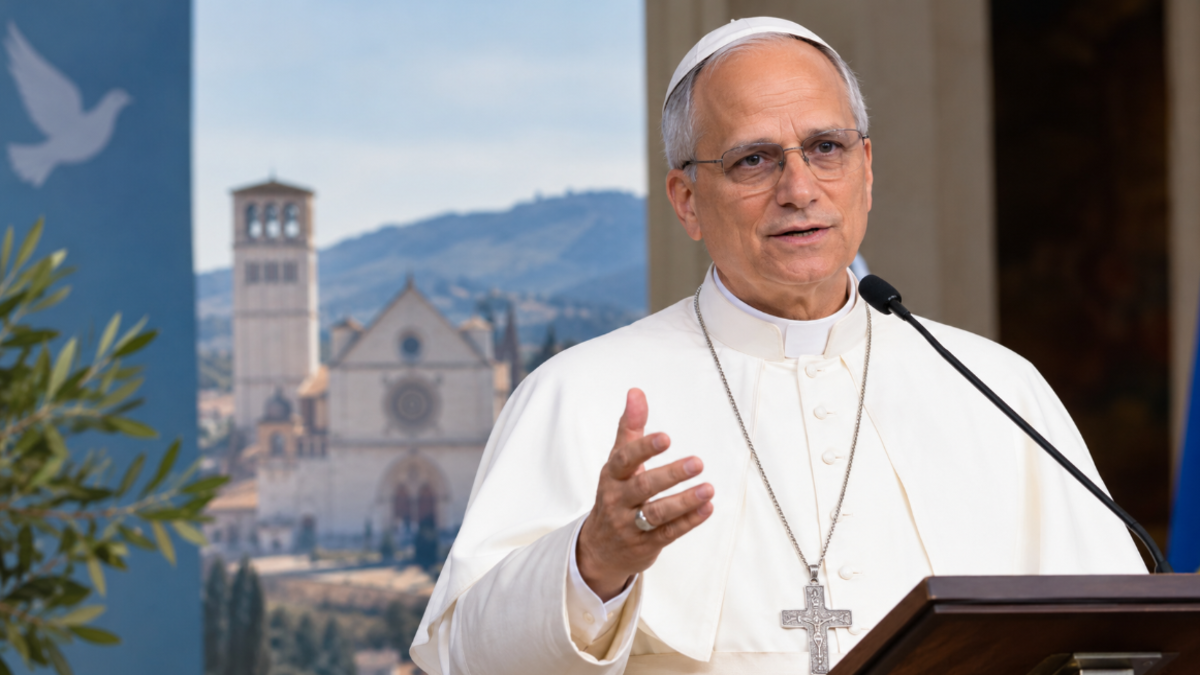
Pope Leo XIV has delivered a forceful message against the use of religion to justify war, declaring that “there is no such thing as a holy war: only peace is holy.” In a video message sent on 27 October to an international peace meeting in Assisi, Italy, the pontiff called on religious leaders and political authorities to reject violence, strengthen dialogue and make peace a shared global priority.


His message, delivered during a gathering marking 40 years since the historic interreligious peace meeting initiated by Pope John Paul II, places renewed emphasis on the responsibility of religious communities to resist hatred and help prevent conflict.

In his address to participants in the international meeting Unarmed and Disarming Peace, Pope Leo XIV warned against the growing acceptance of war as a tool of international politics.
“We must rebuild peace everywhere, not prepare for more wars,” he said, urging believers to reject attempts to invoke God in support of armed conflict.
The pope argued that using religion to legitimize violence contradicts the fundamental purpose of faith. His position is clear: religious beliefs should encourage reconciliation and understanding rather than deepen divisions between nations, communities or peoples.
The message comes amid continuing international conflicts and heightened concerns about militarization. Without presenting religion as the sole cause of war, Leo XIV challenged religious leaders to ensure that faith is not exploited to legitimize violence.
The meeting in Assisi carries particular historical significance. On 27 October 1986, Saint John Paul II brought religious leaders together for a World Day of Prayer for Peace, establishing an important precedent for interreligious cooperation.
Leo XIV recalled that gathering as a continuing example of how people from different religious traditions can work together without abandoning their distinct beliefs. He also acknowledged the work of the Dicastery for Interreligious Dialogue and the Community of Sant’Egidio in sustaining this tradition.
The anniversary is more than a commemoration. It provides an opportunity to assess whether religious institutions are using their influence to reduce hostility and encourage peaceful coexistence.
The pope’s appeal also reflects a broader concern: when national identity, political ambition and religious language become intertwined, communities can be encouraged to view opponents as enemies rather than fellow human beings.
The pontiff presented dialogue, mediation and prayer as central elements of a credible response to conflict.
He called on religious leaders to foster conversations both among believers and throughout society, replacing arrogance with negotiation and mutual understanding.
His position is also consistent with Magnifica Humanitas, his encyclical published on 15 May 2026. In that document, Leo XIV argues that religious traditions have an important role in opposing violence and promoting dialogue between communities. He maintains that using God’s name to legitimize terrorism, violence or war betrays the purpose of religion.
The message has implications beyond religious institutions. Governments, civil society organizations and community leaders also influence how conflicts are understood and whether peaceful solutions remain politically possible.
Dialogue alone cannot guarantee an end to fighting. However, diplomatic engagement can create channels for negotiation, reduce misunderstandings and help establish conditions for reconciliation.
Leo XIV’s declaration challenges the idea that military confrontation can be made morally acceptable simply by attaching religious language to it.
His message does not offer a detailed settlement for any particular conflict. Instead, it establishes a moral principle: religion should not be used as a tool for legitimizing violence.
That distinction matters because contemporary conflicts can involve overlapping political, territorial, historical and religious factors. Treating every conflict as a religious war risks obscuring its actual causes and making reconciliation more difficult.
The pope’s appeal encourages religious communities to resist rhetoric that dehumanizes opponents and to support efforts that protect human life.
It also raises a practical question for faith leaders: how can they turn declarations of peace into tangible action? Possible contributions include facilitating interfaith dialogue, supporting humanitarian assistance, helping displaced communities and encouraging political leaders to pursue negotiations.
These actions cannot replace diplomacy or the responsibilities of governments. They can, however, help strengthen the social relationships on which lasting peace depends.
Pope Leo XIV’s message offers a clear challenge to religious and political authorities: the credibility of appeals to peace depends on whether they are reflected in conduct.
Condemning violence is a necessary starting point, but it is not enough. Religious leaders must also be prepared to challenge inflammatory rhetoric within their own communities, defend the dignity of civilians and maintain relationships across religious and political divisions.
Governments, meanwhile, retain responsibility for diplomatic decisions, the protection of civilians and compliance with international law. Religious appeals can contribute to these efforts, but they cannot substitute for concrete political action.
The significance of the Assisi meeting lies in its insistence that differences of belief need not become grounds for hostility. At a time when war can be portrayed as inevitable, the pope’s call for dialogue and mediation reinforces the principle that peace must be actively pursued.
He said that war must never be waged in God’s name and declared that there is no such thing as a holy war, insisting that only peace is holy.
He delivered the video message on 27 October 2026 to participants in the international meeting Unarmed and Disarming Peace in Assisi, Italy.
It marked 40 years since Saint John Paul II’s World Day of Prayer for Peace, held in Assisi on 27 October 1986, which brought religious leaders together to pray for peace.
He emphasized prayer, interreligious dialogue, mediation, negotiation and a rejection of attempts to justify war through religion.
The address focused on the broader problem of war and its religious justification. It did not propose a specific settlement for an individual conflict.
1. The Holy See (Vatican) — Video Message of His Holiness Pope Leo XIV to the Participants in the International Meeting “Unarmed and Disarming Peace” (Assisi, 27 October 2026)
https://www.vatican.va/content/leo-xiv/en/messages/pont-messages/2026/documents/20261027-videomessaggio-assisi.html
2. The Holy See (Vatican) — Encyclical Letter Magnifica Humanitas of His Holiness Pope Leo XIV (15 May 2026)
https://www.vatican.va/content/leo-xiv/en/encyclicals/documents/20260515-magnifica-humanitas.html
….Read More
Contact: info@abnnews.net