Physical Address
304 North Cardinal St.
Dorchester Center, MA 02124
Physical Address
304 North Cardinal St.
Dorchester Center, MA 02124

Religions News Around the World
Religions News Around the World
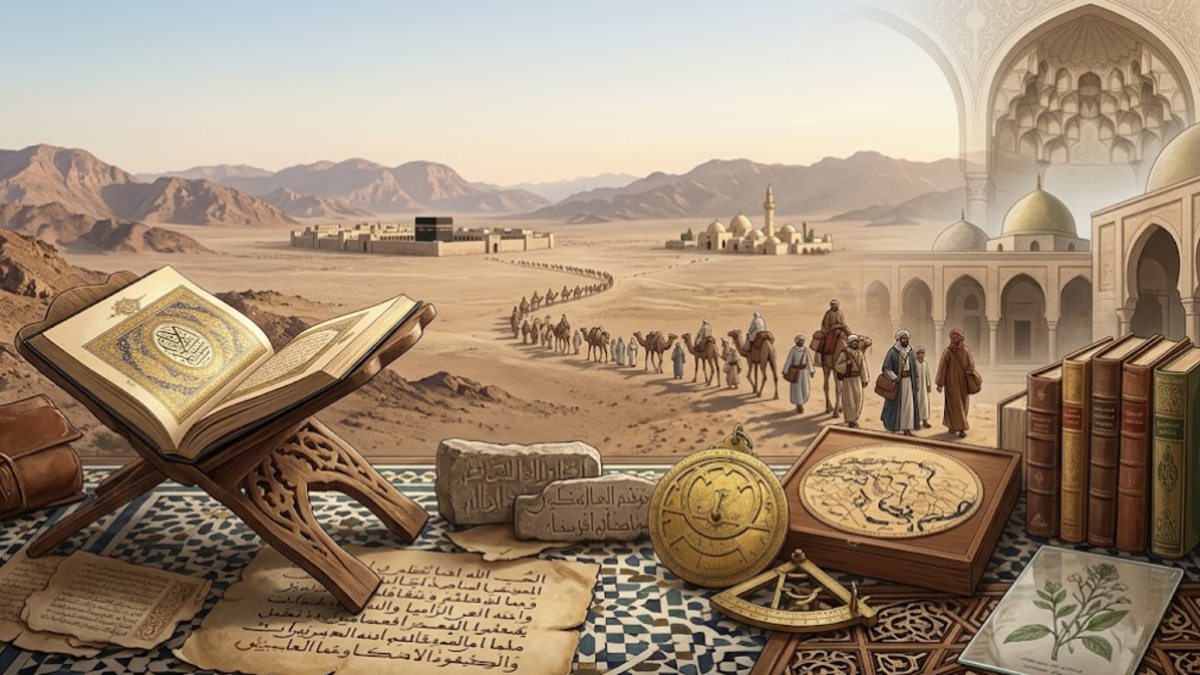
LONDON – ABN News: History of Islam is once again at the centre of international attention as archaeologists, museums and researchers uncover new evidence and revisit centuries of Islamic intellectual and cultural heritage. Recent reports from Saudi Arabia, Uzbekistan and West Africa show how inscriptions, manuscripts, museums and contested artefacts continue to reshape the way the Muslim world’s past is studied and presented. But what can these discoveries tell us about the origins, expansion and enduring legacy of Islam?

The study of Islam is not limited to religious texts or accounts preserved by later generations. Archaeology, inscriptions, manuscripts, architecture and material culture also provide important evidence for understanding the societies that developed around Islam from its earliest centuries.
That approach has gained renewed attention following archaeological work in western Saudi Arabia. A recent survey in Al Mahd Governorate, in the wider Medina region, documented 1,774 archaeological finds, including Islamic inscriptions, older inscriptions, rock art, stone structures, historical palaces, wells and ancient caravan routes.

Researchers recorded 156 archaeological sites during the survey. The material included 461 Islamic inscriptions, 34 Thamudic inscriptions and 1,259 rock-art panels, alongside 11 stone structures, three historical palaces, four wells and two caravan routes.
Among the most notable discoveries were inscriptions containing the name of Umar ibn al-Khattab, the second caliph in Islamic tradition. The findings have attracted attention because inscriptions carved into the landscape can provide evidence about how people used, travelled through and understood the Arabian Peninsula during the early Islamic period.
The discoveries do not, by themselves, establish that Umar personally visited every location where his name appears. Instead, historians must examine the inscriptions, their language, location, dating and archaeological context before drawing conclusions.
That distinction matters. The history of Islam spans more than fourteen centuries and includes religious, political, economic, scientific and cultural developments across a vast geographical area. Each new piece of evidence therefore forms part of a much larger historical record.
Islam emerged in the Arabian Peninsula in the seventh century. According to Islamic tradition and the historical record, Muhammad was born in Mecca around 570 and belonged to the Quraysh tribe, which held an important position in the city’s commercial and religious life.
Muslims believe Muhammad began receiving revelations from God through the angel Gabriel around 610. These revelations continued over the following years and became the foundation of the Quran, Islam’s sacred scripture.
The early message placed strong emphasis on the oneness of God, moral responsibility, charity, justice and accountability. Muhammad’s preaching challenged established religious and social practices in Mecca and attracted both followers and opposition.
The Muslim community later migrated from Mecca to Medina in an event known as the Hijra. The migration became a defining moment in Islamic history and established Medina as a centre of the emerging Muslim community.
Muhammad served not only as a religious leader but also as the head of the community in Medina. Alliances, agreements, conflicts and expanding relations with neighbouring groups shaped the political environment of the Arabian Peninsula.
When Muhammad died in 632, the Muslim community faced the question of political leadership. Abu Bakr became the first caliph, followed by Umar ibn al-Khattab, Uthman ibn Affan and Ali ibn Abi Talib. These four rulers are collectively known in Sunni tradition as the Rashidun, or “Rightly Guided” caliphs.
The period was brief but highly consequential. It established political institutions and helped spread Muslim rule beyond much of the Arabian Peninsula.
The political expansion of the early Muslim state continued under the Umayyad dynasty, which established its capital in Damascus. Muslim rule eventually extended across large areas of the Middle East, North Africa and the Iberian Peninsula, while territories to the east reached into Central and South Asia.
This expansion did not create a single uniform society. Instead, Islamic civilisation developed through interaction among Arabs, Persians, Berbers, Turks, Africans, Central Asians, South Asians and many other peoples.
Languages, artistic traditions, legal schools and intellectual practices varied from one region to another. Arabic became a major language of religion and scholarship, while Persian and other languages played significant roles in literature, administration and culture.
The Abbasid period brought another major transformation. After overthrowing the Umayyads in the eighth century, the Abbasids established Baghdad as their political centre. The city became one of the world’s leading centres of learning, commerce and intellectual exchange.
Scholars worked on mathematics, astronomy, medicine, philosophy, geography and literature. Texts from Greek, Persian and Indian traditions entered Arabic intellectual circles, while Muslim scholars developed and expanded those fields through their own research and debate.
The historical record also reveals disagreement, political rivalry and religious diversity. Sunni and Shia traditions developed distinct interpretations of leadership and authority, while numerous schools of law and theology emerged within the wider Muslim world.
For that reason, the history of Islam cannot be reduced to a simple sequence of rulers. It is also the history of communities, ideas, trade routes, cities, scholars, artisans and ordinary families.
Written sources remain central to the study of Islamic history. Manuscripts preserve religious texts, scientific works, poetry, legal discussions, correspondence and records of administration.
The importance of these materials has become particularly visible as museums and research institutions expand their efforts to preserve and explain Islamic heritage.
In Tashkent, a major new Centre of Islamic Civilization has brought together museum collections, research facilities, a library, archives, restoration laboratories and educational spaces. The centre presents Islamic civilisation through historical objects as well as modern interpretation and technology.
The project reflects a broader trend in which countries with deep Islamic histories are investing in institutions designed to connect archaeological evidence with scholarship and public education.
Such centres can change the way visitors encounter history. Instead of seeing isolated objects behind glass, audiences can examine how manuscripts, architecture, scientific achievements, trade networks and religious traditions developed together.
Museums also face difficult questions. Collections assembled during colonial periods sometimes contain objects and manuscripts removed from their countries of origin. That has led to growing international discussion about ownership, restitution and the responsibilities of museums.
The history of Islam extends far beyond the Middle East. Muslim communities have existed in Africa for centuries, producing scholars, states, commercial networks and manuscript traditions of their own.
A recent dispute over the so-called Ségou treasure illustrates the continuing importance of that history. The collection includes hundreds of manuscripts and other objects associated with El Hadj Omar Tall, a nineteenth-century West African Muslim scholar, religious figure and political leader.
The collection was taken during the French conquest of Ségou in the nineteenth century and later entered French national institutions. Descendants of Omar Tall and Senegalese authorities have pursued the return of the materials.
The issue is not simply about individual objects. Manuscripts can carry religious, intellectual and family histories that connect present-day communities with earlier generations.
The restitution debate therefore raises a wider question: who should control the preservation and interpretation of cultural heritage?
For historians, the return of manuscripts can also create opportunities for local research, digitisation and public education. For communities, it can represent the recovery of material connected to religious and intellectual traditions that colonial rule disrupted.
The discussion demonstrates that the history of Islam is not confined to famous capitals such as Mecca, Medina, Damascus, Baghdad or Cairo. It also developed in Timbuktu, Ségou and other centres across Africa, as well as in Central Asia, South Asia, Southeast Asia and Europe.
Archaeological evidence from Arabia provides another reminder of the importance of movement.
Caravan routes, wells and settlements were essential to life in the Arabian Peninsula. Long before and during the early Islamic period, merchants, pilgrims and travellers crossed difficult terrain linking settlements and markets.
The newly documented routes and wells in Saudi Arabia provide evidence of this physical infrastructure. Such discoveries help researchers understand how people moved through landscapes that modern observers might otherwise view only as remote desert areas.
Trade also helped carry ideas. Goods travelled with people, and so did languages, religious practices, technologies and artistic styles.
The growth of Muslim societies therefore involved more than military expansion. Merchants and scholars played important roles in connecting regions, while migration and pilgrimage created additional networks.
The annual pilgrimage to Mecca became one of the most important links between Muslim communities. People arriving from Africa, Asia, Europe and elsewhere brought different languages and cultural traditions into contact.
Over time, these connections contributed to the remarkable diversity of Islamic civilisation.
Islamic history can also be read through buildings and objects.
Mosques, schools, libraries, markets, palaces, roads, irrigation systems, ceramics, textiles and coins all provide evidence about the societies that produced them.
Architecture changed as Islam reached different regions. Builders incorporated local materials and traditions while developing forms associated with Islamic religious and civic life.
The same process occurred in art. Calligraphy became particularly important, while geometric patterns, vegetal designs, ceramics, metalwork and textiles developed distinctive regional styles.
Scientific history provides another important dimension. Muslim scholars participated in international intellectual networks and preserved, translated, criticised and expanded earlier knowledge.
Astronomy served religious and practical purposes, including the calculation of calendars and prayer times. Mathematics developed through work on arithmetic, algebra and geometry. Medical scholars produced extensive writings on diagnosis, treatment and pharmacology.
These achievements were not isolated from the wider world. Islamic civilisation interacted constantly with neighbouring cultures and earlier intellectual traditions.
The renewed interest in Islamic archaeology comes at a time when cultural heritage faces serious threats from conflict, environmental damage, neglect and illegal trafficking.
Recent reporting has highlighted the destruction and damage affecting historic sites and archives across parts of the Middle East and North Africa. Such losses are significant because archaeological sites cannot simply be recreated once their original layers disappear.
Preservation has therefore become an urgent part of historical research.
Digital technology offers new possibilities. Researchers can photograph inscriptions, create three-dimensional models, digitise manuscripts and make collections available to scholars and students around the world.
These tools do not replace physical artefacts, but they can help document them and broaden access to historical evidence.
They can also encourage a more careful approach to the past. Rather than relying exclusively on later narratives, historians can compare written accounts with inscriptions, archaeological remains, coins, architecture and other evidence.
That process can produce a more detailed picture of how Muslim societies actually changed over time.
The history of Islam is often presented as a completed story beginning in seventh-century Arabia and moving through a succession of caliphates, dynasties and empires.
Modern research shows something more complicated.
Islamic history is continually being reassessed as archaeologists discover new sites, scholars reinterpret manuscripts and museums reconsider how they present their collections.
The Saudi findings demonstrate the value of archaeology in the Arabian Peninsula. The developing museum landscape in Central Asia demonstrates how governments and institutions are presenting Islamic civilisation to new audiences. The dispute over West African manuscripts shows that questions about Islamic heritage remain closely connected to colonial history and cultural identity.
Together, these developments reinforce an important point: historical knowledge changes when new evidence emerges.
The origins of Islam remain rooted in the religious and historical traditions associated with Muhammad, Mecca and Medina. Its subsequent development, however, involved countless communities spread across continents.
The Muslim world produced different political systems, intellectual traditions, artistic schools and social structures. Some flourished for centuries; others disappeared or transformed under new rulers and changing economic conditions.
Today, researchers continue to piece together those stories from fragments preserved in stone, parchment, buildings, archives and oral traditions.
The official Saudi heritage authorities continue to document archaeological evidence from the Arabian Peninsula, making such material increasingly accessible to researchers and the public.
For readers trying to understand the history of Islam, the latest archaeological and museum developments offer more than news about individual discoveries. They demonstrate that the past remains an active field of investigation, where every inscription, manuscript and ancient route can add another piece to a story that stretches across more than a millennium.
The history of Islam traces the development of the religion and Muslim societies from the emergence of Muhammad’s message in seventh-century Arabia through the growth of Islamic states, cultures, intellectual traditions and communities across the world.
Islam emerged in the Arabian Peninsula, with Mecca and Medina playing central roles in its earliest history.
Archaeological discoveries provide physical evidence that can help historians understand early Muslim communities, travel routes, settlements, inscriptions, trade and everyday life.
Yes. Muslim societies and intellectual traditions developed across Africa, Europe, Central Asia, South Asia and Southeast Asia, producing diverse cultures and historical experiences.… Read more
Contact: info@abnnews.net