Physical Address
304 North Cardinal St.
Dorchester Center, MA 02124
Physical Address
304 North Cardinal St.
Dorchester Center, MA 02124

Religions News Around the World
Religions News Around the World
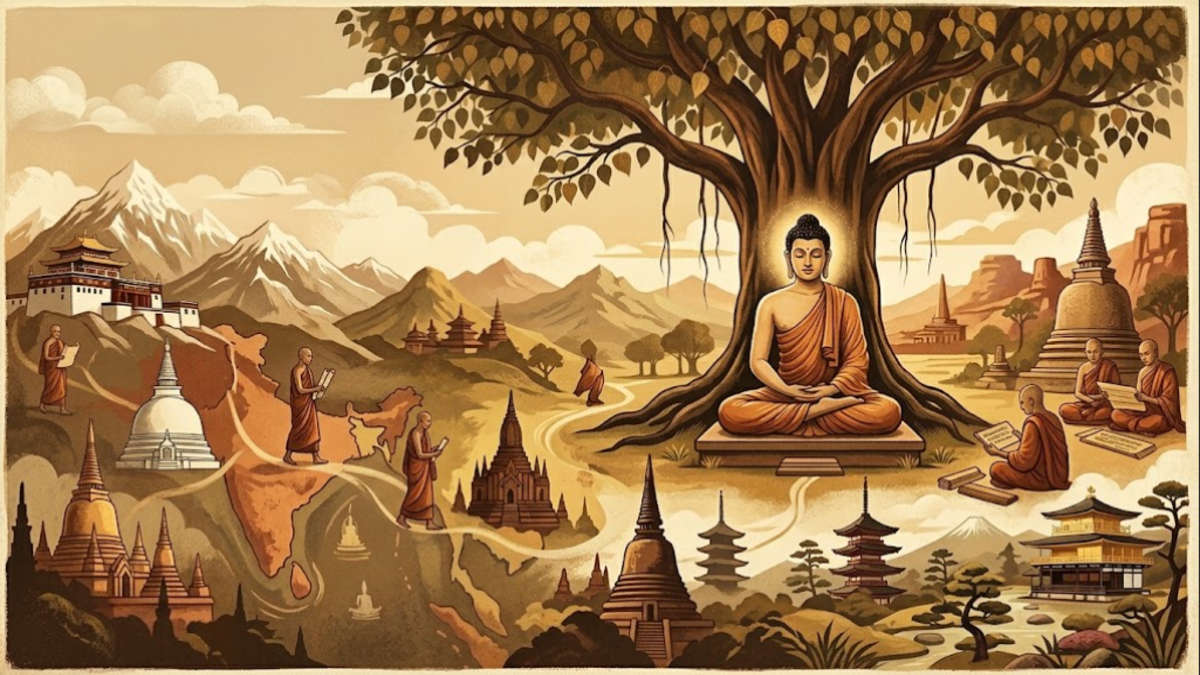
NEW DELHI – ABN News: History of Buddhism has entered a fresh chapter in public attention as ancient Buddhist sites, archaeological evidence and historic places associated with Siddhartha Gautama continue to attract international interest. From its beginnings in the Indian subcontinent to its spread across Asia, Buddhism has developed through centuries of teaching, scholarship, art, trade and cultural exchange. Recent attention to Sarnath and other Buddhist heritage sites has once again highlighted a history that stretches back more than two millennia—but how did Buddhism begin, and how did it become one of Asia’s most influential religious and cultural traditions?

The history of Buddhism is traditionally traced to Siddhartha Gautama, who became known as the Buddha, meaning the “Awakened One.” He lived in ancient South Asia, although historians continue to debate the precise dates of his life.
Buddhist tradition places the Buddha’s early life in Lumbini, in present-day Nepal. He was born into a privileged family and later left that life in search of an answer to the problem of human suffering.

According to Buddhist accounts, Siddhartha encountered old age, sickness and death, experiences that changed his understanding of the world. He eventually abandoned his princely life and began a period of spiritual searching.
After years of seeking answers, he attained enlightenment while meditating beneath what became known as the Bodhi tree at Bodh Gaya in present-day Bihar, India.
The Buddha then began teaching a path that addressed suffering, its causes and the possibility of liberation. His teachings became the foundation of Buddhism and were transmitted initially through oral tradition.
One of the central teachings is the Four Noble Truths. These explain the nature of suffering, its causes, the possibility of ending suffering and the path leading toward that goal.
The Buddha also taught the Noble Eightfold Path, which emphasizes ethical conduct, mental discipline and wisdom. These principles became fundamental to Buddhist practice.
The early Buddhist community included monks, nuns and lay followers. Monastic communities helped preserve the teachings and provided a structure through which Buddhism could expand beyond its original centers.
Archaeological evidence has also contributed to understanding the early history of the religion. Excavations at Lumbini have identified structural remains associated with an early Buddhist sacred complex. UNESCO has reported that archaeological discoveries there provided evidence for an early date associated with the Buddha’s life.
The combination of literary traditions and archaeology continues to shape modern scholarship on Buddhism.
Following the Buddha’s death, his followers continued to preserve and transmit his teachings. The Buddhist community expanded through networks of monasteries, teachers, merchants and rulers.
The early centuries saw the development of different schools and interpretations. Buddhist monks gathered in councils to discuss teachings and disciplinary practices, while oral transmission remained important for preserving religious texts.
A major turning point came during the reign of Emperor Ashoka of the Mauryan Empire. Ashoka ruled much of the Indian subcontinent and became one of the most important political patrons of Buddhism.
Historical evidence, including inscriptions associated with Ashoka, shows that the emperor supported Buddhist institutions and promoted ethical principles across his realm.
Ashoka’s influence helped connect Buddhism with a much wider political and cultural landscape. Buddhist missions and contacts extended beyond the Indian heartland, helping establish communities in other parts of South Asia.
Sri Lanka became especially important in the subsequent development of Buddhism. The island developed a major Buddhist tradition and became an important center for preserving texts and monastic learning.
From South Asia, Buddhism eventually reached Central Asia and East Asia. Merchants and travelers played a significant role in this process, carrying religious ideas along trade routes that connected distant regions.
The Silk Roads became important channels for cultural exchange. Buddhist monks traveled alongside commercial networks, while translations allowed teachings originally transmitted in Indic languages to reach new audiences.
The expansion was not simply a matter of religious conversion. Buddhism interacted with existing philosophies, customs, languages and artistic traditions.
As it moved into new regions, Buddhist communities developed distinct forms of worship, meditation, scholarship and artistic expression.
That diversity remains one of the defining features of Buddhism today.
Buddhist monasteries became more than places of worship. Many developed into centers for education, manuscript production, debate and intellectual exchange.
Nalanda in Bihar became one of the best-known examples. Its history demonstrates the connection between Buddhism, education and international scholarly networks.
Students and teachers from different parts of Asia traveled to major centers of Buddhist learning. They studied philosophy, logic, language, medicine and religious texts.
The movement of scholars helped create intellectual links that extended far beyond political borders.
Buddhist manuscripts also traveled across Asia. Translation became particularly important as teachings were rendered into languages such as Chinese and Tibetan.
The scale of this literary transmission was enormous. UNESCO notes that the spread of Buddhism from South Asia to China led to centuries of scriptural translation, producing a Chinese Buddhist canon containing more than 5,000 fascicles.
These translations preserved religious teachings while also creating new literary and philosophical traditions.
Buddhism reached China during the early centuries of the Common Era and gradually became an important part of Chinese intellectual and religious life.
Chinese Buddhist traditions developed through the work of translators, monks and scholars. They also interacted with indigenous Chinese philosophies and religious practices.
The movement of Buddhist texts across China encouraged further transmission toward Korea and Japan.
Korean Buddhist traditions developed distinctive institutions and artistic styles, while Buddhism became deeply connected with Japanese culture.
In Japan, several major Buddhist schools emerged. Zen Buddhism became internationally known for its emphasis on meditation, discipline and direct experience.
Other Japanese traditions developed around devotion, ritual and philosophical teachings.
Buddhist art changed dramatically as the religion crossed cultural boundaries. Sculptors and painters represented the Buddha and other figures using local artistic conventions.
The Gandhara region, covering parts of modern Pakistan and Afghanistan, became particularly significant for Buddhist art. Its sculptures demonstrate interaction between Buddhist themes and artistic traditions associated with the wider Hellenistic world.
Elsewhere, Buddhist architecture produced monumental stupas, temples and monasteries.
Borobudur in Indonesia became one of the most celebrated examples of Buddhist architecture in Southeast Asia. The monument reflects the scale and sophistication of Buddhist culture outside the Indian subcontinent.
Buddhism also established deep roots across Southeast Asia.
Theravada Buddhism became particularly influential in countries including Sri Lanka, Myanmar, Thailand, Laos and Cambodia, although the religious history of the region is more complex and includes periods of interaction between Buddhist, Hindu and local traditions.
Monasteries became important parts of community life. They served religious functions while also contributing to education and cultural continuity.
Royal patronage played an important role in the development of Buddhist institutions. Kings and courts sometimes supported monasteries, temples and religious scholarship.
At the same time, ordinary communities sustained Buddhism through donations, festivals, pilgrimages and participation in monastic life.
This relationship between monks and lay communities helped Buddhism survive political changes over many centuries.
The religion also left a major architectural legacy. Temples, stupas and archaeological sites across Asia provide evidence of the geographical reach of Buddhist civilization.
Many of these locations remain active religious centers rather than simply archaeological attractions.
Pilgrims continue to visit places associated with the Buddha’s life, including Lumbini, Bodh Gaya, Sarnath and Kushinagar.
Recent international attention has placed Sarnath at the center of renewed discussion about Buddhist heritage.
Sarnath, near Varanasi in Uttar Pradesh, holds a unique position in Buddhist history because tradition identifies it as the place where the Buddha delivered his first sermon after enlightenment.
The site contains important archaeological remains, including the Dhamek Stupa and remnants of ancient monastic complexes.
Its significance extends beyond religious pilgrimage. Sarnath provides evidence of the development of Buddhist architecture, sculpture and monastic culture over centuries.
The site’s international importance received further recognition when the Ancient Buddhist Site of Sarnath was inscribed on the UNESCO World Heritage List during the World Heritage Committee’s meeting in Busan. The designation made it India’s 45th World Heritage Site.
The decision has also renewed discussion about conservation, tourism and the protection of sacred landscapes.
Sarnath has long attracted pilgrims and visitors, but heritage recognition could increase international attention to the archaeological remains and the wider history of Buddhism in northern India.
Recent reporting has also examined whether the new recognition could help Sarnath establish a stronger identity as an independent cultural and spiritual destination rather than remaining primarily an excursion from nearby Varanasi.
For historians, however, the importance of Sarnath goes far beyond tourism.
It represents a crucial moment in the Buddhist story: the beginning of the Buddha’s public teaching career.
The history of Buddhism cannot be understood only through religious texts.
Its development can also be traced through sculptures, inscriptions, manuscripts, temples, monasteries and archaeological remains.
Buddhist art provides a visual record of how communities understood the Buddha and his teachings.
Early Buddhist art sometimes represented the Buddha indirectly through symbols such as the Dharma wheel, the Bodhi tree or footprints. Later traditions increasingly produced human representations of the Buddha.
Different regions developed distinctive artistic languages.
Indian sculpture influenced Buddhist art across Asia, while local cultures introduced their own approaches to architecture and religious imagery.
Written records are equally important.
The preservation and translation of Buddhist scriptures created an extensive literary heritage. Monks and scholars copied manuscripts by hand for centuries before printing technologies transformed the circulation of religious texts.
China, Korea and Japan later developed sophisticated traditions of Buddhist printing.
UNESCO records the survival of major Buddhist scriptural collections, including three editions preserved at Zojoji in Japan. These collections reflect centuries of printing and preservation efforts in China and Korea.
The survival of these materials allows researchers to examine how Buddhist teachings changed as they moved between languages and cultures.
One of the most striking features of Buddhism is its ability to adapt while retaining recognizable core teachings.
Buddhism in Sri Lanka does not look exactly like Buddhism in Japan. Tibetan Buddhism differs in important ways from Theravada traditions in Southeast Asia, while Chinese and Korean schools developed their own philosophical and institutional traditions.
Yet all remain connected to the teachings attributed to the Buddha.
This diversity emerged through centuries of interaction.
Buddhist communities encountered different political systems, languages and social structures. Rather than developing in isolation, they participated in broader networks of trade and cultural exchange.
The result was a religious civilization that crossed borders without becoming culturally uniform.
The modern history of Buddhism has been shaped by colonialism, nationalism, migration, scholarship and global communication.
During the nineteenth and twentieth centuries, Buddhist thinkers responded to changing political and intellectual conditions. Some emphasized meditation and philosophy, while others focused on social reform, education and the recovery of Buddhist heritage.
Buddhist communities also established institutions outside Asia.
Migration helped spread Buddhism to Europe, North America, Australia and other parts of the world. Buddhist centers appeared in major cities, often serving communities from Asian countries as well as people who adopted Buddhist practices independently.
Meditation became particularly influential internationally.
Although meditation has existed within Buddhist traditions for centuries, modern presentations often separate specific practices from their traditional religious settings.
This has created both opportunities and debates about how Buddhism should be represented outside its historical cultures.
At the same time, Buddhist heritage remains closely connected to pilgrimage and religious identity.
Ancient sites continue to serve living communities, demonstrating that Buddhist history is not simply a subject confined to museums and textbooks.
The renewed attention to Sarnath illustrates a wider international interest in preserving Buddhist heritage.
Across Asia, ancient monasteries and archaeological sites face challenges from environmental pressures, urban development, tourism and the passage of time.
Conservation therefore requires cooperation among governments, archaeologists, religious communities and international organizations.
Lumbini provides another example. UNESCO has worked with Nepalese authorities and other partners on conservation and management in the Greater Lumbini area, combining archaeology, heritage protection, planning and environmental considerations.
The preservation of Buddhist sites also has implications beyond religion.
These locations tell stories about ancient trade, migration, education, architecture and political history.
A monastery may reveal how scholars traveled across continents. An inscription can provide evidence about a ruler’s policies. A sculpture can show how artistic ideas moved between regions.
For this reason, Buddhist heritage forms part of the broader history of Asian civilization.
The story also remains relevant to millions of people who continue to practice Buddhism.
Pilgrims visit sacred sites, monks maintain monasteries and communities observe festivals connected with the Buddha’s life.
International observances such as Vesak continue to bring Buddhist communities together. The celebration commemorates major events in the Buddha’s life and has become an important expression of Buddhist identity around the world.
More than two millennia after the Buddha’s teachings first spread beyond their original setting, Buddhism remains a major religious and cultural tradition.
Its history began in ancient South Asia but did not remain there.
It traveled through kingdoms and trading networks, crossed mountains and seas, entered new languages and inspired distinctive schools of thought.
Its legacy survives in temples from India to Japan, monasteries from Sri Lanka to Tibet, manuscripts preserved in libraries and museums, and archaeological sites that continue to attract pilgrims.
The recent international recognition of Sarnath offers a reminder that this history remains relevant today.
For historians, the site provides evidence of Buddhism’s earliest development. For pilgrims, it remains a sacred destination. For the wider public, it offers a window into one of Asia’s most influential civilizations.
The history of Buddhism is therefore not simply the story of an ancient religion.
It is also the story of movement, translation, cultural exchange and the preservation of human knowledge.
The history of Buddhism traces the development of the teachings of Siddhartha Gautama, the Buddha, and their spread from ancient South Asia across Asia and eventually around the world.
Buddhism began in ancient South Asia, with important sites connected to the Buddha located in present-day India and Nepal.
Sarnath is traditionally identified as the place where the Buddha delivered his first sermon after attaining enlightenment.
Buddhism spread through monks, merchants, scholars, translation networks, royal patronage and cultural exchange along land and maritime routes.
… Read more
Contact: info@abnnews.net