Physical Address
304 North Cardinal St.
Dorchester Center, MA 02124
Physical Address
304 North Cardinal St.
Dorchester Center, MA 02124

Religions News Around the World
Religions News Around the World
WASHINGTON – ABN News: Immigration Changes Religious Communities

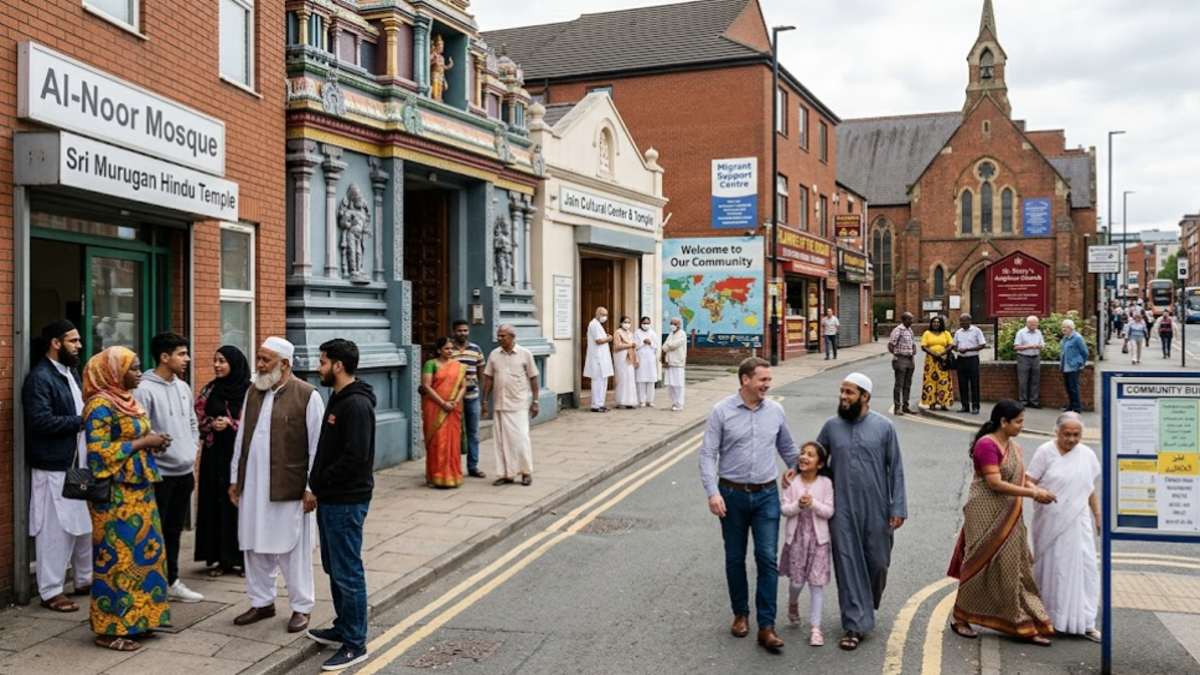
Immigration Changes Religious Communities is becoming increasingly visible across cities where new arrivals are reshaping congregations, places of worship and the way religious organizations serve their neighborhoods. From new mosques and Hindu temples in American suburbs to immigrant-led Christian congregations and growing interfaith cooperation, migration is changing the religious landscape in ways that extend beyond worship. What happens when people bring their faith traditions with them and begin rebuilding community life in a new country?
Immigration does not simply move people from one country to another. It also carries languages, traditions, religious practices, festivals and institutions into new communities.

Recent reporting from the United States and elsewhere shows that this process can be seen in the growth of religious institutions serving immigrant populations. In Frisco, Texas, for example, immigrant communities have been involved in efforts to establish a new mosque, a Hindu temple and a Jain temple. Local reporting has also documented hostility surrounding some of those developments, illustrating how religious diversification can produce both new forms of community life and new tensions.
The change is not limited to Islam, Hinduism or Jainism. Christian communities are also being transformed by migration. Churches in many parts of the United States and Europe increasingly include worshippers whose families originated in Latin America, Africa, Asia and Eastern Europe.
The result can be a congregation where several languages are heard during services, different musical traditions are incorporated into worship and religious celebrations reflect more than one cultural background.
For established religious institutions, immigration can also become an important source of new members at a time when some congregations face declining participation among locally born populations.
Research published by Pew Research Center found that Christians represented 47 percent of international migrants worldwide, compared with 30 percent of the world’s population. Muslims accounted for 29 percent of international migrants, compared with 25 percent of the global population. The same research found that religiously unaffiliated people represented 13 percent of international migrants, while Hindus accounted for 5 percent.
These figures demonstrate that international migration is not religiously uniform. Migrants arrive with a wide range of beliefs, and their destinations experience different combinations of religious change.
One of the most visible consequences of migration is the creation of new places of worship.
A growing immigrant population often needs spaces where people can pray in familiar ways, communicate in their own languages and maintain traditions that may not be widely practiced in the surrounding population.
Mosques, temples, churches, synagogues and other religious centers can therefore become much more than buildings used for weekly worship. They may function as meeting points, cultural centers, language hubs and sources of practical assistance.
A recent report from Osaka, Japan, illustrates this development. A mosque serving Muslim immigrants has become part of a changing local environment in a country that has historically maintained relatively restrictive immigration policies. The mosque is described as a community institution connected to immigrants establishing longer-term roots in Japan.
Similar developments can be found in American cities where immigrant populations have expanded. Religious communities may begin in rented halls, private homes or small commercial buildings before eventually establishing permanent facilities.
This process can change the physical appearance of neighborhoods. A building that once served another purpose may become a mosque, church, temple or community center. Signs may appear in additional languages. Religious festivals can become more prominent in local calendars.
But these developments can also create disputes.
The experience in Frisco demonstrates that religious diversification does not always happen without resistance. Immigrant communities seeking to establish houses of worship have encountered hostility, according to local reporting.
Such conflicts are significant because they reveal that the impact of immigration reaches beyond religious practice. Questions about zoning, identity, public space and belonging can become intertwined with debates about migration.
For many immigrants, a religious institution provides services that go well beyond spiritual support.
New arrivals may need help finding housing, learning a language, locating employment, understanding local institutions or connecting with other families. Religious organizations can become trusted places where these needs are addressed.
Faith-based organizations have also played a role in supporting migrants facing displacement and uncertainty. An international statement from faith-based organizations has emphasized the role of religious groups in accompanying migrants and responding to the consequences of weak protection for migrants and refugees.
That role can strengthen the position of religious institutions within immigrant neighborhoods.
A church or mosque may effectively become a bridge between people who have recently arrived and institutions in their new country. It can provide familiar cultural connections while helping immigrants develop relationships beyond their own ethnic group.
Migration is also changing religious communities that already existed before new immigrant populations arrived.
American churches offer a particularly clear example. Some congregations now include members from several countries, with worship services adapted to accommodate different languages and cultural traditions.
This can produce internal changes in leadership as well. Immigrant pastors, priests, ministers and other religious workers can become increasingly important to congregations seeking to serve growing immigrant populations.
U.S. immigration rules have recognized the role of foreign religious workers. The federal government has described the R-1 religious-worker category as covering ministers and people working in religious occupations for qualifying organizations. The government has also highlighted the contribution of such workers to churches, mosques, synagogues and other religious organizations.
The importance of immigrant religious leaders becomes especially apparent when congregations struggle to recruit locally.
A recent case in Texas involved two Mexican pastors who were detained by U.S. immigration authorities after attending a religious retreat. Local reporting said the couple held R-1 religious-worker and work visas, while immigration authorities disputed their status and said they had overstayed. The pastors were later released following intervention by another religious leader and a member of Congress.
The incident also prompted concern among religious leaders about the ability of churches to recruit foreign clergy.
For immigrant congregations, therefore, immigration policy can have direct consequences for religious life. Visa rules, enforcement policies and decisions affecting foreign religious workers can determine whether a congregation has access to the leaders it needs.
Immigration can sometimes divide religious communities, but it can also encourage cooperation between different faiths.
As cities become more religiously diverse, religious leaders may encounter common challenges. These can include housing, poverty, discrimination, immigration enforcement and access to social services.
Houston provides an example of this development. A study from Rice University examined how faith leaders in the diverse Texas city work together around shared challenges. The research points to cooperation across religious boundaries as communities respond to social issues affecting their members.
South Florida has seen similar cooperation. Reporting from the region described immigration as an issue that has both divided and united religious communities. While disagreements have appeared within individual faith traditions, leaders from different religions have worked together around concerns about immigrant rights and enforcement practices.
This cooperation can change how religious organizations understand their public role.
Instead of focusing exclusively on their own congregations, some religious groups become part of wider networks involving churches, mosques, synagogues, temples, charities and community organizations.
For immigrants, such networks can provide a broader support system.
A newcomer may first connect with a religious community because of shared beliefs or language but eventually develop relationships with people from other religious backgrounds. In this way, religious institutions can become places where social integration takes place rather than spaces that isolate immigrant communities.
Migration also raises questions about identity.
For many immigrants, religion is closely connected to family history, language, food, music and cultural traditions. Maintaining religious practices can therefore help preserve a sense of identity after relocation.
At the same time, religious identity can change as people adapt to their new surroundings.
Children raised in immigrant families may participate in religious traditions differently from their parents. They may speak the dominant language more fluently than their parents, attend schools with people from different backgrounds and develop friendships across cultural and religious boundaries.
Religious organizations consequently face the challenge of serving more than one generation.
A congregation may need services in several languages, youth programs that reflect the experiences of second-generation families and leadership structures that represent different cultural backgrounds.
The process can produce new forms of religious expression.
A Christian congregation founded by immigrants from Africa, for instance, may retain theological traditions familiar to its founders while adopting elements of worship associated with its new country. A Muslim community may preserve practices from its country of origin while developing programs designed for young people who have grown up locally.
The same pattern can be seen among Hindu, Buddhist, Sikh and Jewish communities.
Migration does not necessarily mean that religious traditions remain unchanged. Instead, traditions can be adapted, combined and transmitted in new ways.
The transformation is not always peaceful.
Greater religious diversity can provoke debates over public space, religious buildings and cultural visibility. Some communities welcome new places of worship as evidence of a diverse society, while others oppose them.
The tensions reported in Frisco are an example of how the arrival of multiple immigrant religious communities can become a source of controversy. The city has seen plans and developments involving a mosque, Hindu temple and Jain temple, alongside reports of hostility from some local residents.
Such disputes should not be understood only as religious disagreements. Immigration can become part of a larger debate over who belongs in a community and how quickly neighborhoods should change.
Religion often becomes one of the most visible expressions of those demographic changes.
There are also political consequences. Religious leaders may become advocates on immigration policy, refugee protection and treatment of migrants.
In some cases, religious institutions become places where migrants receive assistance during immigration proceedings or periods of detention. In other cases, religious communities campaign publicly against policies they believe harm immigrants.
This can create divisions within faith groups themselves.
Some members may support stricter immigration controls, while others argue that religious teachings require greater protection for migrants. As a result, immigration can become an internal question of theology, politics and community identity.
The overall picture is complex.
Immigration can strengthen religious institutions by bringing new members, new leaders and new energy. It can also challenge established congregations to reconsider how they worship and how they relate to their surrounding communities.
The changes are particularly visible in countries that have experienced substantial immigration from regions with different religious traditions.
Europe has seen the arrival of Muslim communities from Africa, the Middle East and Asia, alongside Christian migrants from Africa, Latin America and Eastern Europe. Research and academic work on migration and religion has increasingly examined how migrants adapt their religious practices to new environments while also influencing the societies they enter.
Spain provides another example of this broader European transformation. Research on immigration and religiosity has examined the arrival of Eastern European migrants and the resulting growth of Orthodox Christian communities alongside other religious groups.
The changes are not simply a matter of counting believers.
Religious communities influence social networks, cultural events, charitable activity and political engagement. As immigrant populations grow, those institutions can become increasingly important parts of civic life.
The future religious landscape of many cities may therefore depend partly on migration patterns.
Whether communities become more integrated or more divided will depend on many factors, including local policies, economic conditions, public attitudes and the ability of religious institutions to create meaningful connections across cultural boundaries.
Perhaps the most important changes may appear among the children of immigrants.
The second generation often grows up between cultural worlds. Young people may inherit religious traditions from their parents while developing identities shaped by the country where they were raised.
Religious institutions that successfully engage these young people can become places where cultural inheritance and contemporary identity meet.
Others may lose younger members if they fail to adapt to changing expectations.
That makes immigration not only a demographic issue for religious organizations but also a question of long-term survival.
Recent news reports suggest that immigration is changing religious communities in several directions at once.
It is creating new houses of worship, strengthening some existing congregations, bringing foreign religious leaders into established institutions and encouraging cooperation between different faiths.
At the same time, it can generate disputes over religious buildings, immigration enforcement and the cultural direction of local communities.
The most important point is that migration does not simply make religious communities larger or smaller. It changes their composition and, in many cases, their character.
A church may become multilingual. A mosque may serve as a cultural center. A temple may become a gathering place for an immigrant community that previously had little institutional presence. Interfaith organizations may find new reasons to cooperate.
These developments demonstrate that religious life is closely connected to population movement.
As people cross borders, they bring traditions with them. Those traditions then encounter new social environments, where they can be preserved, adapted or transformed.
The result is a religious landscape that increasingly reflects the movement of people across the world.
Immigration can introduce new faith traditions, languages, worship practices and cultural customs while expanding or transforming existing congregations.
Yes. Growing immigrant populations can create demand for mosques, churches, temples, synagogues and other religious institutions that serve specific communities.
Yes. Religious organizations sometimes cooperate on shared issues such as migrant assistance, social services, poverty and discrimination.
Not necessarily. The effect depends on where migrants come from, their religious identities and the religious composition of the communities where they settle.