Physical Address
304 North Cardinal St.
Dorchester Center, MA 02124
Physical Address
304 North Cardinal St.
Dorchester Center, MA 02124

Religions News Around the World
Religions News Around the World
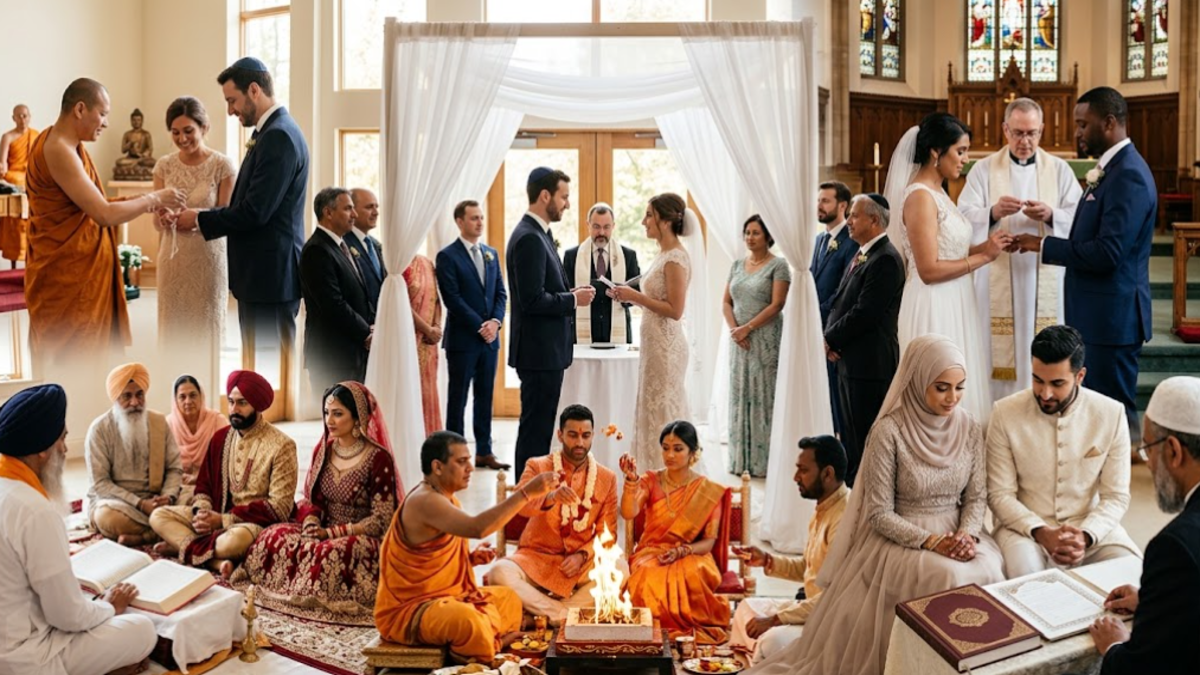
LONDON – ABN News: Marriage Traditions in Different Religions reveal how faith, family and culture continue to shape one of life’s most important ceremonies — but what makes each tradition distinct?

Marriage is more than a legal agreement or a celebration between two people. Across the world, it can also represent a religious commitment, the joining of families and the continuation of customs passed from one generation to another.
The ceremony may take place in a church, mosque, synagogue, temple, gurdwara or another setting, depending on the couple’s faith and community. The words, symbols and rituals can vary considerably, yet many traditions place emphasis on commitment, family responsibility and the beginning of a shared life.

Recent discussions about interfaith relationships have also drawn attention to the ways couples navigate different religious backgrounds. Research in Australia, for example, has shown a significant increase in marriages involving partners from different religious traditions compared with previous decades. An analysis of census data found that one in five marriages involved people from different religions, while almost one in three involved people from different denominations or beliefs.
That trend has made understanding religious wedding customs increasingly relevant, particularly for couples whose families come from different traditions.
There is no single definition of a religious wedding. Even within the same faith, ceremonies can differ according to denomination, country, ethnicity and family practice.
For that reason, the customs described here should be understood as broad traditions rather than rules that apply identically to every couple.
In Christianity, marriage ceremonies commonly take place in a church and may include prayers, readings from the Bible, vows and the exchange of rings. The precise ceremony depends on the Christian denomination.
In Catholic weddings, for example, marriage has a sacramental character. Couples normally make vows before a priest or deacon and witnesses. Other Christian communities may place greater emphasis on the worship service, the couple’s vows and a blessing.
The exchange of rings has become one of the most recognisable elements of Christian and Western weddings, although rings themselves are not exclusive to Christianity.
Jewish weddings have their own distinctive collection of symbols. One of the best-known is the chuppah, the canopy beneath which the couple traditionally stands. The ceremony can also include the signing of a ketubah, a Jewish marriage document outlining obligations within the marriage.
Another widely recognised custom comes at the conclusion of many Jewish wedding ceremonies, when the groom breaks a glass. The act has several interpretations within Jewish tradition and has become an enduring symbol associated with the ceremony.
The variety demonstrates an important point: wedding customs often carry meanings that extend beyond the moment itself.
Hindu weddings are among the most elaborate religious marriage celebrations in the world, but practices vary widely between regions, communities and families.
A Hindu wedding can include several ceremonies before and during the main marriage ritual. Celebrations may involve relatives and friends and can extend over multiple days.
Among the best-known elements is the mandap, the ceremonial structure under which important marriage rituals take place. Fire can also play a central role in the ceremony, with the couple making vows and commitments in its presence.
The saat phere, or seven rounds, is particularly associated with Hindu weddings. The couple moves around the sacred fire while making a series of commitments. The precise wording and interpretation can differ according to tradition, but the ritual represents the couple’s shared responsibilities and journey through married life.
Other customs, including mehndi, music and pre-wedding celebrations, are widespread in South Asian weddings. However, it is important not to automatically classify every popular Indian wedding custom as a religious requirement.
Some practices are cultural rather than specifically religious and can appear in celebrations involving Hindus, Sikhs, Muslims and Christians.
That distinction matters because modern weddings frequently combine religious observance with regional and family traditions.
In Islam, the marriage contract is known as the nikah. The ceremony centres on the agreement between the bride and groom and the responsibilities associated with marriage.
Consent is an important principle. A valid marriage requires the willing agreement of the people entering the marriage, although the precise legal and religious requirements can differ among Islamic schools and communities.
The marriage contract can also specify rights and responsibilities, including the mahr, a mandatory gift or financial obligation from the groom to the bride.
The wedding celebration itself can vary greatly depending on the country and culture in which the couple lives. Some Muslim weddings are large family occasions featuring elaborate clothing, music and meals, while others are relatively simple.
This is another example of the difference between religious requirements and cultural traditions. The core marriage contract belongs to Islamic practice, while the surrounding celebration may reflect local customs.
Muslim wedding traditions in South Asia, the Middle East, Africa and other parts of the world can therefore look very different despite sharing the same religious foundation.
Jewish marriage traditions place strong emphasis on community, family and the obligations created by marriage.
The chuppah remains one of the most recognisable Jewish wedding symbols. The canopy creates a ceremonial space for the couple and has acquired a range of traditional interpretations.
The ketubah is another important feature. Rather than simply functioning as a decorative document, it traditionally sets out obligations associated with the marriage.
Wedding ceremonies may include blessings over wine, the exchange of rings and readings or prayers. Customs differ among Orthodox, Conservative, Reform and other Jewish communities, so there is considerable diversity in how a Jewish wedding is conducted.
The involvement of family and friends can also be significant. In many communities, a wedding is not viewed solely as a private event between two individuals but as a moment that connects families and strengthens communal relationships.
This broader social dimension appears in many religions, even where the rituals themselves are completely different.
The Sikh marriage ceremony is known as Anand Karaj, meaning a ceremony or union associated with bliss.
The ceremony takes place in a gurdwara and centres on teachings from the Guru Granth Sahib, the central scripture of Sikhism. One of the defining rituals involves the couple walking around the Guru Granth Sahib while passages known as the laavan are recited.
The four laavan form the central structure of the Anand Karaj. They describe stages of spiritual development and the couple’s journey together.
The ceremony is therefore not simply a celebration of romantic partnership. It presents marriage as a spiritual relationship in which both partners share responsibilities and seek to develop their relationship with God.
As with other faiths, Sikh wedding celebrations may also incorporate regional and family customs that are not themselves central religious requirements.
Questions surrounding interfaith marriages can be more complicated. Sikh religious authorities and individual gurdwaras have differed over whether an Anand Karaj should be conducted when one partner is not Sikh. Guidance in some communities has encouraged couples from different religious backgrounds to consider a civil marriage followed by religious prayers or another form of blessing rather than conducting an Anand Karaj under circumstances regarded as inconsistent with Sikh rules.
Buddhism presents a different picture because marriage is not generally treated as a sacrament in the same manner found in some other religions.
Buddhist wedding customs vary significantly between countries and Buddhist traditions. Couples may receive blessings from monks, make offerings or participate in ceremonies involving family members and the wider community.
The religious emphasis can focus on compassion, ethical conduct, mutual respect and the responsibilities of married life.
In countries such as Thailand, Sri Lanka, Japan and Tibet, Buddhist-influenced wedding customs have developed alongside local cultures. Consequently, two Buddhist weddings can look very different from each other.
The distinction between religious practice and cultural tradition is particularly important here. A ceremony may contain Buddhist blessings while also incorporating longstanding national or regional wedding customs.
The growing visibility of interfaith couples has created new questions about how traditional ceremonies can be adapted.
Couples may have to decide which religious ceremony to follow, whether both traditions can be incorporated, how children will be raised and which religious celebrations the family will observe.
These decisions can involve more than the couple themselves. Parents, grandparents and religious communities may have strong expectations about the ceremony and the future family.
Interfaith marriage therefore often requires detailed conversations before the wedding. Couples may discuss religious officiants, ceremony locations, readings, food, clothing, holidays and the religious upbringing of future children.
The experience can also create opportunities for families to learn about one another.
An interfaith marriage does not necessarily mean abandoning religious identity. Some couples choose a ceremony that includes elements from both backgrounds, while others conduct separate religious or cultural celebrations.
Specialist guidance on interfaith ceremonies commonly emphasises communication and careful planning, particularly when deciding which rituals can appropriately be combined.
The choices are personal, but they also demonstrate how traditional practices continue to evolve.
Despite their differences, religious wedding traditions often share several themes.
Commitment is one of the most obvious. Whether expressed through vows, a contract, prayers, sacred texts or symbolic rituals, marriage ceremonies generally mark a serious promise between two people.
Family is another common element. Weddings frequently bring relatives together and create relationships between two families.
Community also plays a major role. A marriage may be witnessed and celebrated by members of a religious community, making the ceremony a public expression of a private commitment.
Finally, many traditions use physical symbols to express ideas that are difficult to capture in ordinary language. Rings, sacred fire, canopies, scripture, contracts, garments and ceremonial movements all help communicate the significance of the occasion.
The symbols may be different, but their purpose is often similar: to give visible form to a commitment.
One of the most important points when examining marriage traditions is the need to distinguish religion from culture.
A custom may be strongly associated with a particular religious community without actually being required by its faith.
Food, clothing, music, dancing and pre-wedding parties frequently reflect geography and family history as much as theology.
Indian weddings provide a clear example. Mehndi and sangeet celebrations are now common across many communities and can appear in Hindu, Sikh, Muslim and Christian weddings. Their popularity does not mean that they have the same religious status in every tradition.
Similarly, Western-style wedding receptions may accompany religious ceremonies without being part of the underlying religious rite.
Understanding this difference helps avoid stereotypes and gives a more accurate picture of how people actually marry.
Religious marriage traditions have long histories, but they are not frozen in time.
Migration, international relationships, urbanisation and changing social attitudes have brought people from different religious backgrounds into closer contact.
Australia provides a useful example of this change. Census analysis covering millions of couples found that marriages crossing religious boundaries had become substantially more common than in earlier decades.
The development does not mean religious traditions are disappearing. Instead, couples are increasingly finding ways to negotiate inherited customs within contemporary relationships.
Some maintain a traditional ceremony exactly as their families have done for generations. Others modify parts of the celebration while preserving what they consider the central religious elements.
For religious communities, this creates an ongoing conversation about identity, belonging and the meaning of marriage.
For couples, it can mean balancing personal beliefs with family expectations.
For wider society, it provides a reminder that marriage customs are constantly shaped by the interaction between faith, culture and personal choice.
A wedding can last only a few hours, but the traditions surrounding it may carry centuries of history.
For one couple, walking around a sacred fire may represent their promises. For another, the signing of a marriage contract may provide the foundation of the ceremony. Someone else may stand beneath a chuppah, walk around sacred scripture or exchange vows in a church.
None of these ceremonies can be reduced to a single universal definition of marriage.
Their differences reflect the diversity of religious belief and human culture. Their similarities, meanwhile, reveal common concerns: commitment, responsibility, family, community and hope for the future.
As marriages increasingly cross religious and cultural boundaries, understanding those traditions becomes more important.
Rather than treating different ceremonies as competing versions of the same event, it is possible to see them as distinct expressions of how communities understand love, responsibility and family.
What is a Hindu wedding tradition?
A Hindu wedding can include several rituals, with the sacred fire and the seven rounds, or saat phere, among the best-known elements.
What is a Muslim marriage ceremony called?
The Islamic marriage contract is known as the nikah and centres on the agreement and responsibilities of the couple.
What is Anand Karaj?
Anand Karaj is the Sikh marriage ceremony held in a gurdwara and centred on the teachings of the Guru Granth Sahib.
Can people from different religions marry?
Interfaith marriage is possible in many societies, but religious and legal requirements vary depending on the traditions and country involved.
… Read more
Contact: info@abnnews.net