Physical Address
304 North Cardinal St.
Dorchester Center, MA 02124
Physical Address
304 North Cardinal St.
Dorchester Center, MA 02124
Religions News Around the World
Religions News Around the World
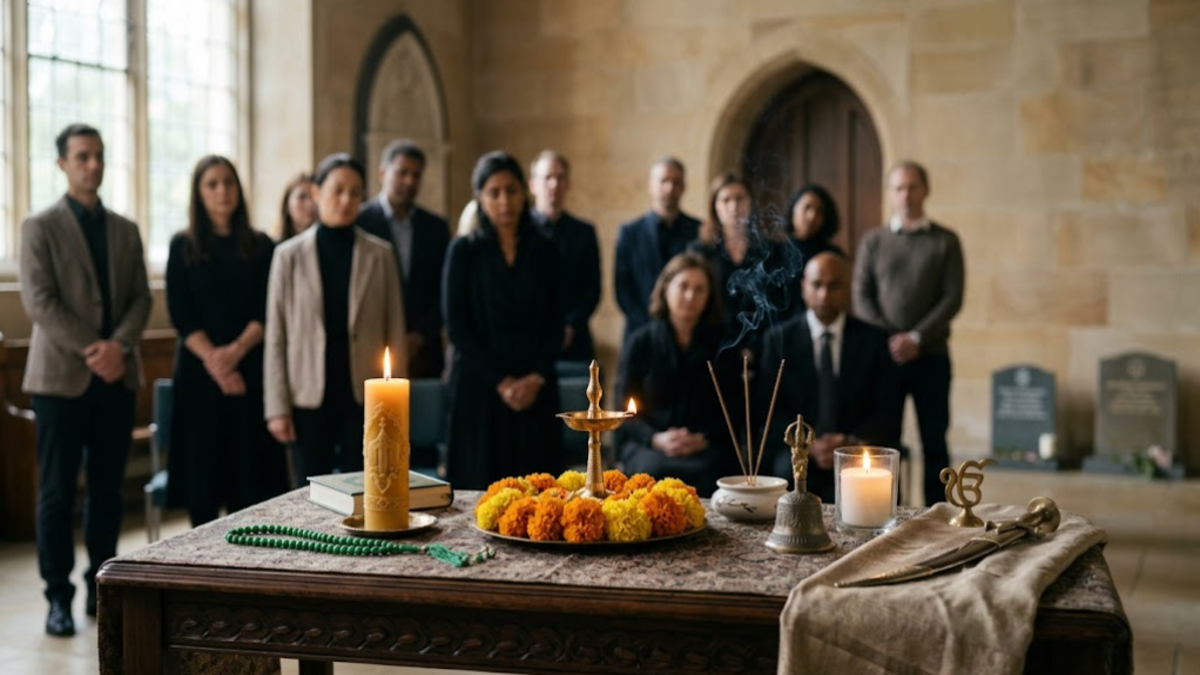
LONDON – ABN News: Funeral Traditions Across Religions remain at the centre of public attention as communities around the world confront death, mourning and the question of how a person’s final journey should be marked. From mass funeral rites following disasters in Nepal to changing approaches to royal and religious ceremonies, recent reports show that the way societies handle death continues to reflect faith, culture, family and circumstance. But what do these traditions mean, and how different are they from one religion to another?

Recent reporting from Nepal has provided a stark reminder of how funeral traditions can become essential to families even when normal burial arrangements are impossible. Following devastating flooding in the Bhote Koshi River area, relatives of people still missing carried out final rites using symbolic effigies made from kush, a type of salt-reed grass. The ceremonies took place after hopes of finding the missing alive had faded.
The development illustrates an important feature of religious funeral traditions: they are not simply ceremonies held after death. They can also provide families with a way to acknowledge loss, express responsibility towards the dead and restore a sense of order when tragedy has disrupted ordinary life.

Funeral customs differ dramatically around the world. Some faiths place great importance on burial, while others traditionally favour cremation. Some communities expect the funeral to take place very soon after death. Others allow time for family members to gather, prepare the body and conduct several stages of remembrance.
Yet beneath these differences lies a common human purpose. Funerals create a structured moment in which the living acknowledge that someone has died and establish a relationship with their memory.
The choice between burial and cremation is one of the clearest differences between religious traditions.
Islam traditionally requires burial. The body is washed and wrapped in a simple shroud before members of the community perform the funeral prayer. Burial normally follows quickly, reflecting the Islamic emphasis on dignity and prompt care for the dead. The deceased is placed in the grave facing the direction of Mecca.
Judaism also traditionally favours burial and places considerable emphasis on treating the body with dignity. Traditional Jewish practice calls for the body to be prepared and shrouded before burial, with prayers and readings forming part of the funeral process. Orthodox Jewish practice does not permit cremation, although Jewish movements differ in their approach to the issue.
Christianity presents a broader picture. Historically, burial held a central place in Christian funerals because of belief in the resurrection of the body. Over time, however, cremation became accepted across many Christian communities. Services commonly include prayers, Bible readings, a sermon or homily, music and words remembering the deceased.
For Hindus, cremation traditionally carries a different spiritual meaning. The body represents the physical form, while Hindu beliefs about reincarnation place greater emphasis on the continuing journey of the soul. Funeral rites can therefore focus on helping the deceased move from one stage of existence to another.
Sikh funeral customs also commonly involve cremation. Known as Antam Sanskaar, or the final rite, the ceremony includes prayers and readings from the Guru Granth Sahib. The funeral can take place at a gurdwara, family home or crematorium, depending on local circumstances.
Buddhist traditions vary significantly according to country, school and culture. Cremation is common in many Buddhist communities, while burial also occurs. Buddhist funeral practices often focus on impermanence, compassion and the transition from one existence to another.
These differences demonstrate why no single funeral model can represent the world’s religions. Even within the same faith, regional customs, family preferences and local laws can alter the ceremony.
Recent reporting has also highlighted how funeral customs are changing beyond formal religious rules.
A report from the Religion Media Centre examined changing funeral rituals and suggested that new approaches to death increasingly connect spirituality with nature and environmental concerns. The development reflects a wider shift in which some families combine religious customs with personal, ecological or secular choices.
That change does not necessarily mean that traditional religion has disappeared from funerals. Instead, families may combine several influences.
A person might receive a religious service but choose cremation for practical reasons. Another family may follow traditional prayers while selecting a less formal memorial. Others may retain particular religious rites while adapting the ceremony to the country where they live.
The issue has become especially visible in societies with growing religious diversity. Funeral homes, cemeteries, hospitals and local authorities increasingly encounter families whose requirements do not fit a single cultural model.
The question is not simply whether a person should be buried or cremated. Religious funeral planning can involve the timing of the ceremony, preparation of the body, prayers, clothing, food, music, location, participation of religious leaders and the way relatives observe mourning after the funeral.
A Pew Research Center study of South and Southeast Asia found that religious elements remain highly significant to many families. In several countries, majorities considered inviting a religious leader to recite sacred texts or preach at a funeral very important. In Thailand, 78 percent said rituals at a temple or another religious site would be very important when planning a loved one’s funeral, while 72 percent of Indonesians gave the same importance to involving an imam or another religious leader.
The research also shows that mourning does not necessarily end when the body is buried or cremated. In five of the six countries examined, majorities said households perform rituals on the anniversary of a family member’s death. In Sri Lanka, the figure reached 93 percent, while Thailand recorded 90 percent.
That finding is significant because it shows that funeral traditions are often only the beginning of a longer process of remembrance.
Modern life can place religious funeral customs under practical pressure.
Families may live far from their traditional homeland. Religious minorities may have limited access to suitable burial grounds or cremation facilities. National regulations can also affect how quickly a body can be buried or whether particular procedures can take place.
These issues have made religious freedom an important part of discussions about death and burial. A United Nations Special Rapporteur report examined the relationship between freedom of religion or belief and the treatment of the dead, underlining how closely burial and mourning practices can be connected to religious freedom.
The principle is straightforward: for many people, the way a loved one is treated after death is not merely a private preference. It can be an expression of religious belief and cultural identity.
Christian funerals vary widely among Catholic, Orthodox, Protestant and other denominations.
A typical Christian funeral may include prayers, scripture readings, hymns and a sermon or eulogy. The service can take place in a church, chapel, cemetery, crematorium or another appropriate location.
The tone also varies. Some traditions emphasise solemnity and the promise of resurrection. Others place considerable emphasis on celebrating the person’s life and providing comfort to relatives and friends.
Orthodox Christian traditions can involve particularly structured periods of remembrance following death. In some communities, prayers and memorial services take place on specific days after the funeral as well as on later anniversaries.
Catholic practice historically placed strong emphasis on burial, although cremation is now permitted under specified conditions. The funeral liturgy remains focused on Christian beliefs concerning death, resurrection and eternal life.
The variety within Christianity is important. A Christian funeral in one country may look very different from one in another country, even though both draw upon the same broad religious tradition.
Islamic funeral traditions are among the most clearly defined approaches to death and burial.
After death, the body is traditionally washed and wrapped in a simple white shroud. The community then performs the Salat al-Janazah, or funeral prayer, before burial.
The emphasis on speed is significant. Islamic tradition generally calls for the burial to occur as soon as reasonably possible, avoiding unnecessary delays. Cremation is not permitted under mainstream Islamic funeral practice.
Simplicity also has an important role. The funeral is not intended to become a display of wealth. Instead, the process focuses on prayer, dignity and submission to God.
Mourning continues after burial. Families and members of the community visit, offer condolences and support those who have lost a relative.
The customs can vary between Muslim communities and schools of thought, but the central principles of prayer, dignity, burial and remembrance remain widely recognisable.
Hindu funeral customs commonly centre on cremation and the belief that death does not represent the end of the soul.
The body may be washed and dressed before the funeral. Relatives gather around the deceased, prayers and mantras may be recited, and offerings such as flowers can form part of the ceremony.
The cremation itself carries spiritual symbolism. Rather than simply disposing of the body, the ritual represents the separation of the physical form from the continuing spiritual journey.
Hindu communities around the world do not all follow identical procedures. Local customs, family traditions and legal requirements influence the precise form of the funeral.
Sikh funerals similarly emphasise acceptance of death as part of the natural order. The Antam Sanskaar can include readings and singing from the Guru Granth Sahib, prayers and cremation.
The Sikh approach places considerable emphasis on accepting God’s will rather than allowing grief to become an expression of rebellion against it.
Both Hindu and Sikh traditions therefore demonstrate how cremation can carry a religious meaning that goes far beyond a practical decision about handling the body.
Jewish funeral customs place strong emphasis on dignity, simplicity and prompt burial.
Traditional Jewish practice includes preparing and washing the body, wrapping it in a shroud and conducting prayers. The funeral itself generally avoids excessive display, reflecting the principle that the dead should receive equal dignity regardless of wealth or social position.
After burial, Jewish mourning follows a structured process. Family members observe particular periods of mourning, remembrance and reflection, creating a framework through which grief can be expressed over time.
Buddhist funeral traditions are more diverse because Buddhism has developed across many societies with distinct cultural practices.
In many Buddhist communities, ceremonies include chanting, prayers and offerings. The precise rituals depend heavily on whether the community follows traditions associated with countries such as Japan, Thailand, Sri Lanka, China or Tibet.
The underlying Buddhist concept of impermanence is central. Death serves as a reminder that physical existence changes and that attachment to life and possessions cannot prevent that change.
For the bereaved, the funeral can therefore become an opportunity not only to mourn but also to reflect on mortality, compassion and the continuation of spiritual practice.
The most striking lesson from recent funeral reporting is that traditions become particularly visible when ordinary circumstances are disrupted.
The Nepal floods provide one example. Families unable to recover bodies have still sought a way to perform final rites, using symbolic representations of the missing.
Japan provides another example from a very different setting. Current reporting on Emperor Emeritus Akihito’s funeral arrangements highlights his long-standing preference for a simpler ceremony with a smaller public impact. The plans include measures intended to reduce the ceremony’s environmental footprint and limit its scale.
The contrast is revealing.
In Nepal, families are adapting ancient rites to a disaster in which bodies remain missing. In Japan, funeral planning is being shaped by a desire for simplicity and reduced environmental impact.
Both cases show that funeral traditions are not frozen in the past. Religious and cultural practices can remain deeply meaningful while adapting to circumstances.
This is also why discussions about funeral traditions increasingly extend beyond theology. They involve environmental concerns, public health, migration, religious freedom, family structures and changing attitudes towards ceremony.
The central purpose, however, remains recognisable across many traditions: to acknowledge death, honour the person who has died and support those who remain.
For journalists, communities and institutions dealing with death, understanding these differences matters. A ceremony that appears unusual to an outsider may carry profound religious significance for the family involved.
Respect begins with recognising that there is no universal definition of a proper funeral.
Across religions, funeral practices may differ in almost every visible detail. One family may gather in a mosque for prayers before a rapid burial. Another may assemble at a crematorium after Hindu rites. A Christian congregation may sing hymns. A Buddhist community may chant. A Jewish family may gather for a simple burial.
Yet these traditions share several themes.
They create a moment of transition. They give relatives and friends a way to express grief. They connect the individual with a wider community. They provide rituals through which people can confront questions about mortality and what may follow death.
In some traditions, the focus lies on resurrection. In others, it rests on reincarnation, rebirth, judgment or spiritual liberation. Some place greater emphasis on the physical return of the body to the earth, while others view cremation as an important spiritual act.
The forms are different, but the human need is remarkably similar.
Recent news from Nepal and Japan, alongside wider reporting about changing funeral practices, demonstrates that these traditions continue to evolve.
For families, the final ceremony remains much more than a formal event. It is often the last public act performed for someone they love.
And as societies become more religiously diverse, understanding Funeral Traditions Across Religions is increasingly important—not simply for understanding faith, but for understanding how communities respond to loss, remember their dead and define dignity at the end of life.
A religious funeral generally provides a way to honour the deceased, support mourners and follow beliefs concerning death and the afterlife.
No. Islam and traditional Judaism favour burial, while Hinduism and Sikhism commonly favour cremation. Christian and Buddhist practices can include either, depending on denomination and tradition.
Some traditions place strong importance on prompt burial. Islamic and Jewish funeral practices, in particular, generally seek to avoid unnecessary delays after death.
Yes. Many communities observe additional prayers, mourning periods, memorial services or death anniversaries. Pew research found that death-anniversary rituals remain common in several South and Southeast Asian societies.