Physical Address
304 North Cardinal St.
Dorchester Center, MA 02124
Physical Address
304 North Cardinal St.
Dorchester Center, MA 02124

Religions News Around the World
Religions News Around the World
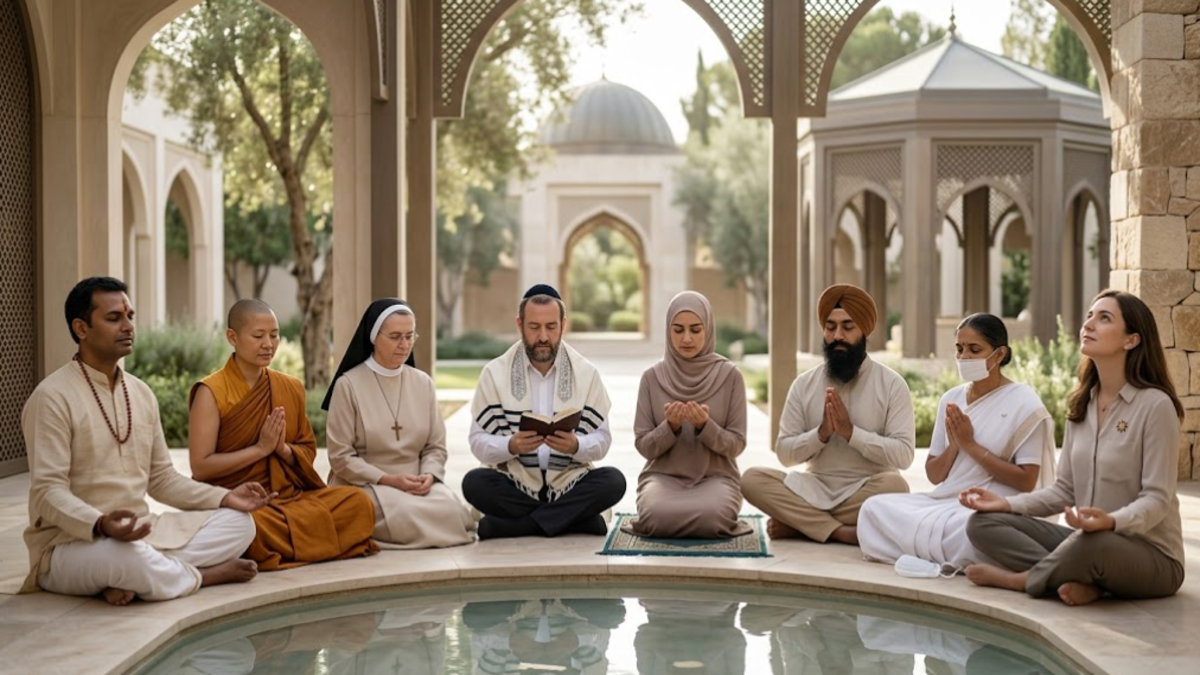
MADRID – ABN News: Meditation in Different Religions remains a powerful spiritual practice across cultures, with traditions ranging from Hindu yoga and Buddhist mindfulness to Christian contemplation, Jewish personal prayer and Islamic remembrance. Current religious coverage is again drawing attention to meditation as part of fasting, prayer and daily spiritual reflection—but how does meditation actually differ from one faith to another?

Meditation is often presented today as a technique for relaxation, concentration or stress management. Religious traditions, however, give the practice a much broader meaning.
For millions of believers, sitting quietly, repeating sacred words, reflecting on scripture or focusing on the breath forms part of a larger spiritual discipline. The objective can include devotion to God, self-knowledge, moral transformation, enlightenment or a deeper awareness of reality.

Recent religious coverage provides a timely example from Hindu practice. Aja Ekadashi falls on September 7, and traditional observance includes fasting, prayer, chanting, charity and meditation. The observance is dedicated to Lord Vishnu and is traditionally associated with spiritual purification, forgiveness, devotion and inner peace.
The significance of the day illustrates an important point: meditation does not always stand alone. In many religions, believers combine contemplation with fasting, prayer, sacred reading, chanting or acts of service.
That distinction matters because the modern word “meditation” covers practices with very different religious purposes. A Buddhist may meditate to cultivate insight into the nature of existence. A Hindu practitioner may use meditation within a broader path involving yoga, devotion and knowledge. A Christian may contemplate scripture and the life of Christ, while a Jewish practitioner may use personal prayer as a way of speaking directly with God.
Islamic spiritual traditions likewise include remembrance, reflection and disciplined attention to God, particularly within Sufi practice.
The similarities can be striking, but the theological meanings are not identical.
Hindu traditions contain some of the world’s oldest and most influential forms of meditation. The practice appears within several philosophical and devotional paths, and there is no single Hindu method that represents every community.
Yoga provides one important framework. Meditation can involve concentration, control of attention, contemplation, mantra recitation and disciplined awareness. The wider objective may relate to liberation, knowledge of the self and realization of ultimate reality.
Different schools place different emphasis on devotion, knowledge, disciplined action and meditation. For some practitioners, meditation forms part of a path toward moksha, understood broadly as liberation from the cycle of rebirth.
Buddhist meditation developed within its own religious framework and also contains considerable diversity.
Theravada traditions, for example, include practices associated with calm and concentration as well as insight. Mahayana traditions developed their own contemplative approaches, while Zen places particular emphasis on disciplined sitting and direct awareness.
The Buddhist objective does not simply amount to becoming relaxed. Meditation can serve the cultivation of insight into impermanence, suffering and non-self, alongside the development of ethical conduct and wisdom.
The distinction between Hindu and Buddhist meditation is therefore important. Both traditions have deep contemplative histories, but their understandings of the self, liberation and ultimate reality are not the same.
Modern mindfulness often removes meditation from those theological contexts. That can make the practice accessible, but it can also obscure its historical roots. Recent discussion of mindfulness has highlighted this tension, particularly because contemporary programs sometimes present practices originating in Buddhist traditions primarily as secular tools for well-being.
Christianity also has a long history of meditation, although Christian contemplation differs in purpose and theological language from many Eastern traditions.
Christian meditation commonly involves reflection on God, scripture, the life of Jesus and the meaning of faith. Instead of trying simply to empty the mind, many Christian approaches deliberately direct attention toward a sacred subject.
Contemplative prayer has developed through numerous Christian traditions. Monastic communities, Catholic spiritual writers, Orthodox practitioners and Protestant communities have all developed different approaches to silence, prayer and reflection.
The Center for Action and Contemplation, for example, publishes daily spiritual reflections rooted in Christian contemplative traditions. Its current daily meditation for September 7 focuses on doubt and the biblical message of liberation and wholeness.
That contemporary example demonstrates how meditation remains part of living Christian spirituality rather than merely a historical practice.
Christian contemplation can involve silence, scripture, prayer and sustained attention. The practitioner seeks to become more receptive to God rather than simply pursuing a particular psychological state.
There are also theological boundaries. Christian authorities have historically distinguished Christian contemplation from meditation systems based on different religious assumptions. The Vatican’s teaching on Christian meditation, for example, has addressed the importance of preserving the Christian understanding of prayer when considering practices from other traditions.
This does not mean that Christians cannot learn from other contemplative traditions. It means that the meaning assigned to a technique depends heavily on the faith framework surrounding it.
Jewish spirituality contains several forms of contemplation, prayer and meditative reflection.
One notable practice is hitbodedut, particularly associated with the Hasidic tradition of Rabbi Nachman of Breslov. It encourages an individual to speak personally with God, often in ordinary language and away from distractions.
The approach differs from the popular image of meditation as complete mental silence. Instead, personal speech, self-examination, prayer and spiritual honesty can become the focus.
Jewish educational sources describe hitbodedut as a way of developing intimacy with God through personal conversation.
Other Jewish contemplative traditions have focused on prayer, sacred names, scripture and focused intention. The Hebrew concept of kavanah, broadly associated with intention or focused devotion during prayer, also illustrates the importance of inward attention.
For many Jewish practitioners, therefore, meditation cannot easily be separated from prayer and religious study.
The emphasis often falls on relationship: the individual turns toward God, examines the self and seeks greater spiritual awareness.
This makes Jewish meditation an important reminder that contemplation does not have to mean sitting silently with closed eyes. It can also involve words, scripture, questioning and personal dialogue.
Islam places strong emphasis on remembrance of God, known as dhikr. While Islamic spiritual practices should not automatically be equated with modern secular meditation, they can involve sustained attention, repetition and inward reflection.
Sufi traditions have developed particularly rich contemplative practices. Repetition of divine names or sacred phrases, disciplined breathing in some contexts, reflection and spiritual self-examination can form part of the pursuit of greater awareness of God.
The purpose remains fundamentally religious. The practitioner seeks closeness to God, purification of the heart and greater spiritual discipline.
This distinction separates Islamic devotional practice from the popular wellness model in which meditation may focus primarily on personal comfort.
At the same time, similarities between traditions can be useful for comparative study. Focused attention, repetition, silence and disciplined awareness appear in different forms across religious cultures.
The outward method may look similar, while the believer’s understanding of what the practice means can be completely different.
That is why describing all religious meditation simply as “mindfulness” risks losing important theological distinctions.
Meditative attention also has an important place in Sikh spirituality.
Sikh practice emphasizes remembrance of the divine Name, often described through simran. Repetition and remembrance can cultivate awareness of God while remaining connected to ethical living and service to others.
The practice does not exist simply as an isolated exercise. Sikh spirituality connects remembrance with humility, equality, honest living and service.
Jainism presents another distinctive model. Meditation has long formed part of Jain spiritual discipline, with practices directed toward self-control, detachment and liberation.
The Jain emphasis on nonviolence also shapes its spiritual outlook. Meditation becomes part of a broader effort to reduce attachment and harmful actions and to progress toward spiritual freedom.
Bahá’í teachings likewise place meditation alongside prayer and reflection. Bahá’í practice encourages believers to turn inward after prayer and reflect upon divine teachings.
The diversity across these traditions demonstrates that meditation cannot be reduced to one universal formula.
The posture may change. The words may change. The object of attention may change. Most importantly, the spiritual destination may change.
Despite these differences, several recurring themes appear.
First is attention. Religious meditation usually asks practitioners to move away from constant distraction and give sustained attention to something considered spiritually significant.
Second is discipline. Meditation rarely functions as a one-time experience. Religious traditions generally place value on regular practice.
Third is transformation. The goal is often not simply to feel calm for a few minutes. Meditation may seek to change how a person thinks, behaves and relates to other people.
Fourth is self-examination. Many traditions ask practitioners to confront pride, anger, attachment, fear or other obstacles to spiritual growth.
Fifth is connection. The object of that connection differs. A Buddhist may focus on reality and awareness without a creator-God framework. A Hindu may seek realization of the self and ultimate reality. A Christian, Jew or Muslim may direct contemplation toward God. A Sikh may cultivate remembrance of the divine Name.
These differences should not be ignored in the search for common ground.
The growth of meditation in contemporary society has created a new relationship between ancient religious practices and modern life.
Meditation apps, retreats, workplace programs and health initiatives frequently use techniques influenced by Buddhist and other contemplative traditions. Some programs deliberately remove religious language so that people of any faith—or no faith—can participate.
Scientific research has also intensified interest in meditation. A recent study reported that an intensive seven-day meditation retreat was associated with changes in brain activity and biological measures connected with neuroplasticity, immune function, metabolism and pain perception. Researchers also reported brain connectivity patterns resembling those associated with psychedelic experiences.
Such findings may help explain why meditation continues to attract public attention.
But religious meditation cannot be evaluated only through scientific measurements.
For believers, its significance may involve questions that laboratory studies cannot settle: How should a person live? What is the nature of the self? What does it mean to encounter God? How can suffering be understood? What leads to liberation?
Those questions belong to philosophy and theology as much as to medicine or neuroscience.
The United Nations has also recognized meditation as an international observance, describing World Meditation Day as an opportunity to broaden information about meditation and its potential benefits.
The comparison across religions reveals an intriguing paradox.
Meditation can look remarkably similar from the outside. A person may sit quietly, close the eyes, repeat a phrase or concentrate on breathing. Yet the internal meaning of that practice can differ profoundly.
For one person, the exercise may represent mindfulness of present experience. For another, it may be prayer. For another, it may be remembrance of God. For another, it may be a disciplined path toward insight and liberation.
That is why journalists, educators and health professionals need to use religious terminology carefully.
Reducing meditation to a relaxation technique overlooks its spiritual history. At the opposite extreme, treating every modern mindfulness exercise as a religious ritual also creates confusion.
The more accurate approach recognizes both realities: meditation has become a global practice with secular applications, while its deepest roots remain closely connected to the world’s religious and philosophical traditions.
Current religious observances reinforce that connection. The Hindu observance of Aja Ekadashi places meditation alongside fasting, chanting, worship and charity, while contemporary Christian contemplative communities continue to publish daily reflections for spiritual practice.
These examples show that meditation remains active within religious life rather than belonging only to ancient history.
As people increasingly encounter religious traditions outside their own communities, meditation is likely to remain a point of cultural exchange.
That exchange can create understanding, but it also requires respect.
Practitioners can recognize similarities without pretending that all religions teach the same thing. They can appreciate breathing exercises, silence, concentration or contemplative prayer while learning why different traditions developed those practices in the first place.
For religious communities, the challenge may be preserving the meaning of meditation while responding to a world that increasingly approaches it through psychology, technology and wellness.
For secular practitioners, the opportunity lies in understanding that many techniques now considered modern have long histories shaped by communities, teachers and religious ideas.
Ultimately, Meditation in Different Religions is not one practice with several names. It is a family of practices whose meanings depend on the traditions in which they developed.
From Hindu yoga and Buddhist insight meditation to Christian contemplation, Jewish personal prayer, Islamic remembrance, Sikh simran, Jain meditation and Bahá’í reflection, the common thread is disciplined attention—but the reasons for that attention remain distinct.
And perhaps that is the most important lesson: meditation may bring people into stillness, but every tradition asks a different question about what they should discover there.
It refers to contemplative, prayerful or focused practices found across religious traditions. Their methods and spiritual purposes vary significantly.
No. Christianity, Judaism, Islam, Sikhism, Jainism and the Bahá’í Faith all contain forms of contemplation, prayer, remembrance or meditation.
The biggest difference is the purpose. Traditions may focus on God, divine remembrance, scripture, self-knowledge, ethical transformation, insight or liberation.
Yes. Modern secular meditation often focuses on attention, relaxation and well-being without adopting a particular religious belief system.