Physical Address
304 North Cardinal St.
Dorchester Center, MA 02124
Physical Address
304 North Cardinal St.
Dorchester Center, MA 02124

Religions News Around the World
Religions News Around the World
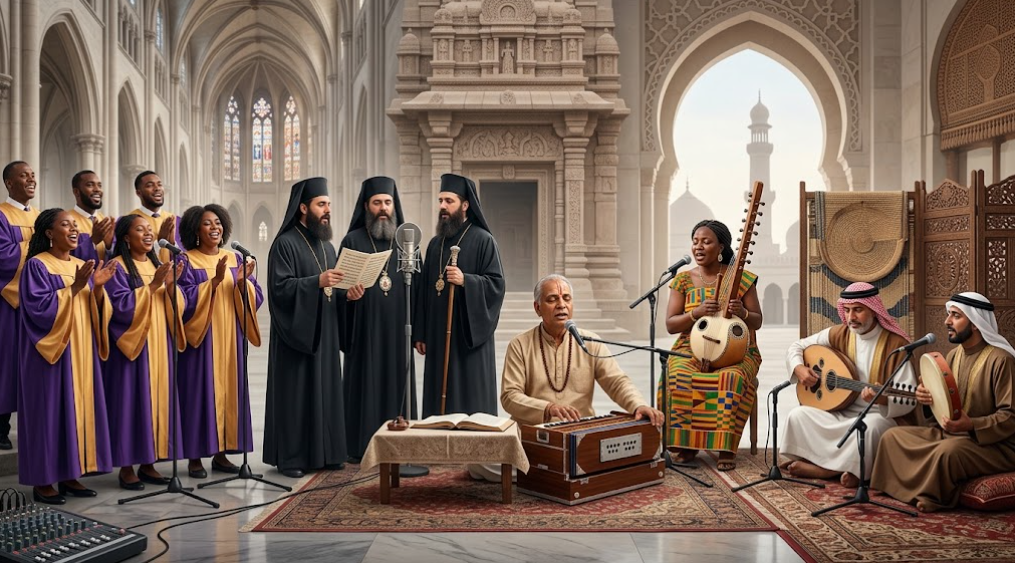
LONDON – ABN News: Religious Music Around the World continues to connect worship, cultural identity and public performance, with Christian festivals, sacred concerts and long-standing musical traditions attracting attention across several countries. From large Christian gatherings in the United States to Orthodox youth events in Romania and sacred-music performances in Europe, religious music remains a living part of cultural life — but what is driving its continuing presence on stages, in churches and in communities around the world?

Religious music rarely stays inside a single definition. It can be a hymn sung by a congregation, a centuries-old chant performed by trained singers, a gospel concert in a large arena or a ritual tradition passed from one generation to another.
Recent developments underline that variety. In the United States, the final day of a major Christian music festival is taking place at the Ark Encounter and Creation Museum in Kentucky, while another Christian worship festival is scheduled in Gettysburg, Pennsylvania. In Europe, sacred music remains part of concert programming, while Romania has hosted a major Orthodox youth gathering where faith, community and religious practice have been placed at the centre of public life.

These events differ greatly in scale and purpose. Some are explicitly designed for worship. Others present religious music as part of a wider cultural or artistic programme. Together, however, they show how sacred sound continues to occupy space in contemporary public life.
The renewed attention also reflects the remarkable variety of musical traditions associated with religion. Christian hymnody, Orthodox chant, gospel, Islamic devotional music, Hindu sacred recitation and other traditions all use voice, rhythm, melody and repetition to convey beliefs and strengthen communal ties.
The distinction between a concert and a religious gathering can also become less clear. A performance may serve as entertainment for one audience member while functioning as prayer, remembrance or spiritual reflection for another.
That dual role helps explain why religious music continues to travel across borders.
The international picture becomes clearer when religious music is considered as cultural heritage rather than simply as a musical genre.
UNESCO describes music as one of the most universal performing arts and notes that it appears in societies across the world, including sacred and ritual contexts. The organisation also points out that traditional musical practices can face pressure when cultural expressions become standardized or are abandoned.
One striking example comes from Greece and Cyprus. Byzantine chant, a vocal tradition associated with the liturgical texts of the Greek Orthodox Church, has existed for more than two millennia. UNESCO describes it as an exclusively vocal, essentially monophonic musical system based on eight modes and transmitted through generations.
The tradition demonstrates how religious music can function simultaneously as worship and cultural memory. Its purpose is not simply to create a pleasing sound. The music supports sacred texts and forms part of religious life.
That relationship between words and music appears in many faith traditions. The sound of a prayer can become inseparable from the prayer itself. A melody can identify a festival, a community or a place. A particular style of chanting can also signal membership in a religious tradition.
In this sense, religious music operates as a form of cultural language.
It can preserve pronunciation, musical structures and ritual practices long after other aspects of everyday life have changed. It can also give younger generations a direct connection to traditions that might otherwise appear distant or historical.
The continuing public presence of sacred music therefore raises a broader question about preservation: how can traditions remain authentic while also reaching modern audiences?
The United States provides some of the clearest evidence of the continuing popularity of Christian music as a public cultural activity.
The 40 Days of Christian Music festival at the Ark Encounter and Creation Museum has reached its concluding day after a programme that brought numerous Christian performers to the venues in northern Kentucky. Organisers say the event has attracted tens of thousands of guests from across the United States and other parts of the world.
The programme has included performers such as Jamie MacDonald, Crowder and CAIN, with concerts staged at the Answers Center and Legacy Hall. A report published ahead of the concluding performance highlighted Jeremy Camp among the artists appearing during the final week.
The festival illustrates one of the defining features of modern Christian music: its ability to combine religious expression with the infrastructure of contemporary live entertainment.
Large venues, touring artists and festival formats allow worship music to reach audiences far beyond traditional church settings. At the same time, the religious identity of the music remains central to the events.
Another example comes from Pennsylvania, where the Fields of Praise Christian music and worship festival is scheduled at The Barn Resort in Gettysburg. The programme includes Christian recording artist Rachael Lampa and is designed around music, worship, community and family activities.
The range of these events suggests that Christian music is no longer confined to a single performance environment. Churches remain important, but festivals, theatres, arenas and cultural venues have become part of the wider ecosystem.
For audiences, the appeal can be both communal and personal. Singing with thousands of other people creates a collective experience, while listening privately to religious music can provide a very different form of reflection.
Religious music also plays an important role in Orthodox Christian traditions, where chanting and liturgical singing are closely connected with worship.
Recent events in Bucharest have highlighted the wider social role of Orthodox religious culture. Thousands of young Orthodox Christians participated in a candlelit Procession of Lights during the International Meeting of Orthodox Youth.
The gathering brought together about 2,400 participants aged between 16 and 35 from Romania and 40 other countries. The procession travelled from the National Cathedral to Patriarchate Hill, combining religious symbolism with a large international youth gathering.
The event demonstrates how religious traditions can create opportunities for young people to build relationships across national borders.
Although the procession itself was not simply a music festival, it belongs to the same wider cultural environment in which chant, liturgy, prayer and public religious ceremonies work together.
Orthodox music has particular importance because the musical form is often inseparable from the sacred text. Byzantine chant offers a clear example. UNESCO describes it as a tradition in which musical expression enhances liturgical texts and remains closely linked to spiritual life and worship.
This connection gives religious music a different function from ordinary popular music.
The objective is not necessarily to produce a conventional song structure or a commercial recording. Instead, musical choices can support prayer, establish a solemn atmosphere and guide participation in a religious service.
At the same time, recordings and digital media now allow listeners outside churches and monasteries to encounter these traditions.
That creates a new relationship between ancient musical practices and global audiences.
Europe continues to provide a strong platform for sacred music in concert settings.
In Paris, a programme combining Vivaldi’s Four Seasons, Ave Maria and other sacred works is scheduled for performance at Saint-Paul-Saint-Louis. The programme places well-known instrumental music alongside religious repertoire, illustrating how sacred works can appear within a broader classical concert experience.
Elsewhere, the musical heritage of the Church remains connected to cathedral and organ traditions.
Norwich Cathedral has continued its summer organ celebrations with special concerts, keeping a historic church instrument at the centre of a public music programme.
The attraction of these performances extends beyond regular worshippers. Classical music audiences can approach sacred compositions as works of musical history, while believers may hear them as expressions of faith.
The same piece can therefore carry several meanings without necessarily losing its original religious identity.
This overlap has helped sacred music survive outside the immediate circumstances for which many works were written.
Compositions created for liturgy can enter concert halls. Chant can appear on recordings. Choirs connected with churches can perform for secular audiences. Historic organs can become attractions for music lovers who may never attend a religious service.
The result is a cultural exchange in which religious music remains connected to its origins while gaining new listeners.
One of the strongest characteristics of religious music is its ability to absorb local traditions.
In Morocco, Gnawa provides a particularly important example. UNESCO describes Gnawa as a set of musical events, performances, brotherhood practices and therapeutic rituals that combine secular and sacred elements. The tradition includes Sufi brotherhood music and lyrics with religious content.
The example shows why it can be misleading to divide music neatly into religious and secular categories.
In many societies, the boundary is porous. A musical tradition can have spiritual roots while also becoming part of festivals, cultural celebrations and public performances.
A similar complexity appears in Turkey through the Semah tradition associated with Alevi-Bektaşi communities. UNESCO describes Semah as rhythmic ritual movement accompanied by musicians playing the saz, with different forms existing across communities. The tradition is connected to Cem rituals and is also used independently to transmit the culture to younger generations.
These traditions underline an important point: religious music is not simply something performed by professional musicians.
Communities themselves can be the custodians.
The music may be taught orally, practised during family events and performed during ceremonies. Its survival can depend on ordinary participants as much as on specialists.
That community-based transmission gives religious music a resilience that commercial music does not necessarily possess.
South Asia provides another powerful example of music’s relationship with religious knowledge.
The Vedic chanting tradition in India represents one of the world’s oldest surviving forms of sacred oral transmission. UNESCO describes the Vedas as a vast body of Sanskrit poetry, philosophical dialogue, mythology and ritual incantations. The Sama Veda contains musical arrangements of hymns, while Vedic verses have traditionally been chanted during sacred rituals and recited in daily practice.
The significance of the tradition lies partly in its precision.
Practitioners use complex methods to preserve the sound and wording of the texts. The transmission begins early and relies on detailed techniques involving tonal accents and pronunciation.
This means the music functions as a preservation system as much as an artistic form.
China offers another example through the Xi’an wind and percussion ensemble. UNESCO records the tradition as more than a thousand years old, with religious belief among the subjects of its verses and performances historically connected with religious occasions such as temple fairs and funerals.
The ensemble tradition also demonstrates the importance of oral education. Its music has been passed from teacher to student through a strict master-apprentice system, while historical scores preserve a large body of repertoire.
These examples reveal a common pattern across very different cultures.
Religious music can function as an archive.
It stores stories, prayers, language, ritual knowledge and collective memory in forms that people can reproduce rather than merely read.
The popularity of religious music does not mean that every tradition is secure.
Traditional music can face difficulties when younger generations move away from established practices, when communities become smaller or when commercial entertainment dominates cultural life.
UNESCO has warned more broadly that traditional performing arts can come under pressure as societies standardize cultural practices. Music may gain international visibility while the particular local traditions behind it struggle to survive.
That tension is visible in the difference between a global religious music festival and a small community maintaining an old chant.
The festival can attract large audiences quickly. A traditional chant may require years of disciplined learning before a performer can participate fully.
Both forms matter, but they depend on different systems of support.
Digital technology has added another layer. Recordings, streaming platforms and social networks can make religious music available to listeners who have never encountered the tradition in person.
That creates opportunities for preservation and education.
But digital exposure can also remove music from its original context. A chant designed for a specific liturgy can become simply another audio track. A ritual performance can be viewed as entertainment without the cultural knowledge that gives it meaning.
The challenge for communities is therefore not only to make music visible but also to preserve the knowledge surrounding it.
Despite enormous differences, religious music around the world often performs similar social functions.
It brings people together.
It marks important moments.
It communicates beliefs.
It creates a sense of belonging.
It can accompany birth, marriage, mourning, festivals and rites of passage.
It can also provide a space for reflection when ordinary language feels inadequate.
The forms vary dramatically. A choir in a Christian church does not sound like a Vedic recitation. Byzantine chant differs from Gnawa. A gospel festival has a very different atmosphere from a traditional Orthodox service.
Yet each can transform individual voices into a collective experience.
That may explain why religious music remains relevant even as societies become increasingly diverse and technologically connected.
People do not necessarily encounter sacred music only through formal religious participation. They may discover it through concerts, recordings, cultural festivals, documentaries, family traditions or international travel.
The result is a growing global musical landscape in which old traditions continue to meet new audiences.
The latest developments show that religious music cannot be reduced to nostalgia.
It remains active, adaptable and capable of drawing large audiences.
Christian festivals demonstrate the continuing strength of faith-based live music in the United States. Orthodox gatherings show how religious traditions can connect young people across borders. European concert programmes demonstrate that sacred repertoire remains an important part of classical music. Meanwhile, long-established traditions in Africa, Asia and the Middle East continue to preserve spiritual and cultural identities through sound.
The most important development may be the growing recognition that religious music is simultaneously art, heritage and social practice.
Its value cannot always be measured by ticket sales or streaming figures.
For many communities, the real measure is continuity: whether a child learns the chant from an elder, whether a congregation continues to sing together, whether a ritual remains meaningful, or whether a traditional performance survives long enough to reach another generation.
That makes religious music part of a much larger story about how societies preserve identity while adapting to change.
Across continents, sacred sounds continue to cross the boundaries between worship and culture, tradition and innovation, local identity and international audiences.
And as today’s events demonstrate, the world’s religious music traditions are not disappearing quietly into history. They continue to be performed, taught, recorded, celebrated and heard.
Religious music is music connected with worship, spiritual practice, religious ceremonies or faith traditions. It can include chants, hymns, devotional songs, ritual music and sacred compositions.
It can be heard in places of worship, concerts, festivals, cultural events, religious ceremonies and increasingly through digital platforms and recordings.
No. Many religious traditions also appear in cultural festivals, concert programmes and educational settings. Some forms combine sacred and secular elements.
Religious music can preserve cultural identity, transmit traditions between generations, strengthen communities and provide a way for people to express spiritual beliefs and collective memory.
… Read more
Contact: info@abnnews.net