Physical Address
304 North Cardinal St.
Dorchester Center, MA 02124
Physical Address
304 North Cardinal St.
Dorchester Center, MA 02124
Religions News Around the World
Religions News Around the World
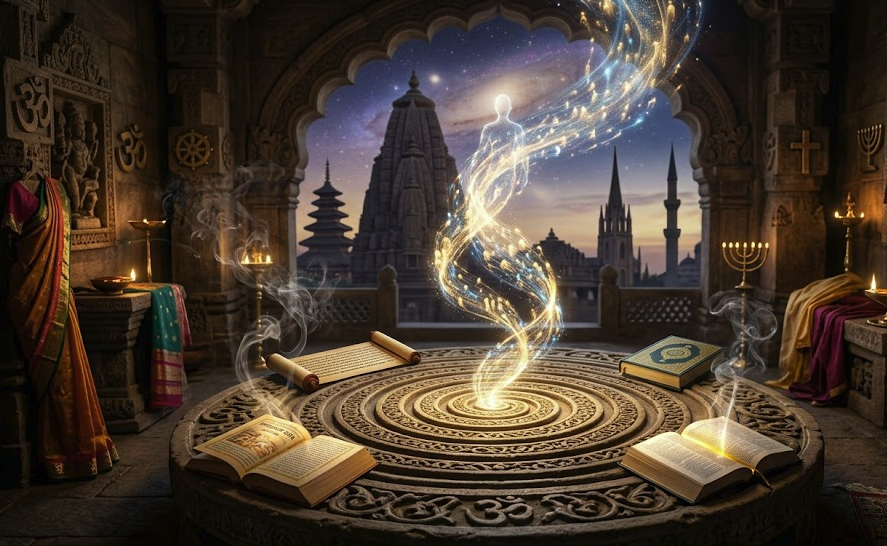
Madrid – ABN NEWS: The profound question of whether reincarnation exists remains one of the most enduring inquiries in human history. It sits at the absolute intersection of philosophical speculation, cultural anthropology, and global theological discourse. While some spiritual traditions firmly maintain that the human soul returns to the material plane in an entirely new physical form, other major global faiths reject this premise completely, viewing existence as a linear, singular journey.

This comparative investigation does not seek to validate or disprove the metaphysical reality of the concept; rather, it aims to present an objective, cross-referenced analysis of what official religious texts, canonical authorities, and holy scriptures declare across more than 30 traditions and belief systems worldwide. A fundamental question persists under historical scrutiny: Is there any universal consensus among global faiths regarding the cyclical nature of the soul?
In comparative religion, reincarnation—often termed transmigration of the soul or metempsychosis—is the metaphysical belief that the essential spiritual core of a living being (the soul or consciousness) survives physical dissolution at death and is subsequently reborn into a new physical vessel, whether human, animal, or spiritual.

However, this concept is far from uniform across global belief systems. Doctrinal approaches can be accurately categorized into three distinct frameworks:
Traditions that view cyclical rebirth as a foundational, non-negotiable spiritual reality.
Religions that categorically reject the concept based on linear divine judgment.
Indigenous or localized beliefs that view the phenomenon symbolically or do not address it directly within their core theology.
In orthodox Hindu theology, the cycle of rebirth, known as Samsara, is an essential doctrine directly intertwined with the cosmic law of Karma (cause and effect). The eternal soul, or Atman, undergoes a continuous series of births and deaths. The physical body is viewed merely as a temporary garment; upon its expiration, the Atman transmigrates into a new form determined by the cumulative moral and spiritual weight of its past actions, a process that continues until ultimate liberation (Moksha) is achieved.
While Buddhism accepts the concept of rebirth, its core doctrine of Anatta (non-self) introduces a profound theological distinction from Hinduism. Standard Buddhist scriptures reject the existence of an unchangeable, eternal soul. Instead, rebirth is understood as the continuation of an evolving stream of consciousness (Vijnana) and karmic conditioning. The cycle of existence is propelled by desire and ignorance, and the ultimate goal remains the cessation of this cycle through the attainment of Nirvana.
Jain theology positions the soul, or Jiva, as an independent spiritual entity trapped within material bonds. According to Jain canonical texts, every action attracts fine particles of material Karma that adhere to the soul, directly determining its next destination among four cosmic realms (heavenly beings, humans, animals/plants, or hellish entities). Liberation is achieved only through absolute ascetic purification.
The holy scripture of Sikhism, the Guru Granth Sahib, explicitly references the concept of transmigration. The human soul is viewed as a spark of the Divine Supreme Reality (Waheguru). Due to worldly attachments and ego (Haumai), souls are subjected to numerous cycles of birth and death across millions of life forms until they achieve spiritual maturity and ultimate absorption into the Divine Creator.
Mainstream Christian theology, across Catholic, Orthodox, and Protestant denominations, categorically rejects the doctrine of reincarnation. Christian eschatology is explicitly linear, founded on the premise of a singular earthly existence. This stance is rooted in canonical texts such as the New Testament (Hebrews 9:27), which states that human beings are destined to die once, and after that to face judgment. The afterlife is characterized by the immediate transition of the soul toward its eternal destination, culminating in the bodily resurrection at the Last Judgment.
Islamic theology and orthodox jurisprudence completely exclude the possibility of the soul returning to earthly life in a different physical body. The Quranic narrative establishes that human life is a singular trial. Upon physical death, the soul enters an intermediate state of consciousness known as the Barzakh, where it remains isolated from the physical world until the Day of Resurrection (Yawm al-Qiyamah). The concepts of divine accountability, eternal reward in Paradise (Jannah), and punishment in Hell (Jahannam) are fundamentally incompatible with cyclical rebirth.
Traditional, mainstream Judaism as articulated in the Hebrew Bible (Tanakh) and the Talmud focuses heavily on earthly life and adherence to divine commandments (Mitzvot), presenting a linear view of history and a singular physical life followed by spiritual accountability. While later mystical currents within Kabbalah, such as the Zohar and the teachings of Isaac Luria, introduced the concept of Gilgul Neshamot (the rolling or cycling of souls) as a mechanism for spiritual rectification, this remains an interpretation confined to specific esoteric schools rather than an orthodox article of faith accepted by general Jewish movements.
Across diverse indigenous African spiritualities, such as the Yoruba and Igbo traditions, concepts analogous to reincarnation exist but operate within a strict communal and ancestral framework. The return of a soul is generally understood as partial lineage rebirth, where the spiritual virtues, traits, or vital essence of an ancestor manifest within a newly born grandchild or relative to preserve the structural continuity of the tribe or family unit.
Shinto theology focuses almost exclusively on the concept of Kami (divine spirits or energies present in nature) and the sanctification of the present material world. Classic Shinto practices do not feature an explicit or detailed doctrine of reincarnation. Instead, upon physical death, human spirits are believed to merge into the collective ancestral spirit world, acting as protective guardians over their living descendants and local natural domains.
Philosophical and religious Taoism observes existence through the lens of the Tao (the universal, primordial way). Taoist literature views life and death as natural transformations within the eternal flow of Qi (cosmic vital energy). While certain later sects integrated elements of Buddhist cosmic cycles, classical Taoism interprets the continuity of life not as the literal migration of an isolated ego, but as the constant recycling of cosmic elements back into the great source of nature.
An objective textual review reveals that the global divergence regarding the destiny of the soul is driven by three primary theological and philosophical structural variations:
The Architecture of Time: Abrahamic faiths (Islam, Christianity, Judaism) operate on a linear model of cosmic time with a definitive beginning and an absolute end. Eastern traditions (Hinduism, Buddhism, Jainism) perceive cosmic time as cyclical, without an absolute temporal beginning or end point.
The Definition of Spiritual Justice: Systems rejecting transmigration locate divine justice in a single, definitive post-mortem judgment based on a single lifetime. Systems accepting transmigration view justice as an ongoing, self-regulating cosmic mechanism operating across numerous lifetimes.
The Concept of the Self: The rejection of the concept often aligns with the belief in a highly specific, immutable individual identity that must preserve its distinct nature for eternal resurrection, whereas acceptance aligns with a fluid view of identity where the outer form is merely accidental.
Is there absolute scientific proof supporting reincarnation?
From an empirical standpoint, there is no universally accepted scientific or physical proof verifying the objective reality of the transmigration of souls; the concept remains strictly within the domain of metaphysical and theological belief systems.
How does reincarnation differ fundamentally from bodily resurrection?
Reincarnation dictates that a singular spiritual entity inhabits entirely different physical bodies or life forms sequentially across time. In contrast, bodily resurrection implies that a specific individual is restored to life at the end of temporal history with their original, unified identity and a glorified physical form.
Do all traditions that believe in reincarnation allow rebirth as animals?
No. While classical orthodox Hinduism and Jainism recognize a vast spectrum of transmigration that includes animal and plant realms based on karmic accumulation, other cyclical traditions, such as certain schools of Druze or African lineage beliefs, restrict spiritual transition exclusively to subsequent human vessels.
Why do some modern esoteric groups interpret mainstream scriptures as supporting reincarnation?
Certain modern spiritual movements often interpret metaphorical descriptions of spiritual rebirth or transformation within linear scriptures as coded references to physical transmigration. However, academic and official institutional authorities within those major faiths uniformly maintain that their canonical texts explicitly reject literal earthly reincarnation.
Ultimately, the global discourse surrounding the destiny of the human spirit reflects a deep diversity in how humanity conceptualizes identity, accountability, and cosmic justice. The stark variation among the world’s major religions demonstrates that the answer to whether the soul undergoes a cyclical journey depends entirely on the fundamental scriptural framework through which an individual interprets life, death, and eternity... Read more