Physical Address
304 North Cardinal St.
Dorchester Center, MA 02124
Physical Address
304 North Cardinal St.
Dorchester Center, MA 02124

Religions News Around the World
Religions News Around the World
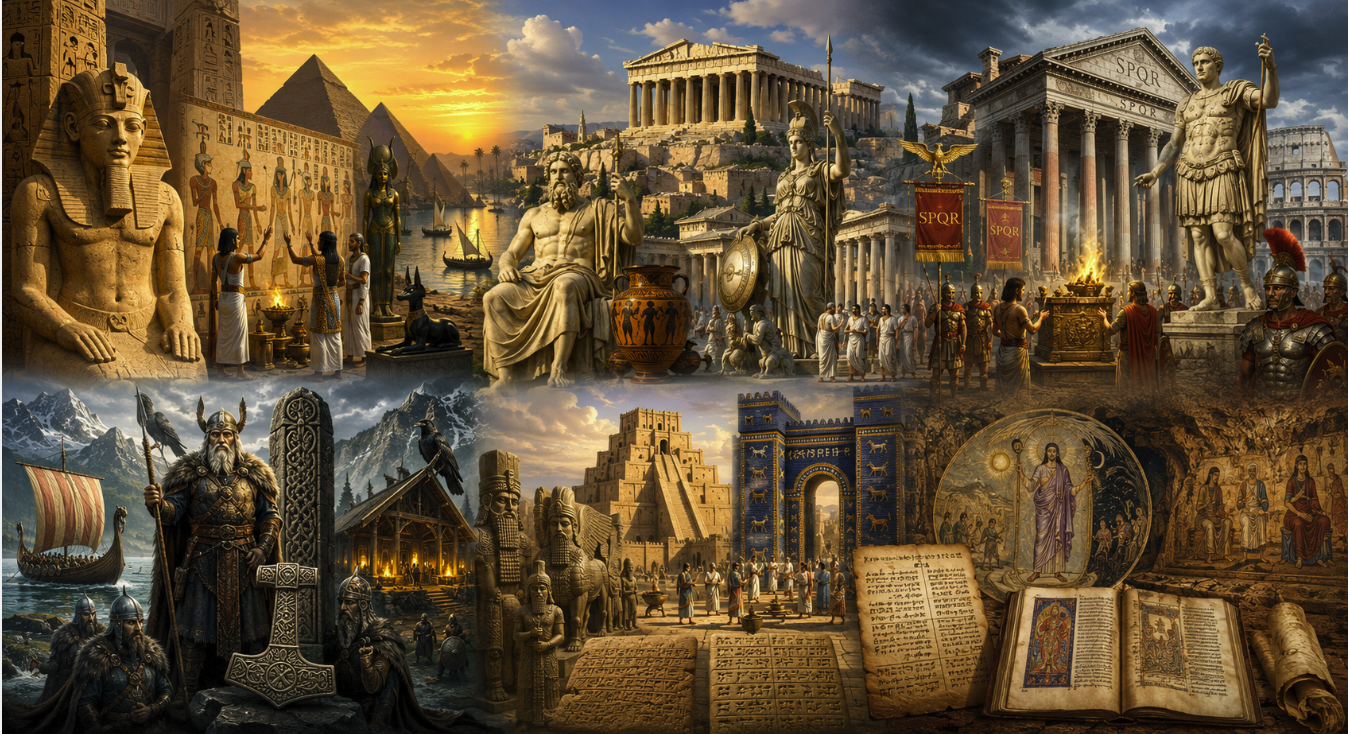
London – ABN NEWS: Extinct Religions occupy a fascinating place in human history, raising a profound question: can a faith truly vanish without a trace? Over millennia, thousands of belief systems have emerged, flourished, and eventually receded into the past. While many institutional belief systems collapsed alongside the empires that protected them, the concept of absolute extinction is highly nuanced. Many ancient belief systems never fully disappeared; instead, they evolved, left indelible cultural marks, or transformed into entirely new frameworks. How do historians draw the line between a religion that is truly dead and one that has simply changed its form?

In historical and anthropological terms, declaring a religion “extinct” does not imply that its memory has been wiped from human consciousness. Rather, scholars use specific criteria to define the end of an active faith.
An extinct religion is characterized by the permanent loss of its living community of worshippers. This includes the disappearance of its official religious institutions, such as priesthoods and dedicated temples, and the cessation of its organized public rituals. In many cases, extinction occurs through syncretism—the gradual blending of older beliefs into newer, dominant socio-religious systems. Consequently, while the theological infrastructure dies, elements of the faith often survive as folklore, cultural customs, or structural components of subsequent world religions.

Throughout antiquity, powerful state religions dominated global civilizations. Today, these systems function strictly as subjects of historical study rather than active paths of worship.
For over three thousand years, the worship of deities like Ra, Osiris, Isis, and Anubis formed the bedrock of Egyptian civilization. This highly complex system centered on cosmic balance (Ma’at) and meticulous preparations for the afterlife. The religion faced a gradual decline following the Greek and Roman conquests, accelerating rapidly with the widespread adoption of Christianity in the 4th century CE. When the last hieroglyphic inscriptions were carved at Philae, the formal priesthood dissolved. Today, no community practices this faith as an unbroken historical lineage, though its monumental architecture and mythology remain globally iconic.
The pantheons of ancient Greece and Rome—featuring deities such as Zeus, Athena, Jupiter, and Minerva—were intricately intertwined with civic duty, governance, and daily life. This system officially ended after Christianity became the state religion of the Roman Empire under Emperor Theodosius I, who banned pagan rituals and closed traditional temples. While modern Reconstructionist movements like Hellenism seek to revive these practices, they are contemporary revivals rather than a direct, continuous transmission of ancient traditions.
The faith of the Vikings and pre-Christian Germanic societies centered on a rich mythology featuring Odin, Thor, Freya, and the concept of Ragnarok. Lacking centralized scriptures, it relied on oral traditions and local chieftains. The religion gradually dissolved between the 10th and 12th centuries as Scandinavia underwent a systematic process of Christianization. While Norse mythology heavily influences modern literature, media, and pop culture, the original structured theological practice vanished centuries ago.
Founded in 3rd-century Persia by the prophet Mani, Manichaeism was once one of the most successful religions in the world, stretching from North Africa to China. It offered a deeply dualistic theology based on an eternal cosmic struggle between Light (the soul) and Darkness (matter). Because it directly competed with Christianity, Zoroastrianism, Islam, and Buddhism, it faced intense, systematic persecution across multiple empires. By the 14th century, its final organized communities in Southern China had vanished, making it one of the premier examples of a major world religion becoming completely extinct as an organized institution.
The cradle of civilization produced some of the earliest recorded religious systems, dedicated to deities like Enlil, Inanna, and Marduk. These faiths introduced foundational concepts like sacred ziggurats and the epic of Gilgamesh. They eroded over centuries of foreign conquests, eventually fading completely with the regional ascendance of Christianity and Islam.
The decline and eventual disappearance of a religious system is rarely accidental; it is almost always driven by macro-historical shifts.
Many ancient religions functioned as state cults. When an empire fell or was conquered, the financial and political mechanisms that maintained temples and paid priesthoods collapsed, forcing the local population to adapt to the conqueror’s culture.
The emergence of highly organized, proselytizing global religions changed the spiritual landscape. Faiths like Christianity and Islam offered universal messages, centralized scriptures, and robust institutional frameworks that rapidly absorbed or replaced localized polytheistic traditions.
Over time, shifts in language, written scripts, and communication networks isolated older traditions. According to analytical reports by ABN NEWS, small-scale tribal religions face the highest risk of total extinction today. When indigenous communities undergo forced displacement, rapid urbanization, or linguistic loss, their orally transmitted spiritual heritage often disappears entirely within a few generations.
To better understand how different faiths managed historical pressures, the table below highlights the varying outcomes of ancient belief systems:
| Ancient Faith | Status of Original Lineage | Modern Cultural Status | Primary Cause of Shift |
| Egyptian Polytheism | Extinct | Highly preserved archaeologically | Conversion to Christianity/Islam |
| Manichaeism | Extinct | Studied strictly through texts | Intensive state persecution |
| Zoroastrianism | Active (Endangered) | Survives in small diaspora communities | Migration and insular traditions |
| Mayan Religion | Active (Syncretized) | Blended into Central American practices | Integration with Catholicism |
It is a frequent mistake to classify certain ancient religions as entirely extinct simply because their global numbers are small or their practices have adapted.
Though often spoken of in the past tense, Zoroastrianism—one of the world’s oldest monotheistic faiths—is not extinct. Following the Islamic conquest of Persia, a significant group migrated to India, where they became known as the Parsis. Today, small but highly dedicated communities continue to maintain sacred fires and preserve their ancient scriptures in India, Iran, and Western diasporas.
Despite centuries of colonial rule and intense pressure to convert, indigenous spiritualities across the Americas never truly vanished. In countries like Guatemala and Mexico, traditional Mayan cosmology remains deeply integrated into daily life, often coexisting alongside or heavily coloring local Catholic practices.
Can a religion be successfully revived after it goes extinct?
While modern groups frequently attempt to reconstruct ancient faiths (such as Neo-Paganism or Kemetism), historians generally view these as new cultural movements rather than direct continuations, due to the broken historical chain of transmission, loss of original oral traditions, and altered social contexts.
What is the difference between a dead religion and a dead language?
A religion is considered dead when there are no longer any living practitioners who utilize it as their active belief system. A language is dead when it has no native speakers, though like Latin, a dead language can still be used officially or academically long after the religion associated with it has vanished.
Are there any completely undocumented religions that went extinct?
Yes. Because writing developed late in human history, thousands of prehistoric, localized, and tribal belief systems undoubtedly existed and vanished without leaving any written records or archaeological traces.
How does syncretism prevent total religious extinction?
Syncretism allows elements of a dying religion to survive by embedding them into a dominant new faith. For example, many ancient European pagan festivals, symbols, and sacred sites were adopted and repurposed by early Christianity, allowing those underlying cultural traditions to endure.
Ultimately, history demonstrates that while the formal, institutional structures of religions can die out completely—as seen in the cases of Manichaeism and Pharaonic Egypt—the core components of human belief rarely vanish without a trace. Instead, they reshape themselves, leaving behind linguistic terms, artistic symbols, and philosophical ideas that continue to influence modern civilizations... Read more