Physical Address
304 North Cardinal St.
Dorchester Center, MA 02124
Physical Address
304 North Cardinal St.
Dorchester Center, MA 02124

Religions News Around the World
Religions News Around the World
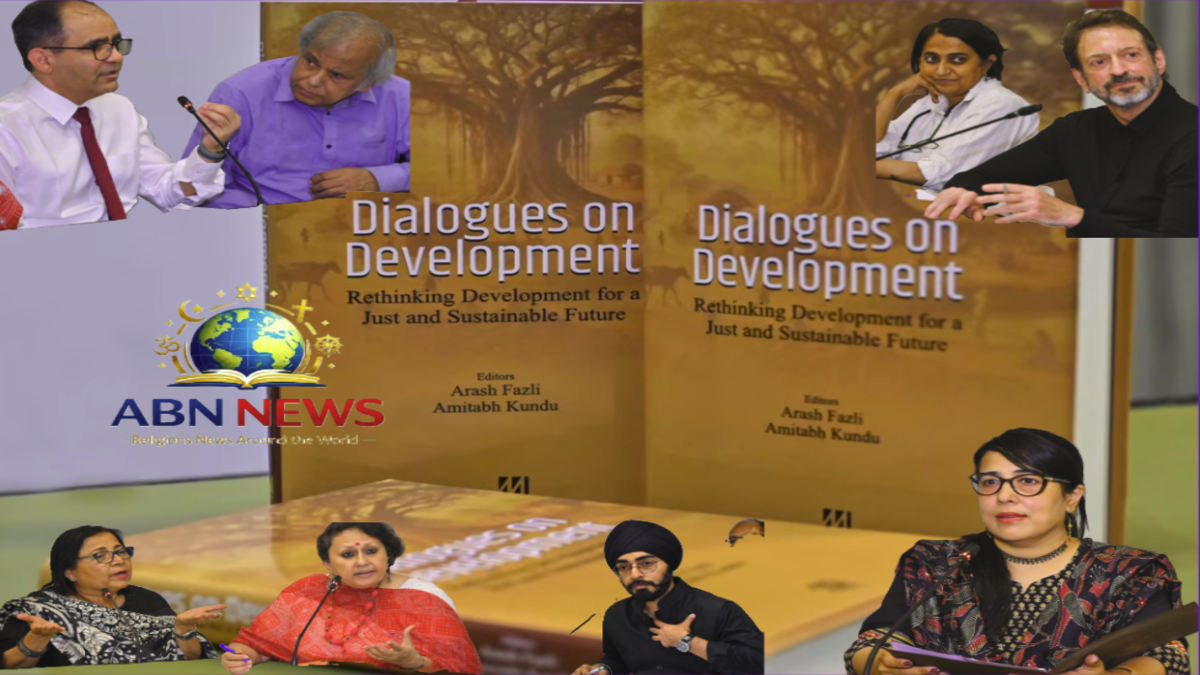
NEW DELHI — ABN NEWS: The official public gathering in India confirmed that the community is shifting its approach as the public framework highlights how The Bahá’í Office Launches a New Book: Dialogues on Development: Rethinking Development for a Just and Sustainable Future to open critical discussions on human welfare. For decades, the international community has measured societal advancement almost exclusively through tangible indicators: gross domestic product, infrastructural expansion, income brackets, and production volumes. While these data points offer clear insights into macroeconomic trends, a growing consensus suggests they frequently overlook the intangible elements that define human well-being. Concepts such as human dignity, the resilience of communal bonds, cultural wisdom, and ecological responsibility often disappear within purely quantitative frameworks.

How can international policymakers transition from a rigid, numbers-driven approach to a holistic model that prioritizes long-term human and environmental flourishing?
The recent gathering at the India International Centre in New Delhi marked a pivotal moment in this ongoing discourse. The Bahá’í Office of Public Affairs of India, collaborating with the Bahá’í Chair for Studies in Development at Devi Ahilya University, officially introduced this significant publication to challenge prevailing paradigms and introduce alternative frameworks for global advancement.

The book is co-edited by Dr. Arash Fazli, Assistant Professor and Head of the Bahá’í Chair, alongside Dr. Amitabh Kundu, Professor Emeritus at LJ University. The volume compiles 14 comprehensive essays derived from an extensive lecture series conducted by the Chair over the past two years. Rather than offering mere academic theory, the text serves as a conceptual bridge, linking structural policy with foundational human values.
The launch event attracted approximately 60 prominent scholars, civil society leaders, and development practitioners. The diverse assembly sought to dissect the core themes of the book, analyzing how theoretical principles can be translated into actionable, localized strategies. According to information obtained by the editorial team at [ABN NEWS], the atmosphere reflected a shared urgency to address systemic global failures through fresh intellectual lenses.
The core thesis of the volume relies on integrating ethical principles directly into policy design, rather than treating them as secondary considerations.
Traditional Model:  [Economic Growth] ──> [Infrastructure] ──> [Policy Check: Ethics as an Afterthought]
Proposed Model:     [Foundational Ethics: Justice & Oneness] ──> [Organic Policy Design] ──> [Holistic Progress]
The contributors argue that true progress occurs when communities are viewed as active protagonists rather than passive recipients of external aid.
The Principle of Interconnectedness: Policies must reflect the oneness of humanity, acknowledging that economic decisions in one region carry profound social ramifications globally.
Environmental Stewardship: Moving away from exploitative resource extraction toward models that safeguard ecological balance for future generations.
Organic and Decentralized Growth: Designing development templates that adapt to the fluid, lived realities of local populations instead of forcing rigid, top-down bureaucratic structures upon them.
The release of this volume comes at a time when the international community faces interconnected crises, including accelerating environmental degradation, widening wealth gaps, and increasing social fragmentation. Traditional models often attempt to solve these issues using the same material-centric logic that created them.
During the panel discussions, Dr. Arash Fazli emphasized that development was historically conceived to bring universal justice to humanity. Over time, however, the field transformed into a highly technical, bureaucratic exercise. Dr. Fazli noted that ethical and spiritual principles must serve as the literal foundation of social planning, rather than optional ideals invoked only when convenient.
As learned by [ABN NEWS] from the discussions, the publication challenges the very language utilized by global institutions. Experts at the event, including former World Bank director Steven Schonberger, pointed out that terms like “developed” and “underdeveloped” create artificial hierarchies. This terminology can foster complacency in wealthy nations while systematically devaluing the cultural wealth, social cohesion, and insights inherent in less wealthy societies. Shifting the terminology toward “human progress” implies a continuous, lifelong journey applicable to every nation.
To better understand the shift advocated by the authors, it is useful to examine how different paradigms approach key societal pillars.
| Development Pillar | Traditional Material Model | Holistic Moral Model |
| Primary Metric | GDP growth, per capita income, industrial output. | Human dignity, social trust, ecological health. |
| Community Role | Passive beneficiaries or consumers of aid programs. | Active protagonists and authors of local progress. |
| Environment | A resource pool to be managed for economic utility. | A sacred trust requiring active stewardship. |
| Implementation | Rigid, top-down, results-oriented templates. | Flexible, organic, and culturally specific learning. |
Reimagining global progress requires a long-term commitment to institutional and grassroots learning. The insights compiled indicate that the Bahá’í Chair views this book launch not as a conclusion, but as the opening chapter of a broader international conversation.
True sustainability demands that young people and local communities are equipped to analyze their own realities. By blending technical expertise with moral clarity, modern society can begin constructing a global framework where economic health and human honor reinforce one another. For further details on global ethical frameworks and international development standards, researchers can consult official outlines available through the United Nations Sustainable Development Goals portal.
The project aims to challenge purely material and economic measures of global progress, offering alternative frameworks rooted in ethics, justice, human dignity, and environmental stewardship.
The volume was co-edited by Dr. Arash Fazli, Head of the Bahá’í Chair for Studies in Development at Devi Ahilya University, and Dr. Amitabh Kundu, Professor Emeritus at LJ University.
The authors argue that relying solely on GDP and infrastructure metrics overlooks vital aspects of human life, such as cultural wisdom, the strength of social bonds, and long-term ecological balance.
The official book launch and its accompanying panel discussion were hosted at the India International Centre in New Delhi, India.
In summary, the detailed concepts found in Dialogues on Development: Rethinking Development for a Just and Sustainable Future offer a timely intervention in a world seeking systemic alternatives. By reframing progress as a moral and collective journey, the publication encourages international practitioners to build a more equitable world.… Read more
Contact: info@abnnews.net