Physical Address
304 North Cardinal St.
Dorchester Center, MA 02124
Physical Address
304 North Cardinal St.
Dorchester Center, MA 02124
Religions News Around the World
Religions News Around the World
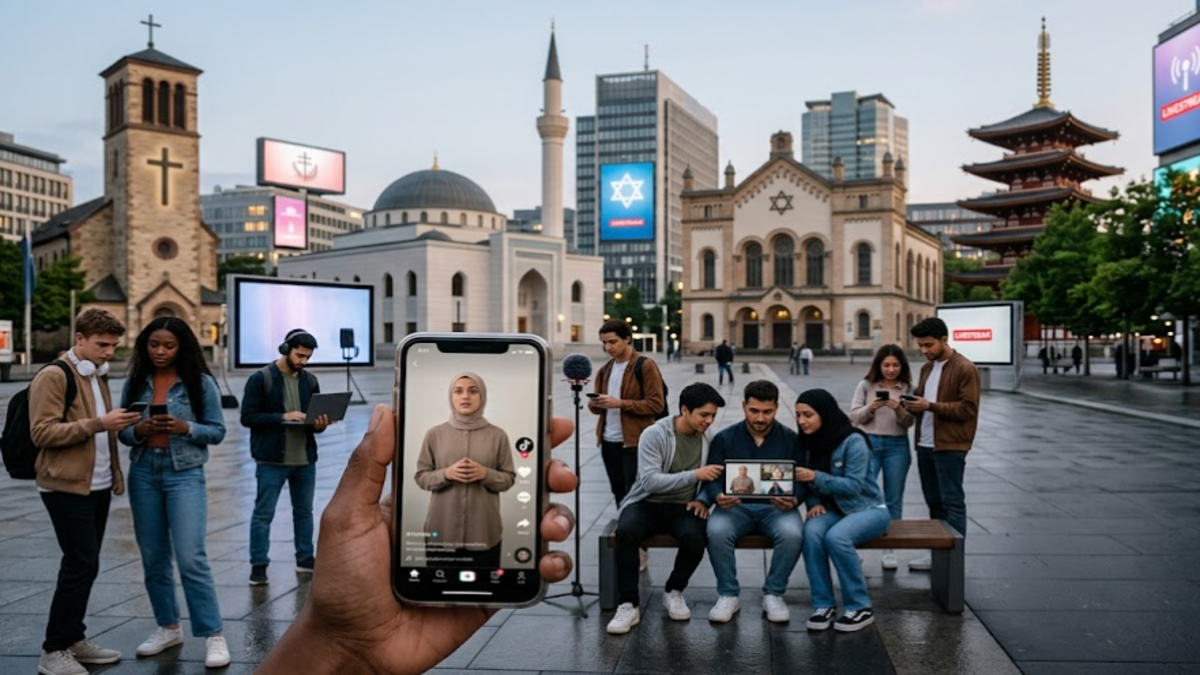
LONDON – ABN NEWS: Religion in the Age of TikTok and YouTube is reshaping how millions of people encounter faith, religious ideas and spiritual questions, as short videos, podcasts and online personalities increasingly compete with traditional institutions for public attention. What happens when the first place a young person turns for answers about God, belief or morality is no longer a church, mosque, synagogue, temple or classroom, but a smartphone screen?

Religion has long adapted to new forms of communication, from printed books and newspapers to radio, television and the internet. But TikTok and YouTube have changed the pace and character of that transformation.
Religious messages can now travel from one person to millions of viewers within hours. A sermon can become a short clip. A theological debate can become a livestream. A question about scripture can generate thousands of comments, responses and counterarguments.

Recent reporting in Britain and the United States shows that religious creators are increasingly treating social media not simply as a place to advertise established institutions, but as a space where people actually encounter religious ideas for the first time.
Researchers are also paying closer attention to this development. At Santa Clara University, sociologist Di Di is studying how religious and spiritual influencers navigate the relationship between authenticity and monetisation on YouTube and TikTok. Her research examines what happens when social-media personalities become sources of spiritual guidance for people who may not rely primarily on traditional religious authorities.
The shift matters because social platforms operate differently from traditional religious institutions. A congregation generally has a recognised leadership structure, established teaching traditions and a physical community. TikTok and YouTube instead place religious content into an environment dominated by recommendation systems, audience reactions, personalities and competition for attention.
That does not necessarily mean religion is disappearing. In some cases, the opposite appears to be happening.
The digital environment is creating new opportunities for people to discover religious traditions, compare beliefs and ask questions that they might hesitate to raise in person.
A recent Washington Post report described a growing group of online religious explainers who attract large audiences by presenting Christianity, biblical scholarship and religious history in accessible formats. Among them is Dan McClellan, whose videos on TikTok and YouTube address viral claims about the Bible. Another creator, Andrew Mark Henry, runs Religion for Breakfast, a channel focused on religious literacy.
The phenomenon is broader than any single denomination. Muslim imams, Christian priests, Jewish educators, Buddhist practitioners, Sikh creators and people outside organised religion are all using digital platforms to communicate with audiences.
The result is a new religious marketplace in which visibility can depend as much on communication skills as institutional position.
The most important change may be the way religious authority is being redistributed.
For centuries, religious institutions controlled many of the traditional routes through which believers learned about doctrine. Clergy, teachers and community leaders remained central figures in explaining sacred texts and religious practices.
Online platforms have introduced another layer.
A young viewer can now hear a priest discussing prayer, watch an imam answer questions about Islam, listen to a Buddhist teacher explain meditation and then encounter an atheist criticising organised religion — all within the same scrolling session.
That experience encourages comparison.
It can also make religious identity more personal. Instead of beginning with membership in an institution, some users begin with a question, a video or a creator whose personality attracts them.
The Washington Post recently reported that some viewers have described religious influencers as guides through a complicated landscape of denominations and beliefs. One creator’s explanatory video about Christian denominations attracted millions of views, while other religion-focused channels have built audiences numbering in the hundreds of thousands or more.
For some viewers, this content provides an introduction to religion. For others, it becomes a form of continuing education.
There is also a growing audience for religious discussion that does not fit neatly into either evangelism or atheism. Dan McClellan, for example, has attracted viewers with an approach that examines biblical claims critically while allowing room for faith. His online audience demonstrates that people can be interested in religious scholarship without necessarily accepting or rejecting a religious tradition outright.
This is one of the most significant developments in digital religion: the internet does not simply offer more religious content. It creates more visible disagreement within religions and between religions.
That can make religious literacy more accessible, but it can also make confusion easier.
A thirty-second video may introduce a complicated theological question, but it cannot necessarily provide the historical, linguistic or cultural context required to answer it responsibly.
The platform rewards clarity and immediacy. Religion often demands patience and nuance.
That tension sits at the centre of the new digital religious environment.
The strongest reason religious organisations are paying attention to TikTok and YouTube is simple: younger audiences already spend substantial amounts of time on these platforms.
Ofcom’s latest research into children’s media habits found that among British 12-to-15-year-olds who access news, TikTok was the most-used source, with 42% saying they use it for news. YouTube followed at 38%. Social media was the most common environment for news consumption among children in this age group.
Religion does not operate separately from this broader information environment.
If young people increasingly discover politics, culture, entertainment and current affairs through video platforms, religious organisations and creators also have an opportunity to reach them there.
The Religion Media Centre recently reported on a panel discussion involving faith-based creators in Britain. The participants included Rev Pippa White, known online as the “TikTok vicar”, and Sabah Ahmedi, known as “the young imam”.
White has more than 31,000 TikTok followers, while Ahmedi has built an online following and receives messages from both Muslims and people who do not identify with a faith.
Their experiences highlight an important feature of social-media religion: audiences do not always behave like traditional congregations.
People may arrive because a video appears on their feed rather than because they deliberately searched for a religious service. They may never attend the creator’s place of worship. They may disagree with the creator on doctrine while continuing to watch.
The relationship is therefore less formal.
A follower is not necessarily a believer. A viewer is not necessarily a member. A viral video does not necessarily translate into participation in a religious community.
Yet exposure itself can be significant.
For someone who has never entered a religious building, a short video may become the first point of contact with a tradition.
For someone raised within a faith, online content may provide an alternative interpretation of beliefs they already know.
And for someone questioning religion, digital platforms offer an enormous library of competing perspectives.
The rise of religious influencers has also introduced a difficult question: what happens when spiritual communication becomes part of the creator economy?
Social-media platforms reward attention.
Views, comments, shares and followers provide measurable feedback. Creators can see immediately which subjects generate interest and which disappear without a response.
That creates incentives that can affect religious communication.
The Religion Media Centre reported that faith-based creators themselves have acknowledged the psychological pressure involved. Rev Pippa White described the attraction of viral attention and the dopamine response associated with sudden increases in views and followers. Sabah Ahmedi similarly said that chasing likes and attention had once taken over his life before he changed his approach.
The problem is not unique to religion.
Every creator working on a major social platform faces pressure to remain visible. But religious leaders face an additional question: should a message about faith be shaped by the same mechanisms that determine entertainment trends?
The answer is not straightforward.
Short-form video can make difficult ideas accessible. A religious teacher can use humour, storytelling and everyday examples to reach people who would never watch a conventional lecture.
At the same time, the pressure to produce increasingly engaging material can encourage simplification.
A complicated theological disagreement may be reduced to a provocative question. A centuries-old religious tradition may be presented through a single personality. A controversial interpretation can receive more attention than a carefully qualified explanation.
The danger is particularly clear when viewers treat popularity as evidence of authority.
A creator with millions of followers may be highly knowledgeable. Another may have little formal training. The platform itself does not necessarily make that distinction obvious.
This is why digital religious literacy is becoming increasingly important.
The move toward digital religion is not based solely on anecdotes from influencers.
Pew Research Center research has found that digital tools already play a meaningful role in religious life in the United States. Three-in-ten U.S. adults said they go online to search for information about religion, while 20% said they watch religion-focused online videos, including content on platforms such as YouTube or TikTok.
The same research found that 11% of U.S. adults follow or keep track of religious leaders online or through social media, while a similar proportion follow celebrities, authors or pastors specifically for religious content.
Digital religion also extends beyond watching videos.
People use websites and applications to read scripture, pray, meditate and participate in online religious groups. Pew found that 37% of U.S. adults had used an app or website for at least one of several religious or spiritual purposes, including prayer, scripture reading, meditation or gratitude.
But the research also offers an important warning against declaring that the internet has replaced traditional religious life.
In-person participation remains stronger in several areas.
Pew found that 19% of U.S. adults had participated in prayer groups, scripture study groups or religious education programs in person, compared with 7% who had participated in such activities online. The figures suggest that digital religion complements physical communities more often than it completely replaces them.
That distinction matters.
A YouTube sermon may reach someone living hundreds of kilometres from a congregation. A TikTok video may answer a question late at night. An online discussion may connect someone with people who share a religious identity.
But digital interaction cannot automatically reproduce every function of a community.
Religious life can involve friendship, charity, ritual, family relationships, physical gathering and mutual responsibility. A follower count cannot measure those things.
The most intriguing development may be the way social media allows people to explore religious identity before committing to an institution.
The old model often began with family.
A child grew up in a particular religious community, attended its ceremonies and learned its traditions. Identity was therefore closely connected to geography and family.
The digital model can work differently.
A person may grow up without strong religious affiliation and later discover Christianity through YouTube, Islam through TikTok, Buddhism through an online teacher or Jewish history through a podcast.
This does not mean the person will necessarily adopt the faith.
But it changes the path by which religious questions enter everyday life.
The Washington Post reported on viewers who found religious content during periods of personal uncertainty. One viewer described discovering online biblical commentary while wrestling with questions about faith and said the experience helped him reconsider what he believed. Another young woman raised in an atheistic household said online religious explainers exposed her to a diversity of religious thought.
Such accounts illustrate why digital religion should not be understood simply as religious advertising.
For some people, it functions as exploration.
That exploration can move in multiple directions. A viewer may become more religious, less religious or simply more informed about different traditions.
The same algorithm can introduce a person to devotional material, academic criticism and atheist commentary within minutes.
The result is a religious environment that is simultaneously more open and more fragmented.
The expansion of religious content online also creates serious editorial and social challenges.
Religion is particularly vulnerable to misinformation because sacred texts, historical claims and theological traditions often require specialist knowledge to interpret.
A misleading statement can spread quickly when it is presented in a compelling video.
A creator may quote a religious text without context. A historical claim may be repeated because it performs well. A controversial interpretation may become popular simply because it provokes anger.
The audience then becomes part of the distribution system.
Comments, duets, reactions and reposts can turn one disputed claim into a much larger argument.
There is another problem: religious content can become entangled with political identity.
Recent reporting on online Christian influencers in the United States has shown that some religious creators discuss questions that extend beyond theology into culture and politics. Debates about Christian identity, nationalism, gender and public policy increasingly appear alongside traditional discussions about scripture and doctrine.
That does not mean religious creators are inherently political.
It means that social media makes it difficult to separate religious conversation from the wider cultural arguments taking place around it.
The same platform that helps someone learn about a religious tradition can also expose them to increasingly polarised communities.
Algorithms are designed to keep users engaged. They do not necessarily aim to produce the most balanced religious education.
For that reason, viewers need to ask basic journalistic questions: Who is speaking? What are their qualifications? What evidence supports the claim? Is the statement widely accepted within the tradition, or is it one interpretation among many?
Those questions are becoming essential tools for navigating faith online.
One of the more positive consequences of the digital transformation is the increased visibility of religious diversity.
A person living in a predominantly Christian, Muslim, Hindu, Jewish or secular community can encounter traditions that may have little presence locally.
That exposure can challenge stereotypes.
A Sikh creator can show everyday life rather than presenting Sikhism solely through textbook descriptions. A Muslim creator can answer ordinary questions about family, work and religious practice. A Christian priest can discuss doubts without treating them as a forbidden subject.
The Religion Media Centre reported on Sikh creator Virdi Mazaria, who said he wanted audiences to see him as a person first rather than reducing his identity to religion. His social-media presence combines his Sikh identity with his work, interests and everyday life.
This is significant because religion often enters mainstream media through major events, conflicts or controversies.
Social media can show another side: ordinary believers living ordinary lives.
It can also give minority communities greater control over how they represent themselves.
Yet visibility alone does not guarantee understanding.
A single creator cannot represent an entire religious tradition. Nor can a viral video provide a complete picture of a faith containing multiple schools, denominations, cultures and interpretations.
The digital audience must therefore distinguish between representation and totality.
For now, the evidence points toward coexistence rather than replacement.
Pew’s research shows that online religious activity has become established, but in-person participation remains important. Meanwhile, religious creators themselves often speak about social media as a tool for reaching people rather than as a complete substitute for community.
The strongest digital religious organisations appear to understand this distinction.
Their social channels can function as an entry point.
Someone watches a video, asks a question, attends an event, joins a community or begins reading more deeply. The screen becomes the doorway rather than the destination.
That model may prove particularly important for younger generations who are comfortable forming relationships and communities online.
At the same time, traditional religious institutions face pressure to adapt their communication.
A sermon designed for a room of several hundred people does not automatically work as a 60-second video. A formal announcement may be accurate but uninteresting in a fast-moving feed.
Religious communicators therefore have to learn the language of digital media without allowing the platform to determine the substance of the message.
That is a delicate balance.
As one British faith-based youth ministry told the Religion Media Centre, creators have to consider how to remain faithful to their beliefs while producing content that people will actually watch.
The next stage of this transformation is unlikely to be limited to TikTok and YouTube.
Social platforms are already being joined by artificial intelligence tools that can answer questions instantly and generate explanations on demand.
Santa Clara University sociologist Di Di has argued that meaning-making frameworks traditionally provided by religious leaders are increasingly being supplemented by social-media influencers and, more recently, AI chatbots. Her research raises questions about what happens when people turn to technology for guidance on questions that were once addressed primarily within faith communities.
That development could make religious information more accessible than ever.
It could also make verification more difficult.
A future user may ask an influencer, a search engine and an AI system the same religious question and receive three different answers.
The challenge will not simply be access to information. It will be deciding which information deserves trust.
For religious institutions, that creates an opportunity as well as a threat.
They can provide reliable educational resources, train leaders in digital communication and engage with questions that younger audiences are already asking.
For journalists, the task is equally important: distinguish religious belief from verified fact, identify the source of claims and avoid treating social-media popularity as proof of credibility.
And for audiences, the responsibility is to remain curious without becoming passive consumers of whatever appears in a personalised feed.
The age of digital religion is therefore not necessarily an age in which technology replaces faith.
It is an age in which technology changes how faith is encountered, discussed, challenged and shared.
A priest, imam, rabbi, monk or religious scholar can now enter a person’s life without ever meeting that person.
A teenager can ask a religious question publicly and receive responses from people around the world.
A scholar can challenge a viral claim before millions of viewers.
And a believer who once felt isolated can discover an international community within minutes.
The central question is no longer whether religion belongs online.
It already does.
The more difficult question is whether the speed, incentives and architecture of social media can support the depth, responsibility and human connection that religious life often requires.
Yes. Social-media videos can introduce people to religious ideas, leaders and debates, although exposure does not automatically mean conversion or long-term religious commitment.
Not entirely. Evidence indicates that online religious activity often exists alongside traditional communities and in-person participation.
Yes. Religious education, biblical commentary, sermons, debates and other faith-related videos attract substantial audiences, including channels with hundreds of thousands or more subscribers.
One major challenge is distinguishing reliable religious education from misinformation, oversimplification and content designed primarily to maximise engagement.
… Read more
Contact: info@abnnews.net