Physical Address
304 North Cardinal St.
Dorchester Center, MA 02124
Physical Address
304 North Cardinal St.
Dorchester Center, MA 02124

Religions News Around the World
Religions News Around the World
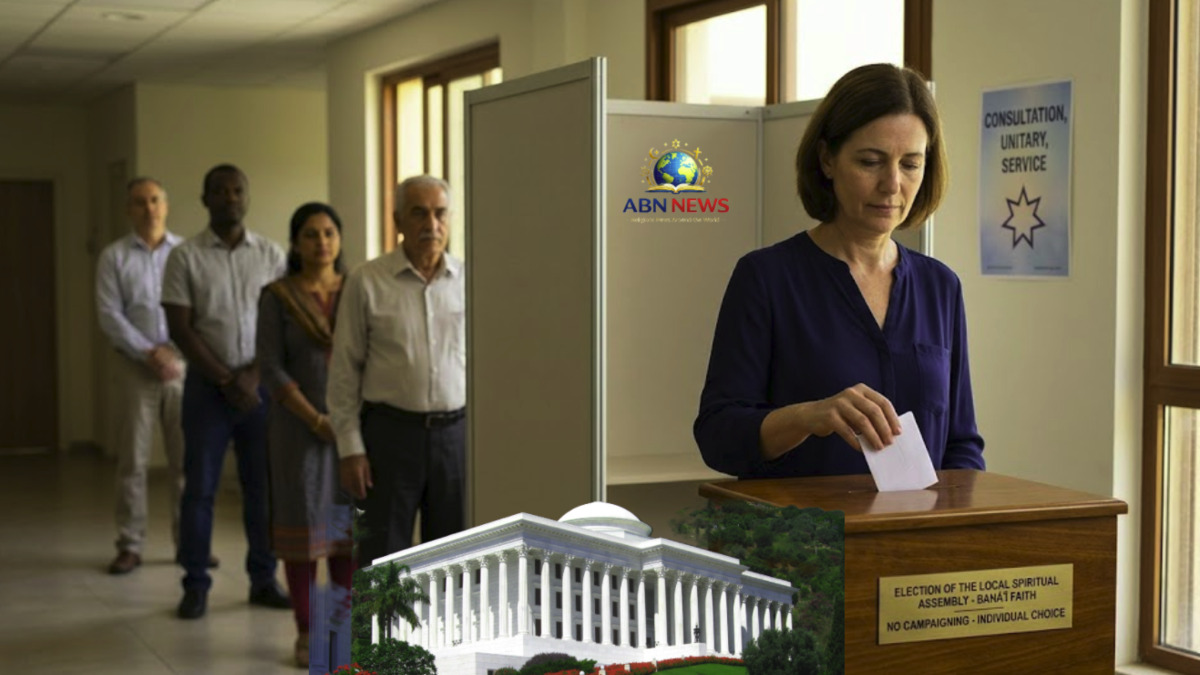
Haifa – ABN NEWS: In a world where political campaigns are often synonymous with noise, competition, and partisanship, the Baha’i elections present a starkly different administrative paradigm. Far from the traditional democratic arenas, this religious and community system operates on a unique set of principles that prioritize collective wisdom over individual power. But how does a global community manage its affairs without a single candidate, party, or platform? According to the administrative protocols of the Baha’i Faith, the answer lies in a spiritualized hierarchy of service.

The Baha’i administrative order is structured as a pyramid, designed to ensure that governance remains rooted in local needs while maintaining global unity. According to information obtained by the ABN NEWS team, this system functions across three primary levels, with elections held periodically to ensure fresh perspectives within its institutions.
Every year, Baha’i communities in towns and cities worldwide elect their Local Spiritual Assembly. These nine-member bodies manage the affairs of the local community. Unlike secular elections, there are no nominations; voters simply write down the names of nine adult members they believe possess the highest moral and intellectual qualifications.

The local assemblies do not directly govern the nation. Instead, the local level elects delegates who then attend a National Convention. These delegates elect the National Spiritual Assembly annually. This body oversees Baha’i activities across an entire country, ensuring coordination between the local and international levels.
At the apex sits the Universal House of Justice, the supreme governing body of the Baha’i Faith. It consists of nine members elected every five years. The electorate for this body is composed of all members of all National Spiritual Assemblies throughout the world. According to the data gathered by the ABN NEWS team, this international election takes place at the Baha’i World Centre in Haifa, Israel.
The most striking feature of Baha’i elections is the total absence of the “electioneering” common in modern politics. The Baha’i constitution strictly forbids several standard political practices:
No Nominations or Candidates: No individual can put themselves forward for election.
No Electioneering or Propaganda: There are no speeches, posters, or promises.
No Parties or Factions: The system is designed to prevent the formation of interest groups or “lobbies.”
In the practice of this system, voters are instructed to choose individuals who demonstrate “unquestioned loyalty, selfless devotion, a well-trained mind, recognized ability, and mature experience.” This shift from “power-seeking” to “service-seeking” is the philosophical cornerstone of the model. While the legislation intended for frequent turnover to allow diverse talents to serve, in some regions, certain members remain for long periods—a challenge that the community continues to address to ensure the emergence of new competencies.
The system we see today is the result of a historical evolution that began in the 19th century. While Baha’u’llah established the principle of “Consultation” (Shura), it was Shoghi Effendi (1921–1957) who meticulously organized the modern administrative structure. The first election of the Universal House of Justice took place in 1963, marking the transition to a permanent international authority.
Within the Universal House of Justice, decisions are managed through collective consultation rather than individual decree. There is no “president” with veto power; instead, the nine members deliberate as a single entity. According to professional sources within the sector, the goal is to reach a consensus. If an impasse occurs, a majority vote is taken, but only after the subject has been thoroughly matured through discussion. This ensures that the “idea is more important than the person who proposed it.”
Who is eligible to vote in Baha’i elections?
At the local level, all adult Baha’is in good standing can vote. At the national level, elected delegates vote. For the Universal House of Justice, only members of National Spiritual Assemblies hold voting rights.
Why are there no candidates in Baha’i elections?
The absence of candidates is intended to prevent ego-driven competition, partisanship, and the social division that often accompanies political campaigns, focusing instead on character and service.
Can women be elected to Baha’i institutions?
Women are eligible for election to all local and national Baha’i institutions worldwide. However, according to Baha’i scripture, membership in the Universal House of Justice is currently limited to men.
What is the term of office for these bodies?
Local and National Spiritual Assemblies are elected annually. The Universal House of Justice is elected every five years.
The Baha’i electoral system serves as a unique internal model that attempts to balance individual freedom of conscience with the need for global administrative unity.