Physical Address
304 North Cardinal St.
Dorchester Center, MA 02124
Physical Address
304 North Cardinal St.
Dorchester Center, MA 02124

Religions News Around the World
Religions News Around the World
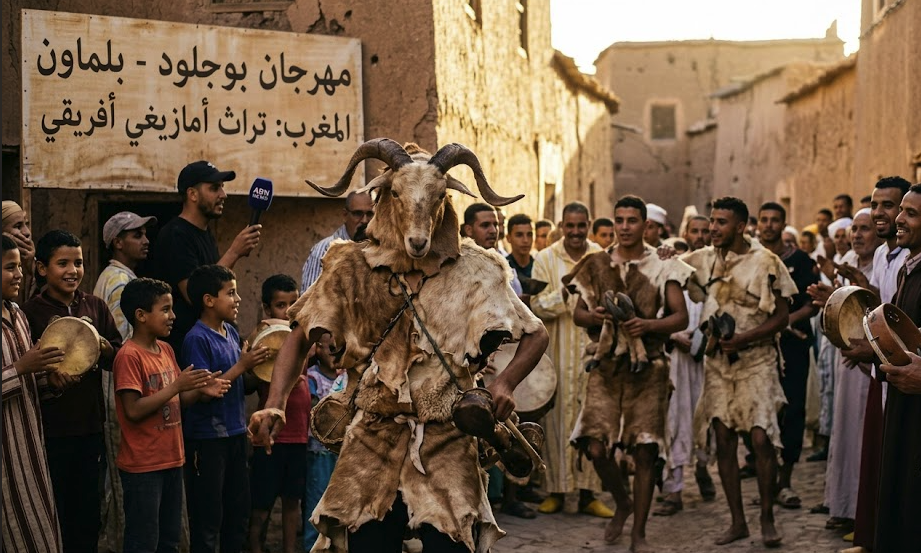
Souss-Massa – ABN NEWS: The streets of southwestern Morocco, particularly across the Souss-Massa region, come alive immediately after the annual celebration of Eid al-Adha with the vibrant, theatrical, and mysterious celebration of the Boujloud festival (also known locally in the Tamazight language as Bilmawen or Herma). While many contemporary observers view it merely as a post-Eid community event, a deep dive into historical, linguistic, and anthropological evidence reveals that this Amazigh carnival predates the arrival of Islam in North Africa, with roots extending deeply into ancient African traditions.

The festival features local youth dressing themselves in the freshly cured skins of sacrificed goats and sheep, wearing real animal horns, and parading through villages and towns. Despite its enduring popularity among local communities, the celebration consistently sparks intense ideological debates every season. It frequently draws sharp criticism from conservative religious voices who condemn the ritual, linking its symbolic elements to pre-Islamic mythology or alternative interpretations of ancient beliefs, while heritage advocates defend it as an irreplaceable pillar of North African identity.
A prominent anthropological perspective, championed by renowned sociologists and ethnographers such as Edward Westermark in his extensive studies of Moroccan folklore, links the Boujloud festival to broader trans-Saharan African traditions. This school of thought views the carnival as a direct extension of ancient agrarian myths centered on animal symbolism, symbolic transitions, fertility, and ritualistic transformation. In these ancient belief systems, donning the skin of an animal was not merely a disguise, but a sacred method to absorb the creature’s vitality and protect the community from malevolent forces.

Far from being an isolated cultural island, Morocco has historically served as a continuous, fluid space of contact between Amazigh, Sub-Saharan African, Mediterranean, and Arab civilizations. These cultural practices did not emerge in a vacuum; they traveled, adapted, and evolved along ancient commercial caravan routes and trans-Saharan migrations. Over centuries, local societies reclaimed these external influences, refashioning them into the contemporary carnival witnessed today.
| Cultural Aspect | Boujloud Carnival (Bilmawen) | General Western Festivals |
| Primary Material | Natural, raw animal skins and horns | Synthetic costumes, fabrics, and plastics |
| Timing | Tied directly to the aftermath of Eid al-Adha | Fixed seasonal, solar, or pagan calendars |
| Core Themes | Fertility, community adaptation, ancestral heritage | Mass entertainment, commercialized reenactment |
| Origin Era | Pre-Islamic / Ancient Trans-Saharan roots | Varies (often Roman, Celtic, or Pagan roots) |
The mechanics of the Boujloud festival are highly structured and vary distinctively from one province to another within the kingdom. In regions like Tiznit, Taroudant, and Agadir, the preparation begins immediately on the first afternoon of Eid. Young men carefully clean and dry the hides of the sacrificed livestock. It takes up to seven goat skins stitched together to create a single authentic costume. The performer’s face is blackened with charcoal or hidden behind a traditional wooden or leather mask to completely obscure their everyday human identity.
During the street processions, the characters of Bilmawen carry the detached hooves of the sacrificed animals. According to local popular belief, being gently tapped by these hooves brings good luck, blessings (baraka), and fertility for the upcoming agricultural cycle. The procession is accompanied by traditional percussion instruments, such as the Bendir and Tam-Tam, creating a rhythmic, trance-like atmosphere that drives the dancers through the crowd, collecting symbolic donations for community charity projects.
According to data analyzed by the research desk at ABN NEWS, Boujloud is best understood as a local Amazigh manifestation with profound African roots, sustained through generations as popular folklore. It continues to enjoy widespread support among the moderate, mainstream Amazigh Muslim population, who see no contradiction between practicing their orthodox faith and celebrating their ancestral customs.
Instead of fading away with the changing religious eras or being erased by administrative shifts, the Boujloud festival secured a new place within the framework of popular Islamic festivities. By strategically aligning itself with the timing of Eid al-Adha, the festival took practical advantage of the abundance of animal skins available immediately after the holiday, seamlessly blending into the celebratory atmosphere of rural and urban neighborhoods.
This tactical temporal alignment is a common phenomenon in global cultural history. Many ancient practices worldwide eventually fused with dominant religious holidays to ensure their long-term survival:
Various northern European winter customs were absorbed into the Christian Christmas calendar.
Ancient Roman agricultural festivals transformed into regional saints’ days.
Pre-Islamic regional folk traditions integrated smoothly into Islamic societies across different continents.
Cultural observers note that striking similarities can easily be drawn between Boujloud and major carnival traditions in Latin America, West Africa, and the European Alps (such as the Krampus or Perchten festivals). These similarities reflect global human expressions from prehistoric eras when humanity lived in closer, raw connection with nature and depended entirely on the cycles of wildlife and agriculture.
Ultimately, the current scheduling of the Boujloud festival alongside religious celebrations does not explain its historical origins, but rather explains its brilliant methodology of survival. It remains a striking example of cultural heritage that endures across generations by dynamically adapting its outer form while stubbornly retaining its historical, indigenous essence.
What is the historical origin of the Boujloud festival?
The festival is an ancient Amazigh-African ritual that predates the arrival of Islam in North Africa, historically linked to prehistoric themes of fertility, animal symbolism, and community heritage.
Why is the festival celebrated directly after Eid al-Adha?
The timing allowed the ancestral ritual to adapt and survive within the modern religious calendar by utilizing the sudden abundance of animal skins available immediately following the traditional family sacrifices of the holiday.
In which parts of Morocco is the festival most active today?
While celebrated in various forms across the country, it sees its highest concentration, largest public turnouts, and most traditional expressions within the Souss-Massa region of southwestern Morocco.