Physical Address
304 North Cardinal St.
Dorchester Center, MA 02124
Physical Address
304 North Cardinal St.
Dorchester Center, MA 02124
Religions News Around the World
Religions News Around the World
WASHINGTON, D.C. – ABN News: History of Greek Religion traces one of the most influential belief systems of the ancient Mediterranean, from early Aegean cults and the rise of the Olympian gods to temples, festivals, mystery traditions and the eventual spread of Christianity across the Greek world. Recent archaeological work is still adding evidence to that story, showing that sacred places could also serve political, administrative and social purposes. How did a religion without one holy book or central church become so deeply woven into Greek civilization?

The History of Greek Religion did not begin with Zeus, Athena or the monumental temples that most people associate with ancient Greece. Its roots reach back into the Bronze Age, when communities across the Aegean developed rituals connected with nature, fertility, ancestors, protection and the forces believed to shape human life.
Archaeologists have found religious objects, figurines, ceremonial spaces and other evidence from the Minoan world of Crete and the Mycenaean mainland. These early traditions did not form a single standardized religion. Instead, communities developed local practices that later contributed to the wider religious culture of the Greek-speaking world.

That local character remained one of the defining features of Greek religion. Ancient Greeks shared many gods and myths, but each city, island and sanctuary could emphasize different deities, titles and rituals. A god might hold a major role in one community while another deity dominated a neighboring region.
Scholars also caution against treating ancient Greek religion as a system built around modern ideas of faith, doctrine and organized worship. Ancient Greeks did not possess a single authoritative scripture that prescribed one universal theology. Religious practice centered on actions such as sacrifice, prayer, offerings, purification, festivals, hymns and participation in sacred communities. Oxford researchers describe religion in the Greek world as “embedded” because it touched public life, family life, law, politics and daily custom.
Myth played a central role, but myth and ritual did not function as separate worlds. Stories about the gods appeared in poetry, drama, sculpture, pottery and public monuments. People also encountered divine figures through festivals, processions, sacrifices and civic ceremonies.
The absence of a central church gave Greek religion a remarkable flexibility. Local traditions could survive alongside broader Panhellenic traditions. Greek communities could honor the same deity under different titles and with different ceremonies, while sanctuaries created places where worshippers from distant communities could meet.
This mixture of local identity and shared religious culture helped Greek religion expand with Greek settlements around the Mediterranean. As communities established themselves across the Aegean, Asia Minor, southern Italy and other regions, religious customs traveled with them and interacted with local traditions.
The familiar Olympian pantheon emerged as the best-known expression of Greek religion, although the ancient world contained many more gods, heroes, spirits and local divine figures than the traditional list of twelve suggests.
Zeus stood at the top of the Olympian hierarchy, associated with the sky, thunder, justice and the protection of social order. Hera represented marriage and queenship. Poseidon governed the sea and earthquakes, while Athena became closely associated with wisdom, strategy and the city of Athens. Apollo connected with prophecy, music, healing and the arts, while Artemis held important associations with the wilderness, hunting and young people.
Demeter represented agriculture and the fertility of the earth. Aphrodite became associated with desire and beauty, while Ares represented the violent dimensions of war. Hermes served as messenger and moved between different realms, including the worlds of gods and humans. Hephaestus embodied craftsmanship and fire. Dionysus became central to wine, theater and ecstatic religious experience.
Yet these gods did not operate like members of a rigid divine government. Ancient Greek worshippers approached particular gods for particular needs, and the same deity could have many aspects. Cult titles could emphasize protection, healing, justice, fertility, travel or other concerns.
Greek religious thinking also allowed room for gods who did not fit neatly into the Olympian pattern. Heroes could receive worship after death, local spirits could protect landscapes, and rivers, springs and mountains could carry sacred significance.
The relationship between humans and gods often revolved around reciprocity. Worshippers prayed, offered gifts and performed rituals, expecting divine favor, protection or assistance in return. This did not mean ancient Greeks thought of the gods as predictable machines. Gods could help, punish, ignore or surprise humans, and people sought to maintain a respectful relationship with the divine.
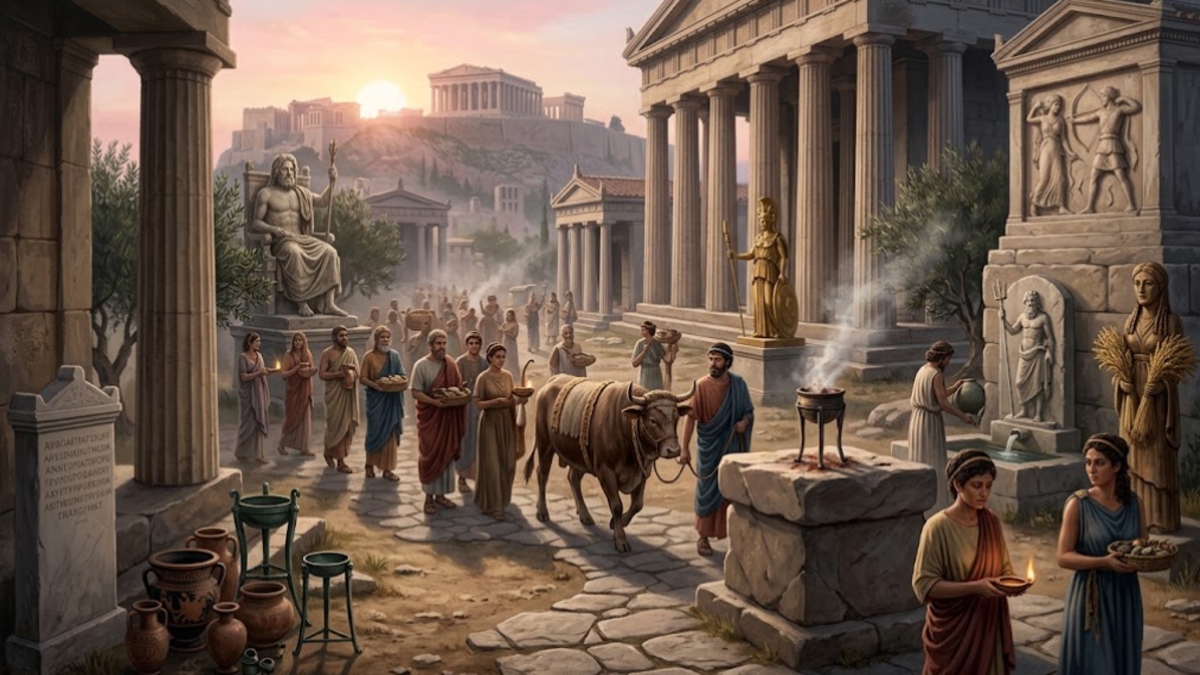
The temple formed one important part of this relationship, but it did not function like a modern church. The central religious action often took place at an altar outside the temple, where priests and worshippers performed sacrifices, prayers and offerings. Temples commonly housed the sacred image of a deity and stood within larger sanctuaries that could include altars, treasuries, theaters, dining areas and other structures.
Religion shaped the Greek city-state, or polis, as deeply as politics and military affairs. Civic identity often included a patron deity, sacred calendar and public festivals that brought citizens together.
Athens provides one of the clearest examples. Athena stood at the center of the city’s religious identity, while major festivals turned religious observance into a public spectacle. The Panathenaia included processions, competitions and offerings connected with the goddess.
Other Greek communities developed equally distinctive traditions. The Olympic Games originated as a religious festival at the sanctuary of Zeus at Olympia, combining athletic competition with worship. The festival honored a deity while also bringing participants from across the Greek world into a shared cultural environment.
Festivals could include music, dance, theater, feasting, athletic events and processions. Religion therefore created opportunities for entertainment and political display as well as worship. Civic leaders could use religious ceremonies to demonstrate wealth, unity and legitimacy.
Sacrifice remained one of the most important forms of worship. Greeks commonly offered animals such as sheep, goats, pigs and cattle, along with wine, grain, incense, oil, honey and other gifts. Ritual specialists performed the ceremony, while participants shared in the resulting feast. This practice linked the religious act to the social life of the community.
Purification also mattered. Worshippers could wash, make offerings or observe rules of ritual cleanliness before entering sacred areas. These practices reflected the idea that contact with the divine required proper behavior.
Priests did not form a single, centralized professional class. Many priesthoods belonged to particular sanctuaries or communities, and some offices followed local traditions or family connections. Women could hold priesthoods and perform important ritual duties.
Recent research has highlighted just how much these roles could involve children. The Austrian Archaeological Institute has reported research showing that young girls in several Greek communities served as priestesses or performed religious tasks. Evidence includes girls carrying sacred objects, caring for divine statues and preparing ritual foods. The research also emphasizes that much of the surviving evidence concerns elite families, which limits what historians can say about ordinary children.
This finding adds an important dimension to the history of Greek religion. Religious life did not belong only to adult male citizens or political leaders. Children, women, families and wider communities all participated, although their roles varied sharply by place, status and period.
Public worship represented only one part of Greek religious experience. Some worshippers also sought access to sacred traditions that promised personal knowledge, purification or hope for the afterlife.
The Eleusinian Mysteries became the most famous example. Participants traveled to Eleusis and underwent initiation connected with Demeter and Persephone. Much of the ritual remained secret, so modern historians must rely on archaeology, limited literary references and other indirect evidence.
Mystery traditions mattered because they offered a different kind of religious experience from civic festivals. They could focus more strongly on initiation, personal transformation and expectations about death.
Oracles also shaped Greek decision-making. At Delphi, worshippers consulted Apollo through the oracle associated with the sanctuary. Individuals and communities sought divine guidance on matters that could affect politics, warfare, colonization and personal life.
Divination appeared in other forms as well. Greeks could interpret dreams, unusual events, animal behavior and other signs as indications of divine intentions. Religious specialists helped interpret some of these signs, although practices differed across communities.
The religious imagination also extended into healing. Sanctuaries dedicated to Asclepius attracted people seeking relief from illness. At places such as Epidaurus, visitors participated in rituals associated with the god of medicine and hoped for divine assistance.
Another important tradition involved Orpheus and Orphic teachings. The Derveni Papyrus, discovered near Thessaloniki, contains an ancient commentary on an Orphic poem and discusses the gods, the soul and the meaning of religious ideas. Scholars date the surviving manuscript to the fourth century BCE, while the work it copies appears older. Its damaged condition has made interpretation difficult, but it remains a major source for understanding the meeting point between Greek religion and philosophy.
That connection between religion and philosophy became increasingly important. Greek thinkers did not simply accept traditional stories without question. Some criticized the behavior of the gods as portrayed by poets, while others searched for deeper explanations of nature, the soul and divine reality. Religious traditions continued, but intellectual debates changed the way educated Greeks discussed them.
Archaeology continues to change the picture of ancient Greek religious life because sanctuaries often preserved objects, inscriptions and architectural remains that written literature never recorded.
A recent excavation at Kleidi Samikon in western Greece offers a striking example. Archaeologists working at a large Archaic-period temple uncovered a bronze inscription and damaged bronze sheets that may represent part of an ancient archive. The team also found a marble basin associated with ritual purification and fragments of a large painted roof ornament.
The temple’s unusual design has attracted particular attention. The building contains two large halls with central rows of columns. Researchers believe one area may have supported ritual activity while another may have served administrative or archival purposes.
That possibility matters because it challenges the simple image of a temple as a place used only for prayer. Ancient sanctuaries could also protect treaties, laws, dedications and civic records. Religious authority could therefore intersect with administration and politics.
The site also connects religion with regional identity. Ancient sources associate the area with the sanctuary of Poseidon Samios, and researchers argue that the sanctuary played an important religious and political role in western Greece.
The discovery fits a broader pattern. Archaeologists increasingly study sanctuaries not as isolated monuments but as living institutions that connected religion, economy, politics and society.
The official Greek Ministry of Culture maintains an ongoing register of archaeological excavation projects across the country, illustrating how research continues to expand the historical record.
These investigations also help historians correct older assumptions. New finds can reveal participation by people who left few literary records, clarify how sacred spaces operated and show how local traditions changed over time.
The evidence from young priestesses is another reminder of this process. Texts and inscriptions can reveal roles that modern readers might overlook, while archaeological objects can place those roles inside the physical spaces where religious life unfolded.
The result is a more complicated and more human portrait of Greek religion. It was not simply a collection of myths about powerful gods. It was a system of relationships, habits, institutions and experiences that involved ordinary people as well as rulers, philosophers and priests.
The history of Greek religion eventually entered a major period of transformation under Roman rule and the spread of Christianity.
Greek religious traditions did not suddenly disappear when the Roman Empire took control of the Greek world. Greek gods continued to receive worship, sanctuaries remained active in many places, and Roman religious culture often blended with Greek traditions.
At the same time, new religious movements expanded. Christianity grew from a small community into a major force across the eastern Mediterranean. Christian communities developed their own sacred spaces, leaders and rituals, while existing religious landscapes gradually changed.
Late antiquity brought major changes to the relationship between religious traditions and public space. Scholars have documented a broader transformation that included the closure or destruction of some temples, the adaptation of others and the construction of Christian churches in changing urban environments.
The transition was neither identical everywhere nor instantaneous. Some old traditions persisted for generations, while others declined more quickly. Religious buildings could also survive after their original cults ended, because communities reused their stones, architectural elements or spaces for new purposes.
Christianity eventually became the dominant religious framework of the Greek-speaking eastern Roman world. Over time, Greek Christian traditions became central to the cultural history of the region, creating a distinction between ancient Greek polytheism and the later Greek Orthodox tradition.
That distinction is important. Modern Greek Christianity does not represent a continuation of the ancient Olympian religion as a system of worship. Yet ancient Greek religion remains deeply embedded in the country’s cultural landscape through archaeological sites, literature, art, philosophy, historical memory and place names.
The continuing attention given to sanctuaries, ancient inscriptions and religious festivals shows why this history still matters. Contemporary Greece preserves a landscape in which ancient temples and later churches can exist within the same wider cultural geography, even though the beliefs associated with them differ fundamentally.
The history of Greek religion therefore reaches far beyond stories of Zeus or the ruins of the Parthenon. It tells the story of how communities understood nature, death, justice, identity and their relationship with forces greater than themselves.
From Bronze Age ritual sites to Classical sanctuaries, from mystery initiations to public festivals, from philosophical questioning to Christian transformation, Greek religious history developed through constant interaction between tradition and change.
New excavations continue to add detail to that long record. The evidence from Kleidi Samikon suggests that sacred spaces could hold documents and support civic organization, while research into young priestesses shows how deeply ritual involved different members of society.
For modern readers, the most important lesson may be that ancient Greek religion never existed as a single, frozen doctrine. It evolved across centuries, absorbed local traditions, responded to political and social change, and left a legacy that remains visible in archaeology and culture.
The gods may belong to the ancient world, but the questions raised by Greek religion — about the divine, human responsibility, death, destiny and the meaning of community — continue to shape the study of civilization.
Ancient Greeks practiced a diverse polytheistic tradition centered on many gods, heroes and local divine powers. Worship varied from one community to another.
The best-known Olympian gods included Zeus, Hera, Poseidon, Athena, Apollo, Artemis, Demeter, Aphrodite, Ares, Hermes, Hephaestus and Dionysus, although local traditions included many other figures.
No single sacred book governed Greek religious belief and practice. People learned religious traditions through ritual, family customs, stories, festivals, inscriptions and participation in community life.
Its decline occurred gradually during the Roman and late antique periods as Christianity expanded and public pagan worship faced increasing restrictions. The change unfolded differently across regions and communities.
… Read more
Contact: info@abnnews.net