Physical Address
304 North Cardinal St.
Dorchester Center, MA 02124
Physical Address
304 North Cardinal St.
Dorchester Center, MA 02124
Religions News Around the World
Religions News Around the World
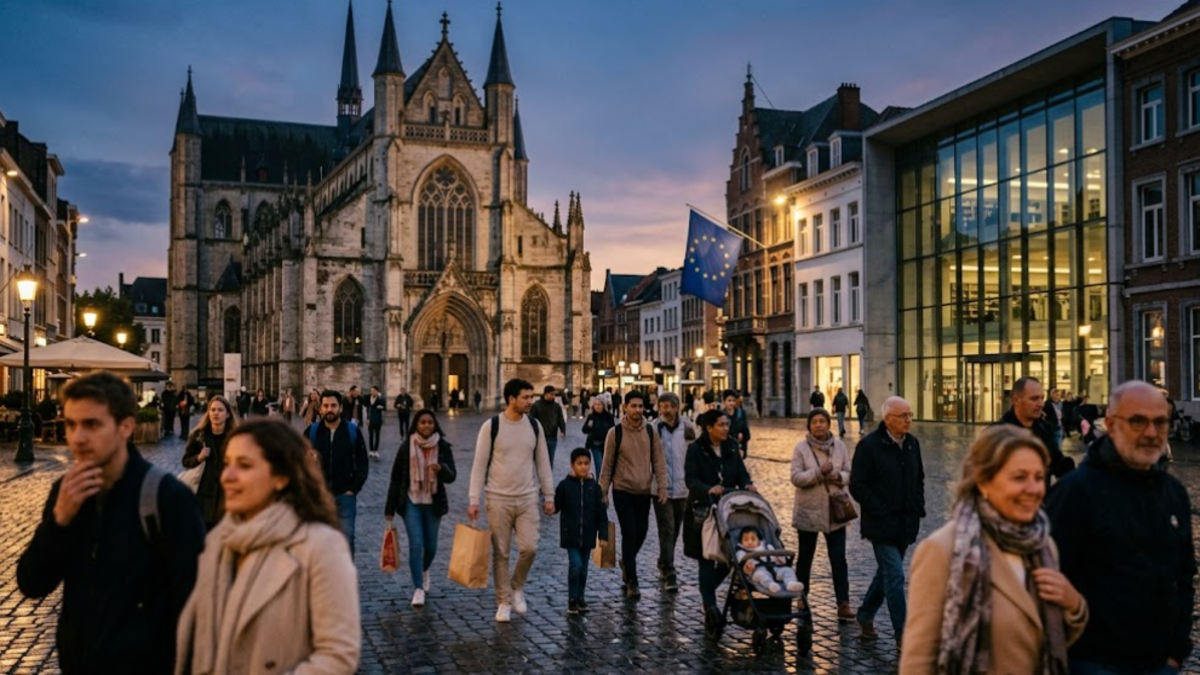
BRUSSELS – ABN News: The Rise of Secularism in Europe

Europe is undergoing a profound change in its relationship with religion. Across much of the continent, fewer people attend religious services, more adults describe themselves as having no religious affiliation, and traditional Christian institutions have lost some of the social influence they once held. Recent reporting and demographic research indicate that the shift is not simply about empty churches; it is reshaping European politics, culture, family life and debates over the role of religion in public institutions. So, how far has secularism changed Europe, and what does the continent’s changing religious identity mean for its future?
The clearest evidence comes from demographic research covering the religious composition of the continent. Pew Research Center’s analysis of religious change between 2010 and 2020 found that Europe’s Christian population fell by 9 percent in absolute numbers, reaching about 505 million people.

At the same time, the number of Europeans who identified as religiously unaffiliated rose sharply. Pew estimated that this group reached about 190 million people in 2020, an increase of 37 percent over the decade. Muslims also increased in number, reaching approximately 46 million, while Europe’s Hindu population rose to around 2 million.
The figures do not mean that every European country is becoming non-religious at the same speed. Europe’s religious landscape remains highly diverse, with substantial differences between Western, Northern, Southern, Central and Eastern Europe.
The distinction between religious identity and religious practice is particularly important. A person may continue to identify culturally as Christian while rarely or never attending church. This has become one of the defining features of Western European religious life.
Pew’s earlier research on Western Europe found that a majority of Christians in the region were non-practicing. The research also showed that people who retained a Christian identity could still differ significantly from people who identified with no religion in their attitudes toward God, religion and society.
That distinction helps explain why the decline of religious practice does not necessarily mean the disappearance of religious culture.
The transformation has been gradual rather than sudden. European societies spent generations moving away from a model in which religious institutions played a central role in everyday public life.
Church attendance has declined in many countries, particularly among younger generations. Religious ceremonies remain important for some families, especially weddings, funerals and major holidays, but participation often reflects cultural tradition rather than regular religious practice.
Researchers increasingly describe secularisation as a process with several stages. A recent study published in Nature Communications proposed that religious decline commonly develops through declining participation in public religious rituals, followed by a reduction in the personal importance attached to religion and, eventually, the abandonment of religious affiliation. The study examined evidence from international and European survey datasets.
This pattern helps explain a phenomenon visible across Europe: people may retain religious symbols, family traditions or cultural references while simultaneously considering themselves secular.
The result is a more complicated religious landscape than a simple division between believers and atheists.
Some Europeans continue to believe in God but do not belong to a religious institution. Others identify with a religious tradition because of family or national culture. A growing number describe themselves as atheist, agnostic or simply as having no religion.
France occupies a distinctive position in the European debate because of its constitutional commitment to laïcité, the French model of secularism.
Unlike many European countries, France has developed a particularly strict institutional separation between religion and the state. The principle has influenced debates over education, public administration, religious symbols and the visibility of faith in public institutions.
The French approach has also become increasingly controversial as European societies have become more religiously diverse.
Debates over Islamic headscarves, religious clothing, public schools and the boundaries of religious expression have repeatedly placed French secularism at the centre of European political discussion.
The issue is not simply whether religion should be permitted. It concerns the point at which the state may regulate religious expression in order to maintain public neutrality, equality or security.
That distinction matters because secularism does not necessarily mean hostility toward religion.
The European legal framework protects freedom of thought, conscience and religion. Article 10 of the EU Charter of Fundamental Rights protects the right to hold, change and manifest religious or other beliefs, both privately and publicly, subject to the conditions established by law.
The European model therefore involves a continuing tension: governments seek religious neutrality while individuals retain rights to religious belief and expression.
Recent reporting has challenged the idea that Europe can simply be described as a continent where religion has disappeared.
Research discussed in recent European coverage has pointed out that religious institutions continue to influence European societies even as traditional participation declines. Churches remain important owners of historic buildings, providers of social services and participants in debates about ethics, education, migration and social policy.
The influence of religion can therefore survive even when personal belief weakens.
Cathedrals and churches remain major parts of Europe’s cultural heritage. Religious festivals continue to shape national calendars. Christian references remain embedded in European art, architecture, literature and political history.
At the same time, newer religious communities have become more visible.
Immigration has contributed to the growth of Muslim communities in several European countries, adding another layer to debates about religion and secular public institutions. Pew’s demographic analysis found that Europe’s Muslim population increased by 16 percent between 2010 and 2020.
This creates a paradox. Europe is becoming less Christian in demographic and institutional terms while, in some places, religious diversity is becoming more visible.
Secularism therefore has not removed religion from European public life. In some cases, it has made the question of religion more politically sensitive.
Generational change is one of the strongest forces behind Europe’s secular transition.
For many younger Europeans, religion is no longer an automatic inheritance. Previous generations were often raised within established Christian traditions, even when their personal commitment was limited. Younger people are more likely to regard religious affiliation as a personal choice.
That does not automatically translate into atheism.
Some young Europeans describe themselves as spiritual rather than religious. Others maintain selective traditions without accepting institutional authority. Some move between religious and non-religious identities during their lives.
The important change is that religious affiliation increasingly competes with other forms of identity.
Education, professional life, political values, online communities and individual autonomy all play a larger role in shaping personal worldviews.
The growth of secularism has consequences beyond churches and religious organisations.
European political parties increasingly operate in societies where voters do not share a common religious identity. Questions once framed through Christian morality are now frequently discussed through concepts such as individual rights, equality, privacy and personal autonomy.
That does not mean religion has disappeared from politics.
Instead, religion has become one interest and identity among many.
In some countries, political movements emphasise Christian heritage as part of national identity. In others, secular parties argue that public institutions should remain strictly neutral toward all faiths.
The debate becomes particularly intense when religious freedom intersects with questions about immigration, education, women’s rights, freedom of expression or national identity.
Recent European discussions about secularism have therefore often focused less on whether people may believe and more on how religious belief should interact with public institutions.
The Council of Europe describes freedom of thought, conscience and religion as including both the right to practise religion and the principle of state neutrality.
That principle provides an important framework for understanding Europe’s current debate. Secularism is not necessarily the exclusion of religion from society. It can also mean preventing the state from favouring one belief system over another.
There is no single European model.
Western Europe has generally experienced a stronger decline in Christian practice than some parts of Central and Eastern Europe. In countries with strong historical ties between national identity and religious institutions, religious affiliation can remain comparatively significant.
Poland, Romania and some other parts of Central and Eastern Europe demonstrate why European secularisation cannot be treated as a uniform process. Religious identity remains more prominent in parts of the region, even while social attitudes continue to evolve.
Southern Europe presents another complicated picture.
Countries such as Spain, Italy, Portugal and Greece retain strong cultural connections with Christianity, but cultural affiliation does not necessarily correspond to regular participation in religious services.
Spain is a particularly revealing case. Catholic traditions remain visible in public celebrations, architecture and family customs, while the country has experienced substantial secularisation in social attitudes and religious practice.
This combination of cultural Christianity and personal secularism is increasingly common across the continent.
Europe’s religious map is therefore not being replaced by a simple map of believers and atheists. Instead, it is becoming more fragmented.
The rise of secularism is taking place alongside increased religious diversity.
Migration has brought larger Muslim communities to many European countries, while Jewish communities, Eastern Christian traditions, Hindu communities and other religious groups also form part of Europe’s changing social landscape.
This creates new challenges for governments.
A state that treats religion as a private matter must still determine how it responds when citizens seek to express religious identity in schools, workplaces, public spaces or political life.
France provides one model. Other European countries have adopted different approaches, often allowing greater visibility for religious symbols and institutions.
The debate is particularly sensitive because European law simultaneously protects religious freedom and allows certain restrictions when they meet legal and democratic requirements.
The European Union’s fundamental-rights framework makes this balance explicit: freedom of religion includes public and private manifestation of belief, while limitations must satisfy legal and democratic conditions.
The challenge for European governments is therefore not simply to manage secularism. It is to preserve neutrality without turning neutrality into discrimination.
The decline in religious practice has created practical consequences for Christian institutions.
Fewer regular worshippers can mean declining donations, reduced congregational life and difficulty maintaining large historic buildings.
Some churches have responded by expanding social programmes, cultural activities and community services. Others have faced difficult decisions over the future use of buildings.
Yet the decline is not uniform.
Some congregations continue to attract committed members, while religious movements in particular communities have experienced renewed interest. The existence of secularisation at a national level does not prevent religious revival at a local level.
Recent coverage has also highlighted the continuing cultural and economic influence of religion in Europe, suggesting that measuring religious strength only through church attendance can produce an incomplete picture.
A nearly empty church can still be an important historic monument, a community centre, a charitable institution or a symbol of national identity.
That makes the future of Europe’s religious heritage an issue extending beyond theology.
The deeper question is what secularisation means for European identity.
For centuries, Christianity was one of the major forces shaping Europe’s institutions, political traditions, art and social structures. As religious practice declines, Europeans are increasingly debating which elements of that heritage should remain part of their collective identity.
Some see secularisation as a natural development of modern democracy. From this perspective, a neutral state protects both believers and non-believers.
Others worry that weakening religious institutions could leave societies with fewer shared traditions and sources of community.
Still others argue that Europe can preserve its cultural heritage without restoring religion to a dominant public position.
These disagreements are unlikely to disappear.
The latest demographic evidence suggests that secularisation is a powerful long-term trend, particularly in Western Europe. But the same evidence shows that religion continues to exist in new forms and that religious diversity is increasing.
The future may therefore be less about a completely secular Europe and more about a Europe where religion occupies a different place.
Faith may become more voluntary, more diverse and less tied to national identity. At the same time, governments will continue to face difficult questions about religious expression, public neutrality and equal treatment.
The rise of secularism has changed Europe, but it has not erased religion from the continent.
Instead, Europe is moving toward a society in which belief is increasingly a matter of personal choice, while religion remains part of public debate, cultural heritage and social life.
No. Religious practice has declined significantly in many European countries, but religion remains important to millions of people and continues to influence culture, politics and public life.
France is particularly associated with secularism because of its constitutional principle of laïcité and its strong separation between religion and the state.
Christianity is declining in demographic and participation terms, particularly in Western Europe, but it remains Europe’s largest religious tradition and continues to have major cultural and institutional influence.
Not necessarily. In the European legal framework, secular public institutions can coexist with protections for freedom of thought, conscience and religion.
… Read more
Contact: info@abnnews.net