Physical Address
304 North Cardinal St.
Dorchester Center, MA 02124
Physical Address
304 North Cardinal St.
Dorchester Center, MA 02124

Religions News Around the World
Religions News Around the World
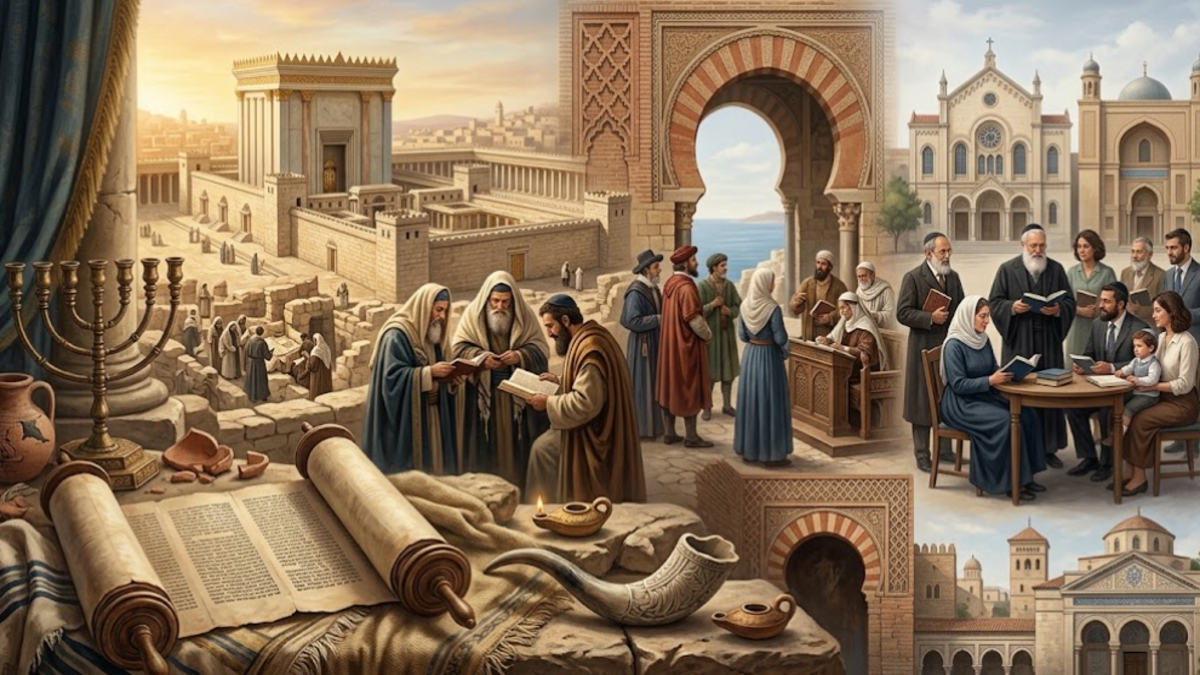
LONDON – ABN News: History of Judaism is once again drawing attention as museums, researchers and Jewish communities around the world preserve ancient texts, examine archaeological evidence and confront the challenge of keeping centuries-old traditions alive. Recent cultural reports have highlighted everything from medieval Torah manuscripts in Spain to the survival of Jewish communities in India, offering fresh reminders that Judaism is not only a religion but also a long historical experience shaped by migration, persecution, scholarship, adaptation and cultural continuity. So how did one of the world’s oldest monotheistic traditions develop across thousands of years?

The History of Judaism reaches back to the ancient Israelites and the religious traditions that developed among the peoples of the ancient Levant. Jewish tradition connects the origins of the faith to the patriarchs Abraham, Isaac and Jacob and, later, to Moses and the revelation of the Torah.
Historians distinguish between religious tradition and what can be established through archaeological and textual evidence. The story of ancient Israel therefore combines biblical narratives with evidence from inscriptions, archaeological sites and documents from surrounding civilizations.

The Israelites gradually developed a distinctive religious identity centred on worship of one God, covenant, law and communal responsibility. Jerusalem eventually became the principal spiritual centre of the Israelite kingdoms.
The biblical account describes the establishment of a united monarchy associated with Saul, David and Solomon. Solomon is traditionally credited with building the First Temple in Jerusalem, which became the central sanctuary for Israelite worship.
After the kingdom divided, the northern Kingdom of Israel and the southern Kingdom of Judah followed separate political paths. The northern kingdom fell to the Assyrian Empire in the eighth century BCE, while Judah survived longer before facing the Babylonian conquest.
The destruction of Jerusalem and the First Temple by the Babylonians transformed Jewish history. A significant part of Judah’s population was taken into exile, creating conditions in which Jewish religious identity increasingly had to function away from the traditional centre of Jerusalem.
The Babylonian period became a crucial stage in the development of Jewish identity. Exile forced communities to preserve traditions, texts and communal practices under radically different political circumstances.
When the Persian ruler Cyrus the Great conquered Babylon, Judeans were permitted to return and rebuild their sanctuary in Jerusalem. The Second Temple subsequently became the centre of Jewish religious life.
That period would last for centuries and witness enormous political and religious change.
The Second Temple period was far from uniform. Jewish communities lived under Persian, Hellenistic and Roman political authority, while Jewish religious thought developed in several different directions.
The arrival of Alexander the Great’s forces in the region brought the Jewish population into an increasingly Hellenistic world. Greek language and culture spread widely, producing both cooperation and resistance.
Some Jews embraced aspects of Hellenistic culture, while others regarded outside influence as a threat to Jewish religious practices. These tensions contributed to the Maccabean revolt against Seleucid rule.
The revolt eventually led to the establishment of the Hasmonean dynasty and a period of Jewish political independence. The era became especially important in Jewish memory and remains closely associated with the story commemorated by Hanukkah.
At the same time, Jewish religious life became increasingly diverse. Pharisees, Sadducees, Essenes and other groups held different views about religious authority, law, ritual and the future of the Jewish people.
The Temple remained central, but synagogues and other forms of communal religious life also developed. Jewish communities existed outside Judea, particularly in places such as Babylonia and Egypt.
This early Jewish diaspora is important because it demonstrates that Jewish life outside the Land of Israel did not begin only after the destruction of Jerusalem by Rome. Jewish communities had already developed across the eastern Mediterranean and the Near East.
Recent interest in this wider history continues to shape public exhibitions and academic discussions. A British Museum event devoted to the ancient kingdoms of Israel and Judah attracted a large audience, illustrating continuing public interest in archaeology and the ancient foundations of Jewish civilization.
The Second Temple itself was destroyed by Roman forces in 70 CE during the First Jewish-Roman War. That event fundamentally changed Judaism.
Sacrificial worship at the Temple could no longer serve as the centre of religious life. Jewish scholars and communities therefore developed forms of religious practice capable of surviving without the Temple.
The destruction of the Second Temple did not end Jewish religious life. Instead, Judaism underwent one of the most significant transformations in its history.
Rabbinic Judaism gradually became the dominant form of Jewish religious tradition. Rabbis placed increasing emphasis on Torah study, interpretation, prayer, ethical behaviour and the development of Jewish law.
The Mishnah became one of the foundational works of rabbinic literature, followed by the Talmudic traditions that developed in the Jewish communities of the Land of Israel and Babylonia.
This intellectual tradition allowed Jewish communities to preserve religious law while adapting to different political and social environments.
The synagogue became a central institution. Jewish households and communities could maintain Shabbat, dietary laws, festivals, prayer and study regardless of whether they lived in Jerusalem, Babylonia, North Africa or Europe.
That adaptability became one of the defining characteristics of Jewish history.
Judaism also developed a sophisticated culture of interpretation. Religious texts were studied not simply as historical documents but as sources of law, ethics, philosophy and spiritual reflection.
Over the centuries, Jewish scholars produced extensive commentaries and legal works. Their writings helped communities respond to questions created by changing societies while maintaining connections with earlier traditions.
The history of Judaism therefore cannot be reduced to a sequence of political events. It is also the history of an intellectual tradition that constantly debated how ancient teachings should guide life in new circumstances.
As centuries passed, Jewish communities established themselves across a vast geographic area.
The Jewish world included communities in the Middle East, North Africa, the Iberian Peninsula, Italy and other parts of Europe. These communities did not all develop in the same way.
Distinct languages, customs, musical traditions, foods and religious practices emerged. Sephardi Jewish culture flourished particularly in Spain and the Mediterranean world, while Ashkenazi Jewish communities developed across parts of Central and Eastern Europe.
Other Jewish communities maintained their own traditions in places such as Yemen, Persia, North Africa and India.
The diversity of Jewish history is particularly visible in the survival of the Cochin Jewish community in India. Recent reporting has focused on elderly members of the community and efforts to preserve its synagogue, library and museum as the number of local Jews has declined.
The story demonstrates how Jewish history extends far beyond Europe and the Middle East. Jewish communities established themselves in distant regions while maintaining links to Jewish religious and cultural traditions.
In Europe, however, Jewish communities repeatedly faced discrimination, expulsions and violence. Medieval Jewish life existed alongside periods of intellectual and economic achievement, but also under severe restrictions.
The expulsion of Jews from Spain at the end of the 15th century marked another major turning point. Sephardi Jews dispersed across the Ottoman Empire, North Africa and other regions, carrying Spanish Jewish traditions with them.
A recently displayed medieval Sephardi Torah manuscript offers a particularly tangible connection to that history. Parchment leaves from a Torah scroll originating in medieval Spain are among a small number of known early Spanish Torah scrolls and provide evidence of Jewish religious culture before the expulsion.
Such manuscripts are more than religious objects. They preserve information about writing practices, artistic conventions and the communities that produced and used them.
The modern period brought dramatic changes to Jewish communities.
The spread of Enlightenment ideas and the development of modern nation-states gradually changed the legal position of Jews in parts of Europe. Emancipation offered new opportunities for citizenship, education and professional life.
At the same time, antisemitism continued to shape Jewish experience.
Jewish communities responded in different ways. Some pursued religious reform, while others strengthened traditional observance. Secular Jewish movements also emerged, including political and cultural movements that sought new forms of Jewish identity.
Modern Jewish identity consequently became increasingly diverse.
The Holocaust represents the most devastating catastrophe in modern Jewish history. Nazi Germany and its collaborators murdered approximately six million Jews during the Second World War.
The genocide destroyed families and communities across Europe and left a permanent mark on Jewish collective memory.
After the Holocaust, debates over Jewish survival, security, identity and political self-determination gained new urgency. The establishment of the State of Israel became a central development in modern Jewish history, while large Jewish communities continued to live in countries across the Americas, Europe, Australia, South Africa and elsewhere.
Current cultural reporting shows that Jewish history is not confined to textbooks or ancient archaeological sites.
It remains visible in synagogues, manuscripts, family traditions, museums and community institutions.
A recent exhibition at the YIVO Institute for Jewish Research in New York, for example, has examined an unexpected aspect of Jewish social history: beliefs and practices surrounding magic, fortune-telling and occult traditions. The exhibition uses books, manuscripts, photographs, letters and other material to explore practices that existed alongside formal religious teaching.
The subject illustrates an important principle for historians. Religious communities are never completely defined by official rules. Ordinary people may interpret, follow, ignore or reinterpret those rules in different ways.
Jewish history contains similar contrasts between religious law and everyday life.
Another example comes from the Samaritan community, a small group that traces its ancestry to the ancient Israelites but follows religious traditions distinct from mainstream Judaism. Recent reporting about Samaritan ceremonies has renewed interest in the ancient divisions and continuities surrounding Israelite religious traditions.
These communities help researchers and the public understand that the ancient religious landscape was more diverse than a simple linear story suggests.
Judaism itself also remains diverse. Orthodox, Conservative, Reform and other Jewish movements have developed different approaches to religious law, worship and modern society.
Yet many Jewish communities continue to share core elements, including the Torah, Jewish festivals, Shabbat, Hebrew traditions, communal institutions and a strong connection to Jewish historical memory.
The History of Judaism matters not only because Judaism is an ancient religion. It matters because Jewish history provides a remarkable case study in cultural survival.
Jewish communities experienced conquest, exile, migration, discrimination and genocide. Yet they preserved religious texts, languages, family traditions and communal institutions across changing political borders.
The history also demonstrates how traditions evolve.
The Judaism practised during the First Temple period differed from the Judaism of the Second Temple. Rabbinic Judaism developed after the destruction of the Temple, and modern Jewish movements later introduced further changes.
Continuity and transformation therefore exist together.
Modern museums and archaeological discoveries keep adding detail to the historical record. Manuscripts can reveal how Jews wrote and studied sacred texts. Archaeological remains can illuminate settlement patterns and religious practices. Community archives can preserve personal experiences that never appeared in major historical chronicles.
For journalists and historians, this evidence provides an opportunity to move beyond simplified accounts of the past.
The history of Judaism is not a single uninterrupted story of one community living in one place. It is a complex history involving many communities, languages, political systems and cultural environments.
From ancient Israel and Judah to Babylon, from medieval Spain to India, and from European cities to contemporary Jewish communities around the world, Jewish history has repeatedly demonstrated the ability of a culture to preserve its identity while adapting to new circumstances.
That combination of continuity and change explains why the subject remains relevant today.
The ancient world continues to attract museum audiences. Medieval manuscripts continue to reveal new details. Communities such as the Jews of Cochin continue to confront the challenge of preserving their heritage.
And every surviving synagogue, manuscript, family story and religious tradition adds another piece to a history that stretches across thousands of years.
Judaism is the religious and cultural tradition of the Jewish people, centred on belief in one God, the Torah and a wide body of religious law, practice and interpretation.
Its origins developed among the ancient Israelites over many centuries. Religious tradition traces key foundations to the patriarchs and Moses, while historians examine biblical, archaeological and other ancient evidence.
The destruction in 70 CE ended the Temple-based sacrificial system and accelerated the development of rabbinic forms of Judaism centred on Torah study, prayer, communal life and Jewish law.
Jewish communities exist across the world. Major communities have developed in Israel, the United States and Europe, while smaller historic communities have survived in regions including India, North Africa and the Middle East.
… Read more
Contact: info@abnnews.net